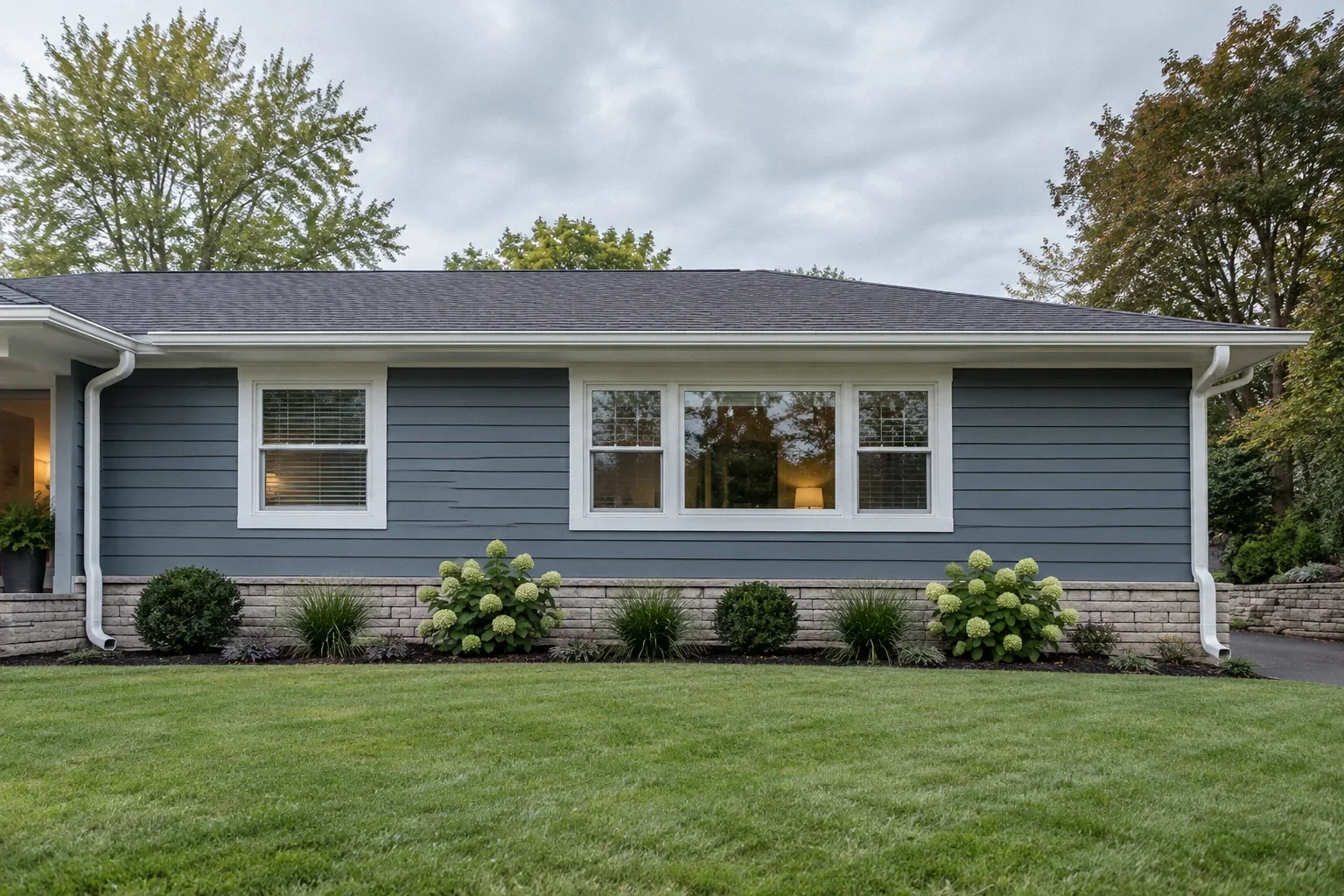
An upper downspout concentrates runoff onto a lower roof or gutter. Review where that stream lands, the condition of the receiving roof area, and the lower gutter’s ability to collect and discharge it. Changes should be coordinated between roofing and gutter professionals.
Trace the upper catchment and landing point
Document which upper roof planes feed the downspout and where its discharge lands. A ground-level photograph that includes both levels is more useful than a close view of the lower overflow alone. Note whether the stream reaches the lower gutter directly, crosses roofing first or is concentrated by another feature. Avoid assuming the visible lower roof area is the only contributing catchment. The upper roof can add water that is easy to overlook when a bidder sizes or diagnoses the lower run in isolation.
The upper-roof account identifies a concentrated stream as the relevant difference along the lower gutter. This Reddit account is anecdotal, not technical authority. [2]
Separate collection problems from roof condition
The lower gutter may overflow while the roof remains sound, or the discharge path may coincide with damaged roofing or a leak. These are separate questions. Ask a roofer to assess roof condition where appropriate and a gutter professional to assess collection and discharge. Do not infer roof failure from discoloration alone, but do not dismiss repeated localized wetting without inspection. PNNL presents roof runoff as a coordinated system. [1] The inspection should therefore show how the upper and lower portions interact instead of treating each contractor’s scope as an isolated piece.
A guard can change how the stream enters
If the lower gutter has a guard, a concentrated stream may behave differently from water spread along the eave. Ask whether water is skimming the guard, overtopping a full gutter or missing the receiving area altogether. Removing or changing a small section may alter behavior, but it should follow an inspection rather than guesswork. Product-specific installation and maintenance requirements still apply. A guard problem and an outlet limitation can coexist, so a successful small adjustment does not establish that the entire downstream route has adequate capacity.
Compare routing options as complete details
A proposal to extend the upper downspout should explain how it is supported, how it reaches the receiving point and how it relates to the roofing below. Do not accept improvised attachments or assume a long pipe laid across a roof is automatically appropriate. The selected detail needs review for the actual roof material and maintenance access. Alternatives may differ in appearance and scope, but the comparison should focus on the full path from upper collection to final discharge. A change that merely shifts the concentrated stream to another vulnerable location is incomplete.
Include the lower outlets and ground destination
Sending the stream directly into the lower gutter does not eliminate the water; it changes where it enters. Ask whether the lower run, its outlets and the ground-level route have been considered with the upper catchment included. If the lower downspout connects to unknown buried piping, retain that uncertainty in the proposal. A route can collect water neatly at roof level and still back up below. The contractor should explain which portions were inspected and which require additional evaluation before a performance claim can be made.
Plan a coordinated verification
A completion check should observe the new routing, receiving gutter and final outlet. Any roof work should be documented separately, including materials and attachment details. A controlled demonstration is useful for visible connections but does not reproduce every wind or rainfall condition. Keep later storm footage from the same safe viewpoint used before work. If interior moisture remains, return to the building-envelope investigation instead of assuming the gutter alteration addressed every possible water entry path.
Keep the upper and lower scopes connected
Ask the roofing and gutter proposals to use the same catchment sketch. The roofer should understand the intended discharge route, and the gutter installer should understand any attachment or material restrictions. If each works from a different assumption, a neat installation can still leave the central problem unresolved.
The handoff is especially important when only one contractor is hired initially. A gutter contractor may identify a roofing concern without being responsible for repairing it. A roofer may restore the receiving roof area without changing lower-gutter capacity. The owner needs those exclusions in plain language so the second task is not lost.
After alteration, compare three observations: where the stream first lands, whether the lower gutter contains it, and whether water reaches the final destination. Success at the first observation does not establish the other two. This sequence is a practical way to evaluate the complete change without pretending a short demonstration reproduces every storm. Keep photographs of concealed or difficult-to-access attachments with the final record.
A discharge change may alter appearance at a prominent roof elevation, so discuss the proposed route before installation. Ask for a photograph marked with the intended pipe path and connection points. Appearance preferences can then be considered among technically appropriate options rather than becoming a last-minute reason to improvise the route. If the preferred concealed or less visible option requires additional work, have that scope explained clearly. The contractor should not imply that the most visible arrangement is the only possible one without reviewing the site, nor promise an invisible solution without resolving support and access. Preserve the approved routing image with the final photographs. That record helps explain any later difference between what was proposed and what was installed.
| Decision area | Question or evidence |
|---|---|
| Upper collection | Which roof area contributes? |
| Receiving roof detail | Who verifies material and attachment suitability? |
| Lower gutter | Does collection match the redirected stream? |
| Final route | Was discharge observed beyond the lower downspout? |
Example: overflow beneath one upper downspout
Consider a lower gutter that works along its full length except where an upper downspout empties onto the roof above it. The owner asks for a wider lower gutter. That may be appropriate, but the investigation should first document whether the stream skips the guard, misses the trough or fills the gutter faster than its outlet discharges. The proposed remedy should address the observed mechanism and include the additional upper catchment in any capacity assessment. A larger profile alone does not answer a poorly directed stream, and a better-directed stream does not answer an obstructed outlet.
Keep the trade handoff explicit
Ask who owns the roof attachment and who owns the receiving gutter connection. Retain an overall photograph showing both levels and a note identifying any roof areas that were not inspected. If different contractors are involved, make sure each sees the same route sketch and understands the assumptions used by the other.
- Where does the upper stream first contact the lower assembly?
- Was the lower drainage route evaluated with upper-roof flow included?
- Who verifies roofing compatibility and supports?
What to take away
- Include the upper roof in the lower gutter catchment.
- Distinguish guard skimming from downstream backup.
- Coordinate routing changes with the roof material and final outlet.
Sources & further reading
Reddit links show the questions people ask; they do not establish a diagnosis or a legal requirement. Technical requirements depend on the product, building and jurisdiction. See our research approach.
- DOE/PNNL: Gutters and DownspoutsTechnical / official reference
Roof-water system components, material tradeoffs, separation from footing drain; program-specific distances are not universal local code.
- Reddit discussion: Water flowing over gutter guardsCommunity question · anecdotal
Anecdotal homeowner discussion used to identify the question; not technical authority or evidence of this property’s condition.
Planning a Bay Area project?
Explore YKCA’s website and discuss the scope and services you need directly with them.