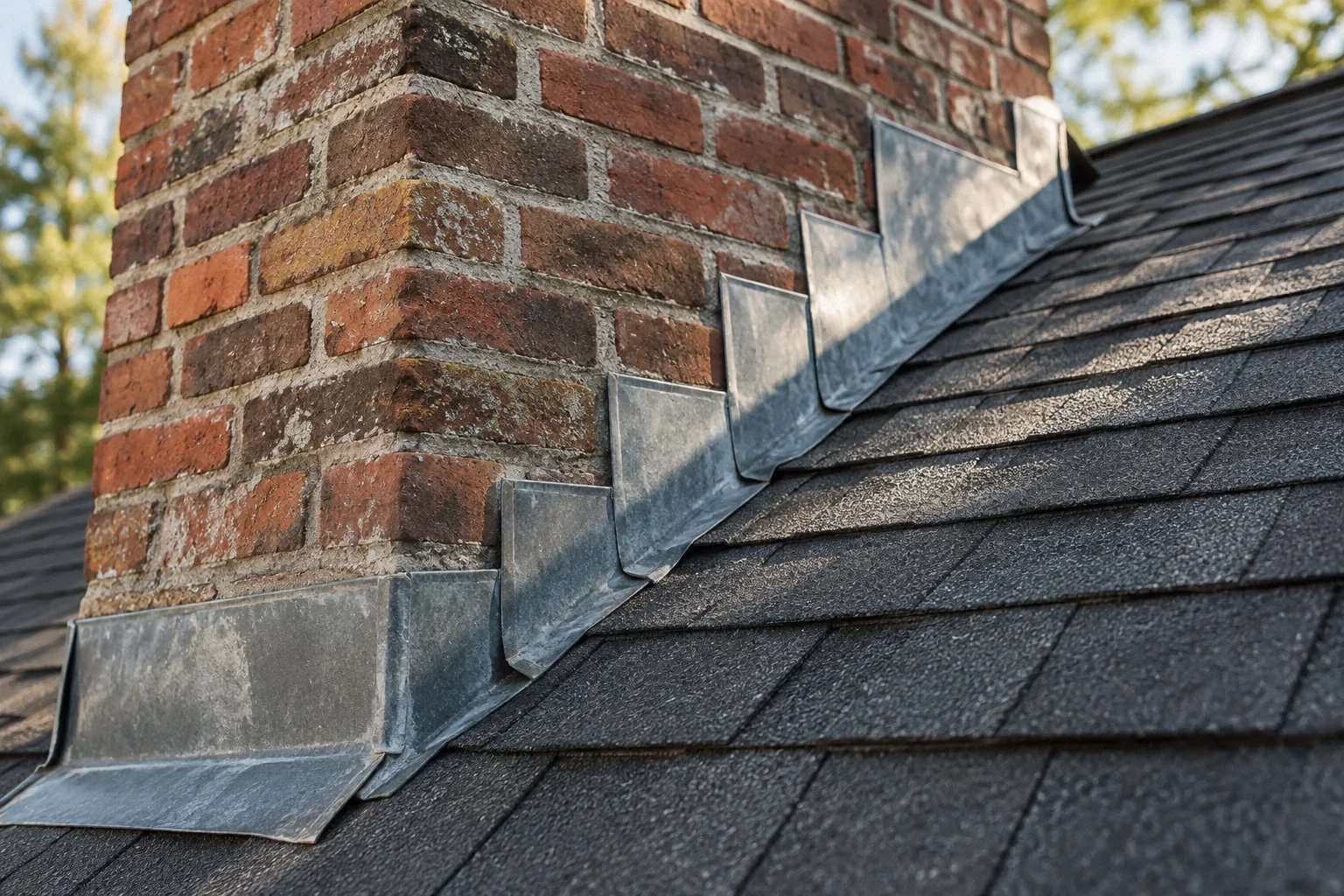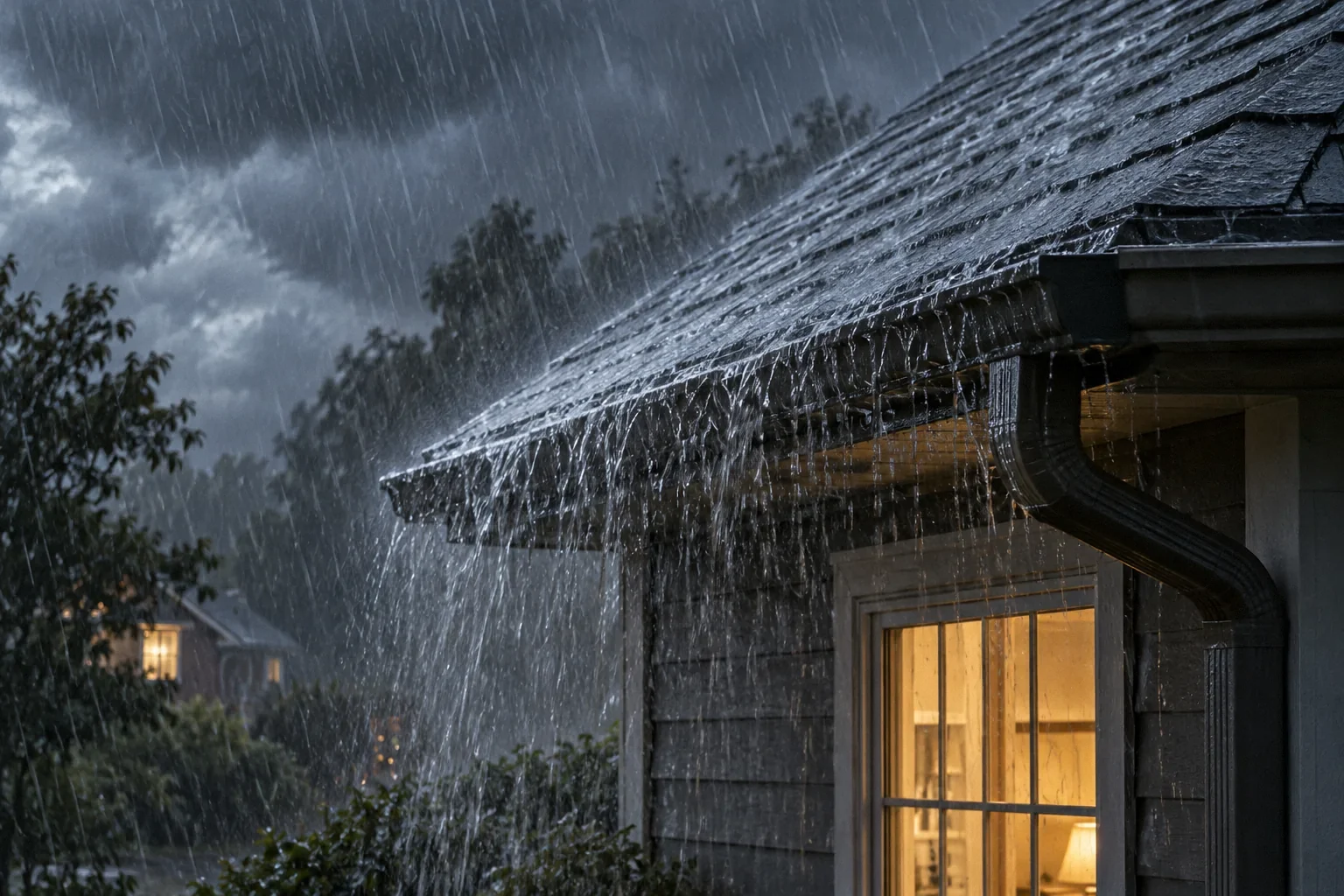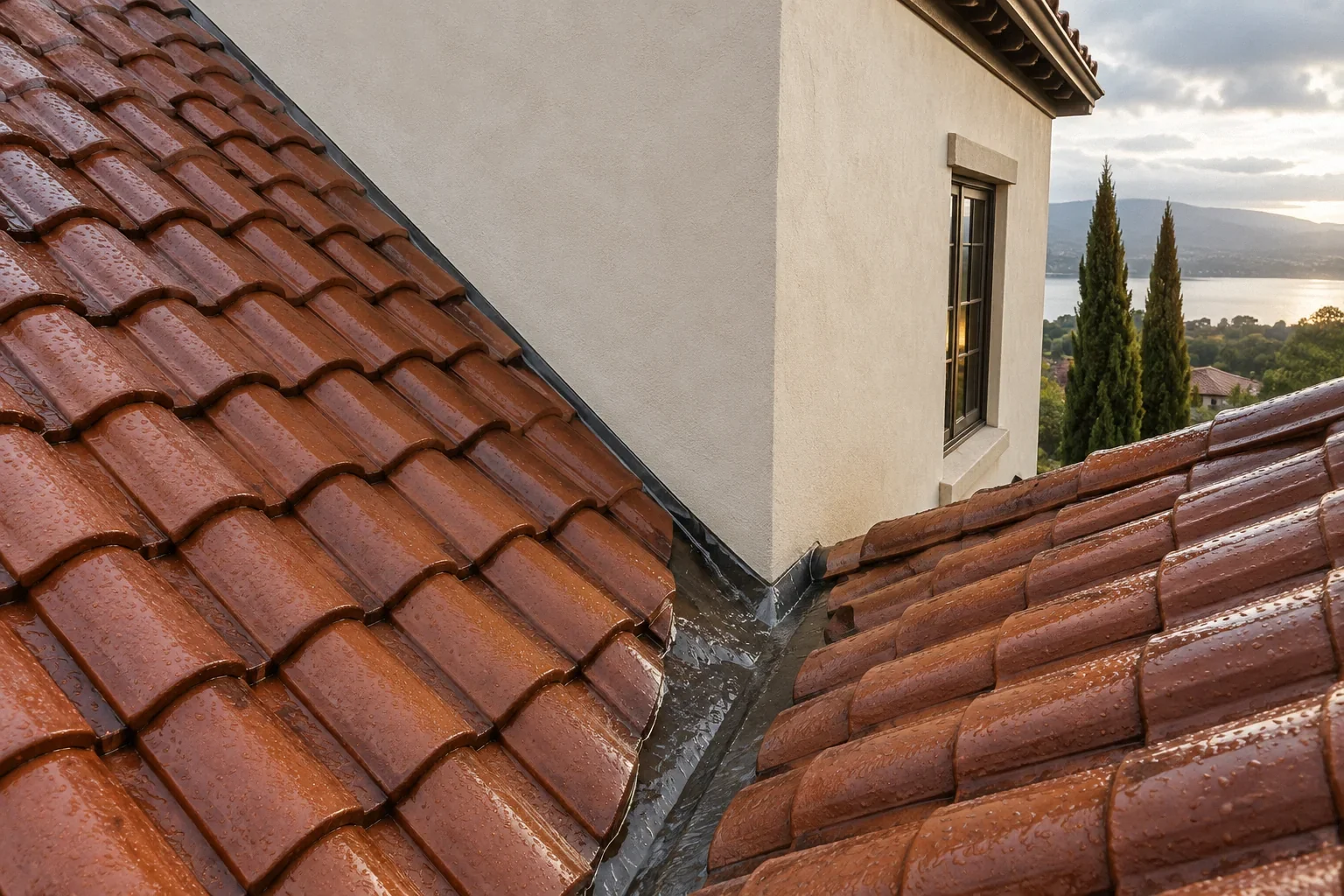
A valley that sends concentrated roof runoff directly into a wall junction requires more than a search for a small hole. Its termination must deliver water into a reliable drainage path. Where the roof geometry traps or redirects runoff into the wall, the repair may involve redesigning the transition rather than applying more sealant.
Follow the valley through its termination
Valleys collect water from adjacent roof planes. At their lower ends, that combined flow must continue onto roofing or into a drainage component without entering the wall assembly. A valley-to-wall intersection combines changes in slope, flashing and wall drainage. PNNL specifically identifies roof valleys and roof-wall joints as details to inspect during roof work. [1] The visible metal is only one part of that connection.
Other explanations to distinguish
Debris in a valley, damaged metal, an incorrect overlap, a missing wall transition or a geometry that concentrates flow into a confined corner can produce similar symptoms. A wall leak above the roof may also emerge near the same junction. These alternatives demand a view of the entire drainage route. The presence of sealant neither proves nor disproves any one of them.
Evidence to request before choosing the work
Request wide photographs of both contributing roof planes and close documentation of the terminal junction. Ask where the water is intended to go after it leaves the valley. The investigation may need information about wall cladding and concealed flashing, because a roof-only photograph cannot show continuity behind siding. A proposal should distinguish a localized defective component from a configuration that requires a new transition design.
Have the proposed repair drawing include the lower end of the valley, not only the area where the stain appears. A transition can look complete in a close-up while still delivering water toward an unresolved corner. Ask whether the revised route connects to an existing outlet or creates a new concentration elsewhere. This keeps the discussion focused on the whole route rather than the appearance of newly installed metal.
How the findings change the repair decision
Replacing flashing may be sufficient if the geometry already provides a clear outlet. If the geometry sends water into an obstructed corner, the scope should show the revised path and how it integrates with roof and wall materials. Changes to framing or larger roof geometry require appropriate design and permitting assessment. Do not accept a promised permanent solution that never explains the destination of the concentrated runoff.
A practical example and what it does not prove
In one sampled discussion, a relatively new roof leaked where valley flashing met step flashing. Commenters disagreed about patching versus changing the configuration. [2] The useful lesson is not to adopt their remote verdict. It is to require an on-site explanation of the valley discharge. A drawing showing the proposed drainage route can resolve more than another photograph of a caulked corner.
Limits and when professional review matters
This is a coordination problem when roofing and siding systems meet. Assign responsibility for opening and restoring each layer so that one trade does not leave an unfinished connection for another. Homeowners should not remove siding or redirect roof water experimentally. Hidden deterioration may expand the repair once exposed; establish documentation and change-order expectations before that work starts.
Evaluate the termination as a small drainage design
A valley ending against a wall cannot be understood from the valley metal alone. Draw the contributing planes and the intended path beyond the intersection. The drawing should answer where water goes next, including the lower termination. A new metal piece that merely changes the location of a trapped corner does not resolve the original design question.
Distinguish changes to flashing from changes to roof geometry. The latter can involve framing, supporting surfaces and wall restoration that a small patch estimate does not include. Ask the contractor to identify which category the proposal belongs to. This prevents an owner from approving a vaguely described flashing repair and discovering later that the durable solution requires a much larger coordinated project.
- The outlet path is clear but a lap is defective: a bounded detail reconstruction may address the observed mechanism.
- Runoff terminates in a confined wall corner: request a design showing the revised discharge path.
- The proposed diversion creates another concentration: review the receiving area before accepting the modification.
Questions that resolve the remaining uncertainty
At a complicated junction, request a sketch that includes the wall finish and its drainage relationship, not only roof metal. The owner can then see whether the proposal restores both assemblies. If the sketch ends at the face of siding without showing how the concealed connection is addressed, the scope still contains an important unanswered question. That question should be resolved before the corner is covered again.
A valley repair has an upstream and downstream boundary
The upstream boundary identifies the roof planes contributing water to the junction. The downstream boundary identifies the route after that water leaves it. A proposal that documents only the damaged corner omits both relationships. Even a small repair should explain how it receives and releases water. Where the valley meets a wall, the wall drainage connection also belongs in that explanation.
A metal replacement can restore a damaged component within sound geometry. A redesigned transition changes where or how water moves. A framing change alters the geometry itself. These options differ in scope and professional coordination, so the estimate should not describe all three simply as valley flashing. The owner needs to know which problem is being solved and which adjacent layers will be disturbed.
Consider a proposed diversion away from a wall corner. The design is incomplete until the receiving area is identified. Moving concentrated flow onto another vulnerable junction would change the symptom without resolving the overall route. Ask the professional to show the complete transition in context. This does not require a complex drawing for every project, but it does require an intelligible destination. Completion photographs should include that destination rather than only a close-up of the newly installed metal.
What to take away
- Follow the valley water through its termination and away from the wall.
- Distinguish failed flashing from geometry that needs redesign.
- Require roofing and wall-restoration responsibilities in the written scope.
Sources & further reading
Reddit links show the questions people ask; they do not establish a diagnosis or a legal requirement. Technical requirements depend on the product, building and jurisdiction. See our research approach.
- PNNL penetration flashingTechnical / official reference
Water-control continuity and penetration detailing; avoid treating illustrated assembly as universal code
- Homeowner discussion: Two leaks on 1y/o roofCommunity question · anecdotal
Anecdotal issue research, not technical authority or proof about another property.
Planning a Bay Area project?
Explore YKCA’s website and discuss the scope and services you need directly with them.