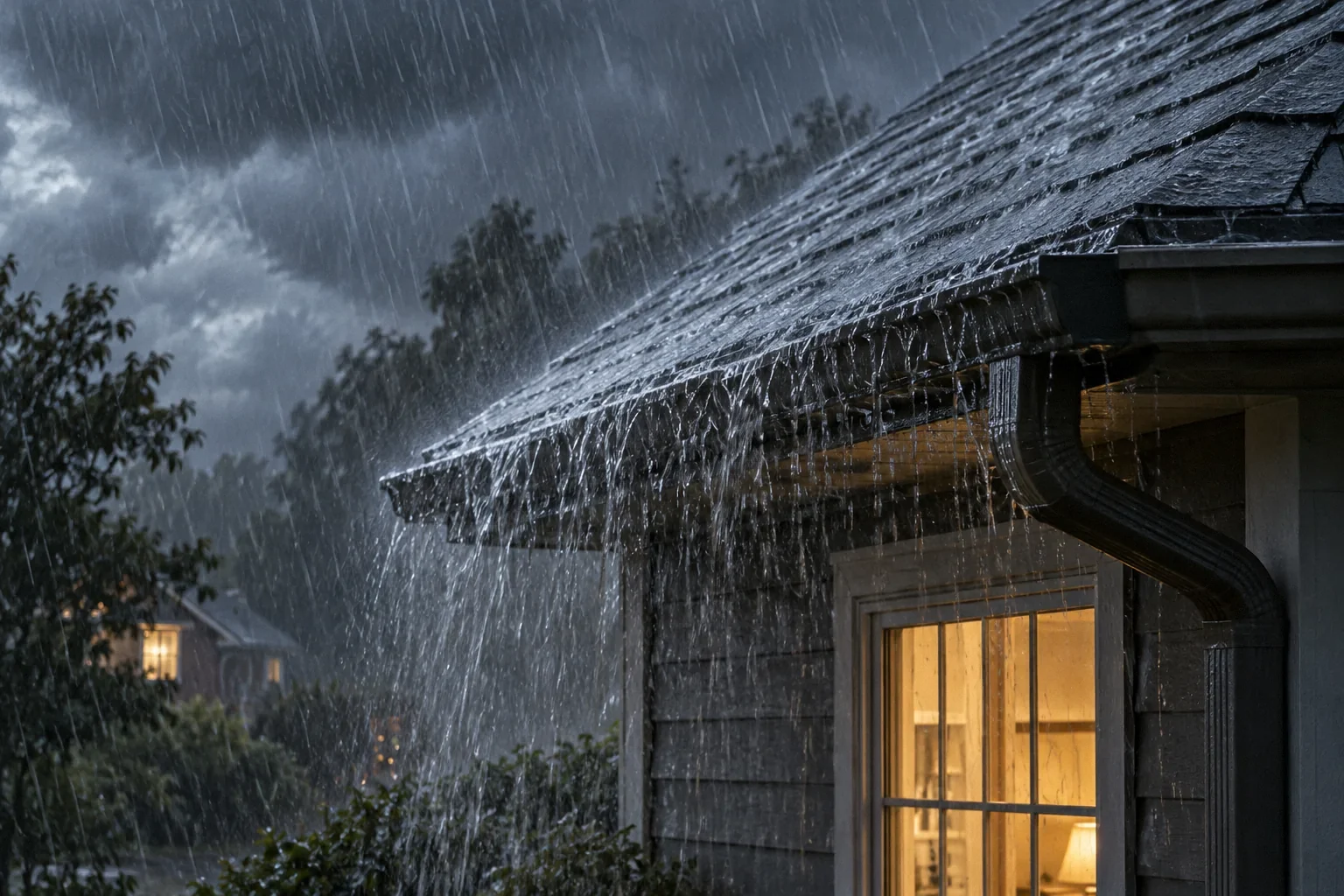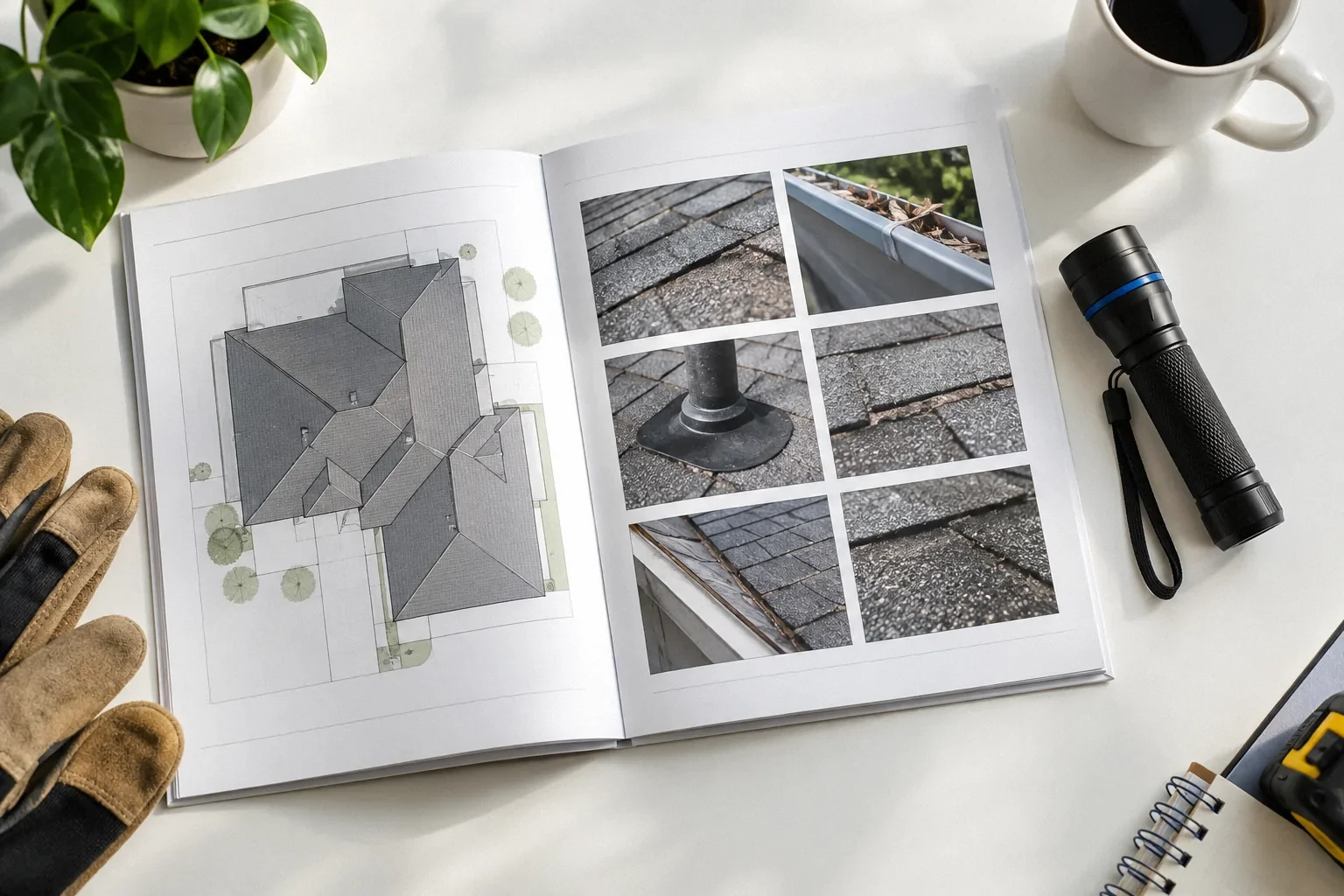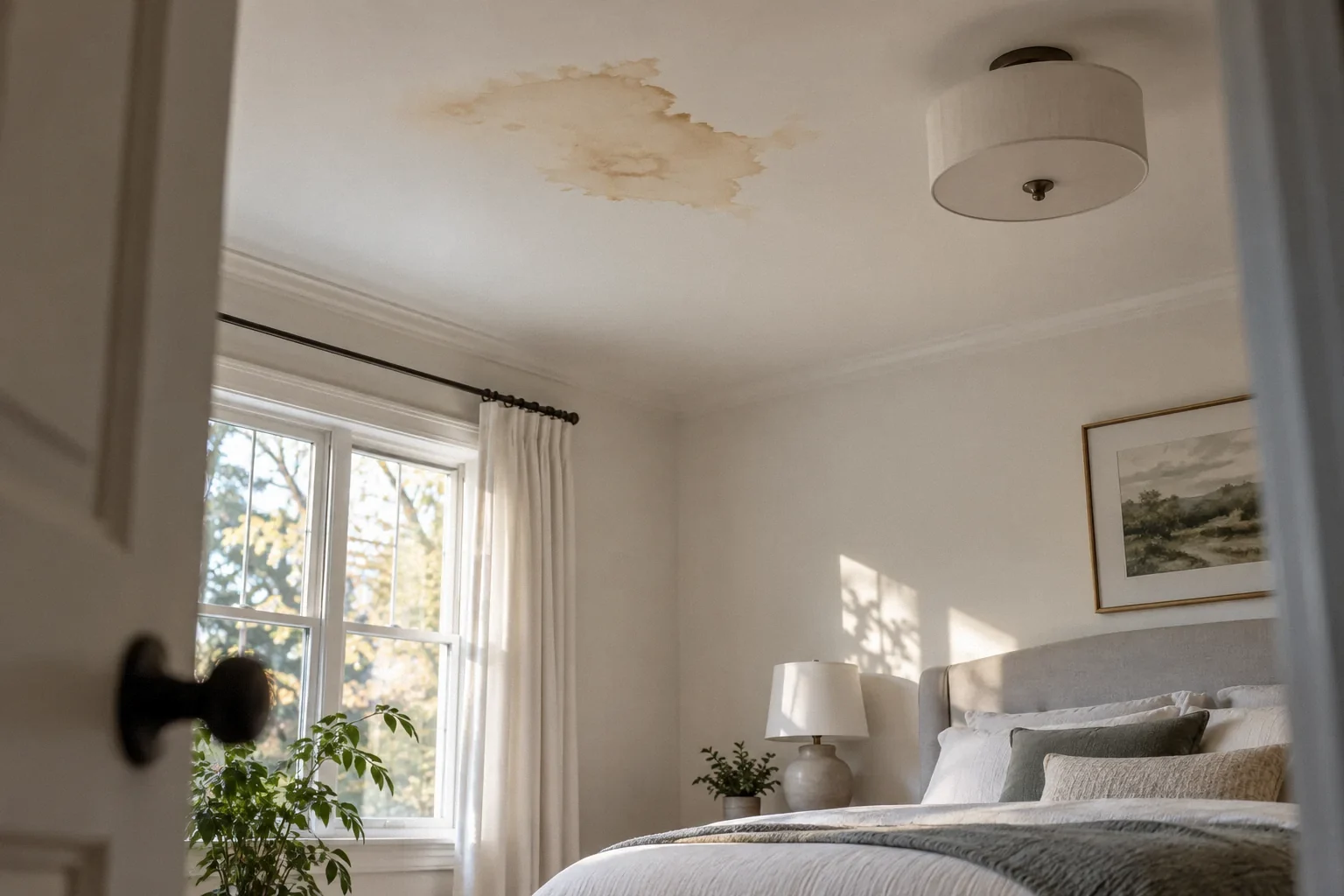
The ceiling stain is often an exit point rather than the roof entry point. Water can follow the underside of decking, a framing member, a membrane layer or an installation gap before it becomes visible indoors. A useful inspection maps that route and tests plausible origins instead of simply patching the roof directly above the stain.
Why the visible exit can mislead
Roof assemblies contain overlapping surfaces and many changes in direction. Water that crosses the covering may encounter underlayment before reaching a deck joint. Once indoors, it can follow a rafter or pipe and drop at a low point. On a low-slope roof, moisture may also spread within concealed components. PNNL describes roof penetrations as interruptions in a continuous water-control layer; understanding that interrupted layer is more useful than assuming a vertical path. [1]
Other explanations to distinguish
A stain under a vent might come from the flashing around the vent, a defect farther upslope, or leakage within the pipe system itself. A stain near an air handler might reflect a condensate problem or roof water arriving at the equipment curb. The closest roof feature is a candidate, not a verdict. Similarly, a dry visible surface during a visit does not rule out intermittent wind-driven entry that occurred during different weather.
Evidence to request before choosing the work
Ask for a plan or marked photograph that relates the indoor location to roof slopes, penetrations, walls and drainage routes. Include dates and the direction of severe weather if known. The report should distinguish observed wet material, inferred travel paths and inaccessible areas. Where diagnostic opening or controlled testing is justified, a professional should define the limited question it will answer and arrange protection and restoration. Broad untargeted opening can create more disruption without improving the diagnosis.
A useful location reference connects the stain to fixed building features such as an exterior wall or a clearly identified room corner. The professional can translate that reference onto the roof plan. Avoid relying on phrases such as above the bed, because furniture moves and later contractors may not see the same layout. Consistent references let successive observations contribute to one investigation instead of starting it again.
How the findings change the repair decision
A durable repair needs to address the verified entry mechanism and the affected assembly, not merely the final drip location. If the proposed work is directly above the stain, ask what evidence connects those locations. If several origins remain possible, agree on a staged investigation and clear decision points. Water testing, when appropriate, belongs in a controlled professional plan; indiscriminately soaking the entire roof can obscure the sequence and worsen damage.
A practical example and what it does not prove
Imagine a ceiling spot next to a bathroom vent. A roofer finds an intact visible collar but a separate flashing defect higher on the slope. A documented wet trail connects that defect to the vent opening through which water finally drips. Replacing only the collar might change the visible exit without removing the source. Mapping the route makes the repair explainable and gives the owner a specific area to monitor afterward.
Limits and when professional review matters
Infrared images can help locate anomalies, but they do not draw a guaranteed path from the stain to an exterior hole. Thermal differences require interpretation and, where necessary, corroboration. [2] Some paths cannot be proven without access that is disproportionate to the problem; a report should say so. Recurrent unexplained leakage warrants a specialist investigation, especially where several contractors have already patched different details.
Separate the source map from the damage map
The area needing interior restoration can be larger or smaller than the exterior repair area. A leak map should therefore distinguish where water entered from where materials became wet. A contractor can correctly identify a small exterior opening yet still leave the owner needing assessment of a larger affected interior area. Conversely, a large ceiling stain does not automatically justify broad roof replacement.
When successive contractors mark different roof locations, compare their proposed paths. Ask whether each path is supported by observed wetness, physical geometry or a controlled investigation. A plausible route is useful but remains a hypothesis. The report becomes stronger when it identifies an observation that excludes the competing route instead of merely adding another arrow to the roof photograph.
- An upslope defect aligns with a documented wet trail: evaluate that connection rather than limiting work to the roof over the stain.
- Several indoor marks share a possible route: establish whether they reflect one entry or separate events before combining repair quantities.
- A roof patch stops one mark but another grows: retain both location histories and reassess the relationship.
Keep the travel path and affected area separate
There are at least three boundaries in a leak investigation: the suspected entry area, the route through the assembly and the material affected indoors. They need not overlap vertically or occupy the same area. A small exterior defect can therefore lead to a larger restoration project. That does not mean the exterior repair itself must become roof-wide; it means the different scopes need their own evidence.
An investigator can test the proposed path against building geometry. If the explanation requires water to cross a location that was observed dry under the relevant conditions, the hypothesis may need revision. If the path follows a documented wet connection, confidence may increase. Such reasoning is more useful than drawing the shortest line from a ceiling spot to the closest pipe on a roof photograph.
The final report should retain uncertainty where the route cannot be observed. For example, a professional may identify a defective exterior detail and a plausible concealed connection without tracing every inch. That can support a reasonable repair, provided the limitation is stated and follow-up is defined. It should not be presented as direct observation of a fully exposed path. Owners can then distinguish a supported working conclusion from a claim of certainty that the access did not permit.
What to take away
- Map the entry point, travel route and indoor exit separately.
- Ask for evidence before approving a patch directly above the stain.
- Treat a thermal anomaly as an investigation lead, not a proven water path.
Sources & further reading
Reddit links show the questions people ask; they do not establish a diagnosis or a legal requirement. Technical requirements depend on the product, building and jurisdiction. See our research approach.
- PNNL penetration flashingTechnical / official reference
Water-control continuity and penetration detailing; avoid treating illustrated assembly as universal code
- FLIR airborne roof inspectionsTechnical / official reference
Thermal inspection application; manufacturer marketing, anomalies require corroboration
- Homeowner discussion: Leaking vent. Flat roofCommunity question · anecdotal
Anecdotal issue research, not technical authority or proof about another property.
- Homeowner discussion: TPO Roof Leak due to Pooling Water?Community question · anecdotal
Anecdotal issue research, not technical authority or proof about another property.
Planning a Bay Area project?
Explore YKCA’s website and discuss the scope and services you need directly with them.