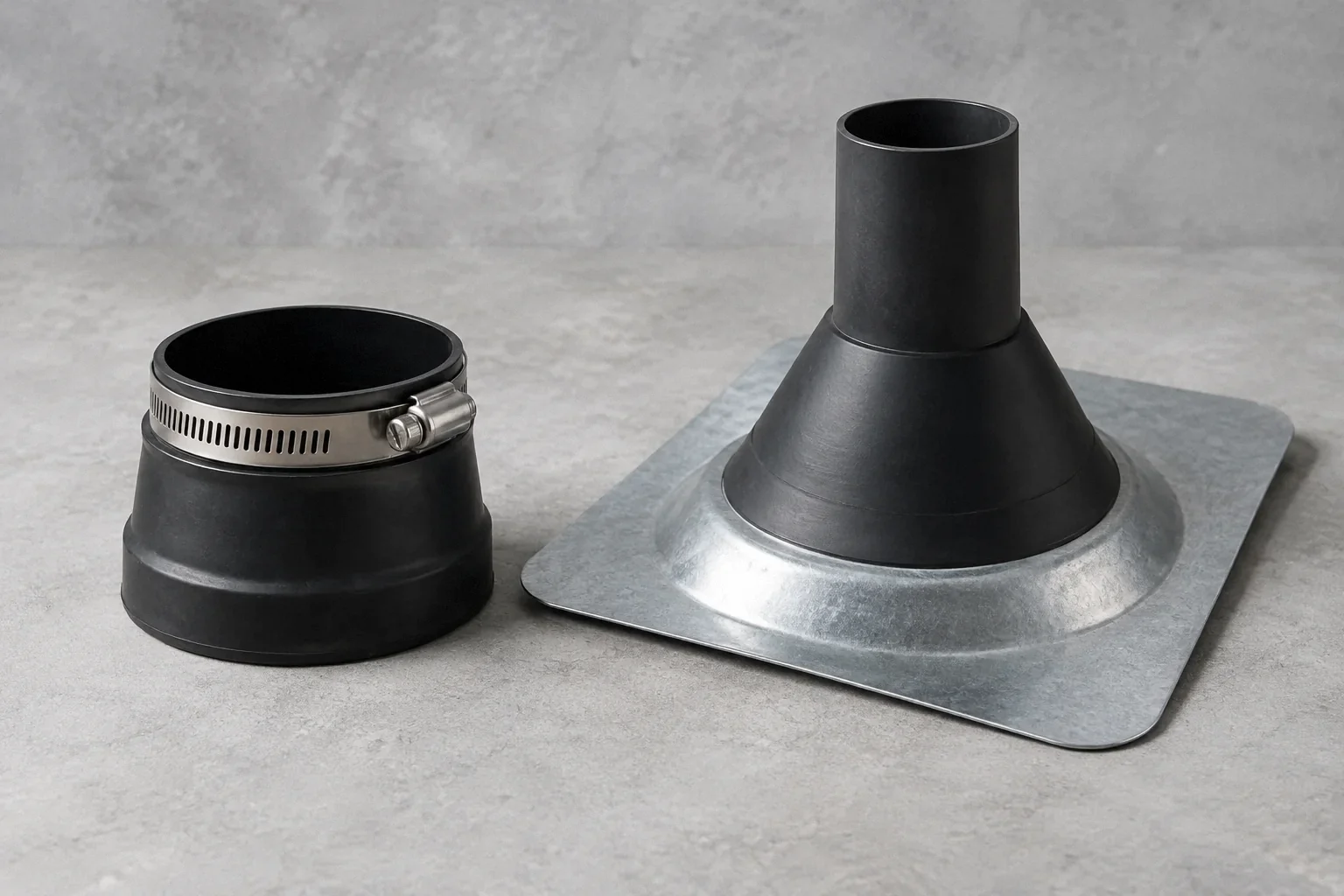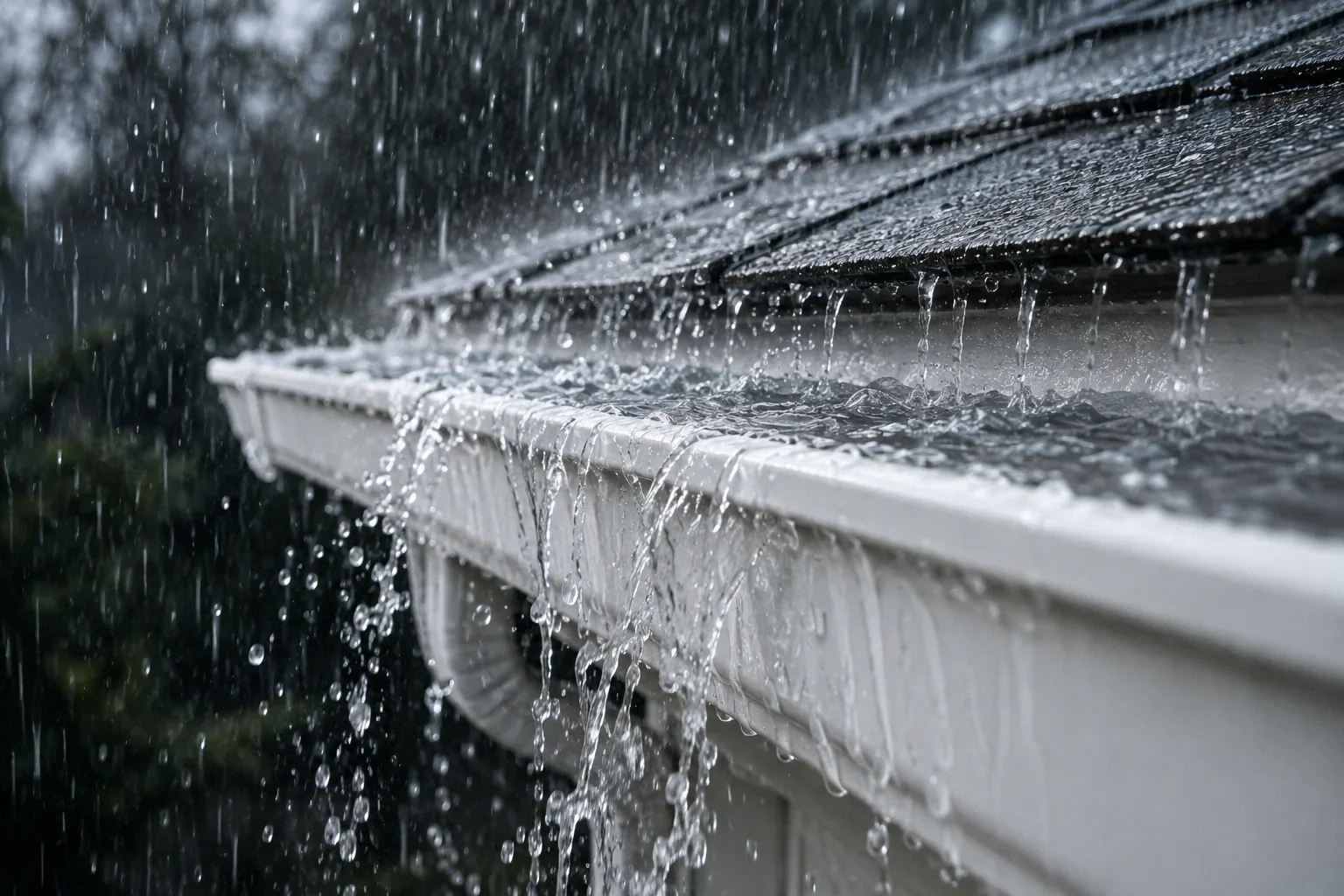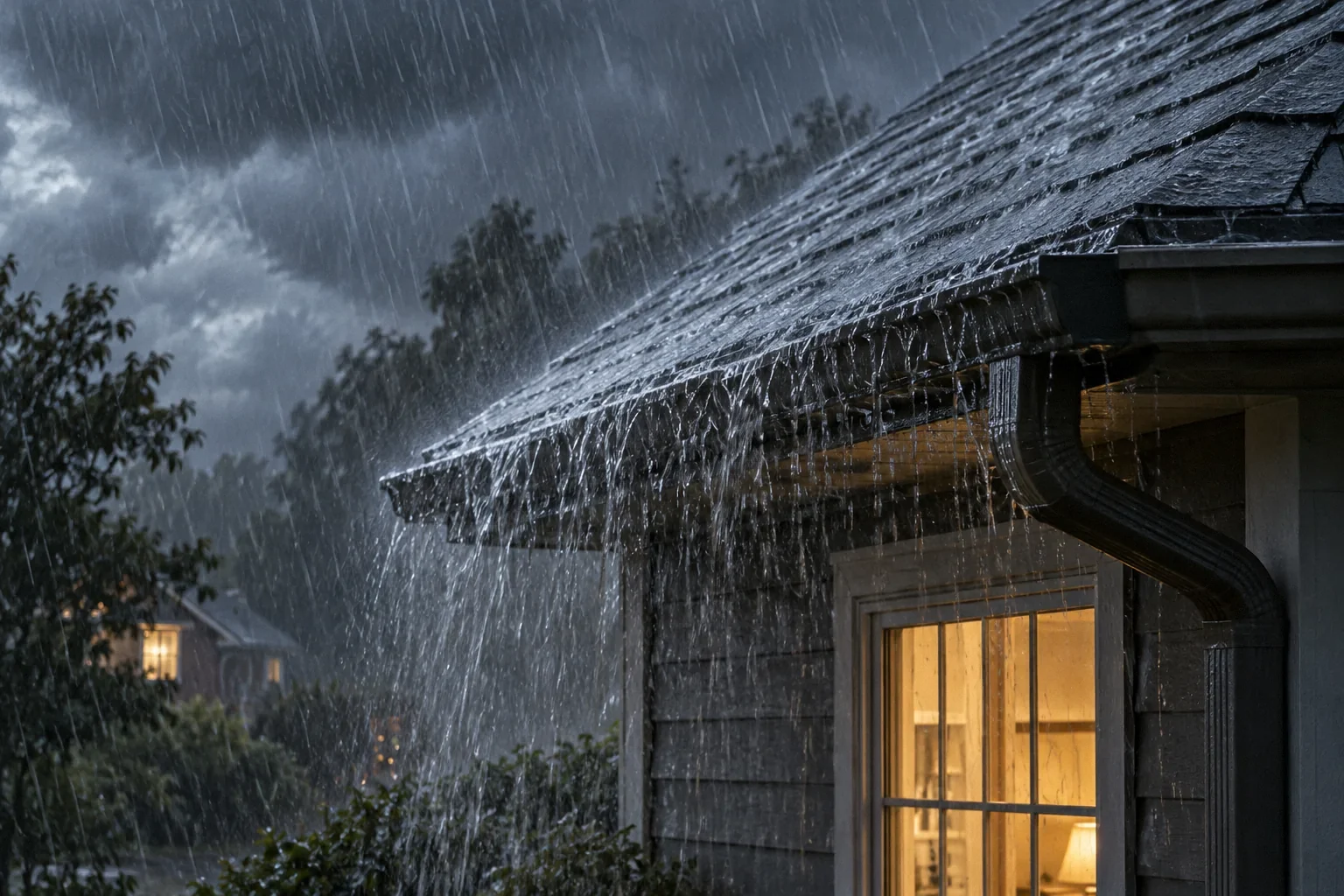
A roof that stays dry in light rain but leaks in a downpour may have a detail that fails only under concentrated runoff, wind exposure or backed-up drainage. The distinction is diagnostic, not reassuring. Identify what changes during the troublesome storms before deciding that the whole covering has failed.
What changes during the storm
More intense rain increases the water arriving at valleys, roof-wall junctions and outlets. Wind can change how water reaches an opening. A drainage restriction may become visible only when incoming water exceeds the available path. Flashing must remain integrated with the surrounding water-control layers, and low-slope drainage must carry water off the assembly. A repair should restore that function rather than merely add another exposed sealant bead. [1]
Other explanations to distinguish
Compare intensity with duration. A leak after hours of moderate rain can suggest a different mechanism from an immediate drip during a short gusty storm. Consider an upper roof delivering concentrated runoff, a debris-restricted outlet, or a penetration with a flawed overlap. Indoor humidity and mechanical equipment can create coincident moisture, so heavy-rain timing does not eliminate every non-roof explanation.
Evidence to request before choosing the work
Record when the first drip appeared, when the rain started, whether wind was unusual and how long dripping continued afterward. Photograph interior progression safely. Request inspection of runoff routes serving the suspect area, not just the nearest shingle. Ask the professional to document the roof-wall transitions, penetrations and outlets that could be exposed under those conditions. Drain maintenance findings should identify the obstruction and any resulting damage rather than stop at the word clean.
Ask whether earlier successful-looking repairs were followed by the same kind of rain that exposed the problem. If the roof leaked during wind from one direction but was checked only during calm rain, the result remains limited. This does not mean waiting indefinitely for another storm. It means the professional should explain whether detail verification or controlled investigation can resolve the uncertainty before the next severe event.
How the findings change the repair decision
If a blocked outlet caused water to rise against otherwise sound details, the scope may center on drainage and verification of affected materials. If the detail itself has an incorrect relationship to the water path, cleaning alone will not repair it. A replacement recommendation should explain why local correction is impractical or why defects are widespread. Persistent heavy-rain leakage is a reason to improve the diagnosis, not an invitation to repeat the same patch.
A practical example and what it does not prove
A house leaks only when wind drives rain toward a dormer. An inspection in dry weather finds no missing shingles. The useful follow-up examines the valley discharge and its transition into the dormer wall. If the water is being concentrated into a vulnerable junction, the corrective design must handle that flow. The roof can look visually complete while one transition remains functionally inadequate.
Limits and when professional review matters
Do not reproduce storm conditions with a garden hose from the roof or a ladder. Testing can introduce water into places that natural rain would not reach and can create a fall hazard. A professional may use controlled testing when the assembly and access make it appropriate. A single dry storm after repair is encouraging but may not reproduce the rain direction, duration and intensity that originally exposed the defect.
Distinguish intensity from accumulated exposure
A short violent storm and a long steady rain may expose different weaknesses. Ask whether the first drip appears immediately or after a delay, and whether that pattern has repeated. The answer helps the investigator choose what to examine; it does not independently prove a mechanism. Do not translate delayed dripping into a confident statement about saturation without examining the assembly.
Another useful comparison is weather direction. If several episodes occur with rain driven toward one building face, document that association and inspect the relevant interfaces. If leakage occurs regardless of wind but only after prolonged rain, the investigation should remain broader. This is a reason to compare episodes systematically rather than describing every event as the same heavy rain.
- Leakage begins promptly during directional wind: include exposed wall and roof transitions in the investigation.
- Leakage begins only after prolonged rainfall: ask whether the observed assembly supports a delayed water path.
- Cleaning an outlet changes the symptom: record the improvement but verify whether the affected roof detail also needs correction.
Use storm comparisons to narrow the investigation
Create separate columns for rain duration and wind exposure rather than combining them into a single description of bad weather. A leak during a brief gusty event and a leak after prolonged calm rain may point the investigator toward different details. The information is most useful when several episodes can be compared. One event may establish a concern without providing enough variation to distinguish the competing explanations.
Ask whether the water-handling route changes as rainfall increases. A valley receives runoff from contributing planes; an outlet serves a particular roof area. The professional should explain how those relationships bear on the suspect junction. This is not an invitation to infer a universal capacity from roof appearance. It is a way to identify which actual drainage components belong in the inspection instead of examining isolated shingles only.
A repair can then be described against the trigger. If a restriction was responsible, the completed work should address that restriction and assess the affected details. If an exposed transition admitted wind-driven rain, the correction should restore that transition. If the cause remains uncertain, the contractor should state what further observation or controlled investigation would distinguish the possibilities. Repeating the phrase heavy-rain leak does not itself define a repair.
What to take away
- Compare rain intensity, duration and wind direction instead of recording rain alone.
- Inspect concentrated runoff paths and outlets as well as the covering.
- Require the repair explanation to match the conditions that trigger leakage.
Sources & further reading
Reddit links show the questions people ask; they do not establish a diagnosis or a legal requirement. Technical requirements depend on the product, building and jurisdiction. See our research approach.
- PNNL penetration flashingTechnical / official reference
Water-control continuity and penetration detailing; avoid treating illustrated assembly as universal code
- Carlisle drainage maintenanceTechnical / official reference
Drainage blockages, ponding loads and edge support
- Homeowner discussion: Two leaks on 1y/o roofCommunity question · anecdotal
Anecdotal issue research, not technical authority or proof about another property.
- Homeowner discussion: Leak at vent stackCommunity question · anecdotal
Anecdotal issue research, not technical authority or proof about another property.
Planning a Bay Area project?
Explore YKCA’s website and discuss the scope and services you need directly with them.