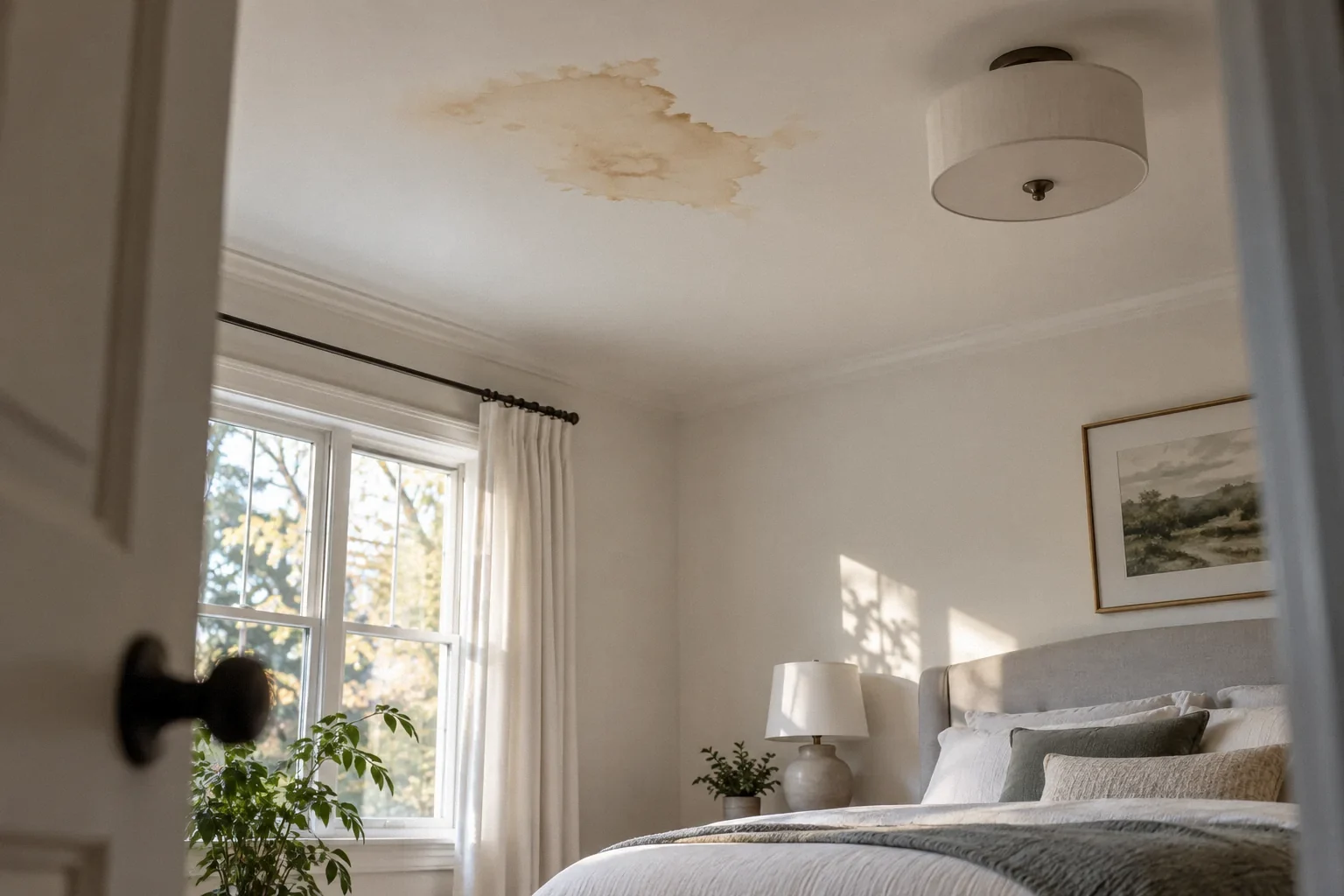
Intact-looking roof tiles do not rule out a leaking roof assembly. Water can enter through details or reach damaged material beneath the tile covering. The question is whether the problem is a localized defect or a broader underlayment and flashing condition. That distinction determines whether a targeted repair or a larger tile removal and reset project is reasonable.
Tile appearance does not reveal concealed condition
A tile roof is an assembly of covering units, supporting components, underlayment and flashings. The TRI installation manual addresses these elements together, with details that depend on roof geometry and application. [1] Tile condition and the condition below it are related but different observations. Preserving attractive tiles does not require pretending the concealed layers are sound.
The two water-control levels explain the apparent contradiction: tiles can remain visually intact while a concealed detail needs attention. TRIA describes water shedding at the tile surface and secondary protection at the deck/underlayment level around penetrations. A repair should restore the relevant levels rather than assume a new visible tile alone renews the concealed connection. [4]
Other explanations to distinguish
A broken or displaced tile can matter, but so can a valley, wall junction, penetration or aged underlayment beneath otherwise intact tiles. Water can travel before it reaches the ceiling. A single repaired leak followed by another does not prove that every square foot has failed, but it does justify reviewing whether the initial scope was too narrow. Age alone cannot locate the current entry point.
Evidence to request before choosing the work
Ask for photographs of representative concealed conditions obtained through professionally planned access, with each location identified. The inspection should explain whether findings are isolated or repeated and which areas remain unexamined. Request documentation of flashings and transitions, not just a photograph of old underlayment. If salvage is contemplated, assess tile type, condition and replacement availability before assuming every existing unit can return.
A representative inspection should explain why the selected locations are informative. Looking only beneath the most obvious broken tile may establish one defect without describing the rest of the roof. Looking only at an easily accessible dry area has the opposite limitation. Ask the inspector how the sample relates to the proposed local or broader work, and which uncertainty would remain after that sample.
How the findings change the repair decision
A local repair is easier to justify when the defect is bounded and surrounding layers can be integrated reliably. Broader renewal becomes more compelling when several representative areas show deterioration or repair cannot connect to serviceable material. Compare section-by-section work with a larger project using the risks of repeat access, transitions and tile availability. Avoid guaranteed service-life promises based solely on the underlayment's marketing label.
A practical example and what it does not prove
A sampled owner loved the existing clay tile but faced recurring leaks and conflicting large repair proposals. [2] A useful decision process separates aesthetic retention from concealed-layer renewal. The question is not simply whether to keep the tile roof. It is which tiles are suitable for reuse, how much underlayment requires renewal and how the completed assembly will be detailed.
Limits and when professional review matters
Tile surfaces are not a safe homeowner inspection platform; access can create damage as well as fall risk. A photograph cannot establish all concealed conditions. Have the contractor state the sampling limits and the process for documenting additional deterioration during opening. If framing or deck distress is found, its evaluation belongs in the scope before the new water-control layers cover it again.
Choose inspection locations that answer the scope question
Opening only beneath a visibly broken tile may identify a local concern without telling the owner whether broader renewal is needed. Opening only an easy dry area can be equally unrepresentative. Ask why the selected locations are informative and how they relate to the recommendation. Sampling should support the decision being made, not merely produce a photograph of concealed material.
Recurring leaks also need location history. If each episode occurs at a different detail, the pattern may justify a broader review even when individual repairs seem plausible. If the same unresolved junction leaks repeatedly, a better local diagnosis may be the next step. The number of service visits alone cannot distinguish those situations.
- A localized detail is defective but nearby layers appear serviceable: evaluate a bounded repair with an explainable transition.
- Representative areas show repeated concealed deterioration: compare broader renewal rather than relying on isolated patches.
- Several leak locations lack a common map: organize the history before interpreting recurrence as whole-roof failure.
Questions that resolve the remaining uncertainty
Compare the inspection question with the access provided. A small local opening may be enough to diagnose one leak but insufficient to justify a roof-wide remaining-life conclusion. If the proposal relies on a broader condition assessment, ask what representative evidence supports it. The professional should be able to distinguish a strong local finding from a more tentative judgment about unexamined areas.
Tile removal can reveal more than underlayment condition. The contractor should document any support or deck concern and identify the appropriate evaluation before rebuilding the layers above. A reset scope should not assume that every newly exposed issue can be handled by installing a different underlayment product.
The covering and the concealed renewal scope can diverge
The owner may want to retain a distinctive tile appearance while needing significant work underneath. Those goals are not inherently contradictory. Evaluate tile suitability and matching separately from underlayment and flashing condition. A proposal for new underlayment does not automatically require replacing every sound tile; a preference for tile reuse does not establish that concealed components can remain.
The key scope question is how representative the observed deterioration is. A localized penetration problem calls for different evidence from a recommendation to renew an entire roof section. Ask why the selected inspection locations support the conclusion. A photograph of one damaged concealed area proves that location needs attention; it does not independently define every unexamined area.
Repeated leakage should be mapped by detail and date. Several different failing interfaces may justify broader assessment, while repeated leakage at one unresolved junction may indicate an inadequate local diagnosis. This distinction matters when an owner feels trapped in a succession of repairs. A condition map can reveal whether the next expenditure should investigate the same mechanism more carefully or plan renewal of a wider affected assembly. Neither conclusion should be based solely on the number of previous invoices.
What to take away
- Visible tile condition does not establish concealed-layer condition.
- Use representative documented inspection to separate local and widespread defects.
- Evaluate tile reuse independently from underlayment renewal.
Sources & further reading
Reddit links show the questions people ask; they do not establish a diagnosis or a legal requirement. Technical requirements depend on the product, building and jurisdiction. See our research approach.
- TRI concrete and clay manualTechnical / official reference
Tile assembly, slope and underlayment specifics; regional adoption applies
- Homeowner discussion: Underlayment question on tile roof in PhoenixCommunity question · anecdotal
Anecdotal issue research, not technical authority or proof about another property.
- Homeowner discussion: Tile roof underlaymentCommunity question · anecdotal
Anecdotal issue research, not technical authority or proof about another property.
- TRIA: Tile penetration flashing guidanceTechnical / official reference
Surface and secondary deck-level water protection at tile penetrations.
Planning a Bay Area project?
Explore YKCA’s website and discuss the scope and services you need directly with them.