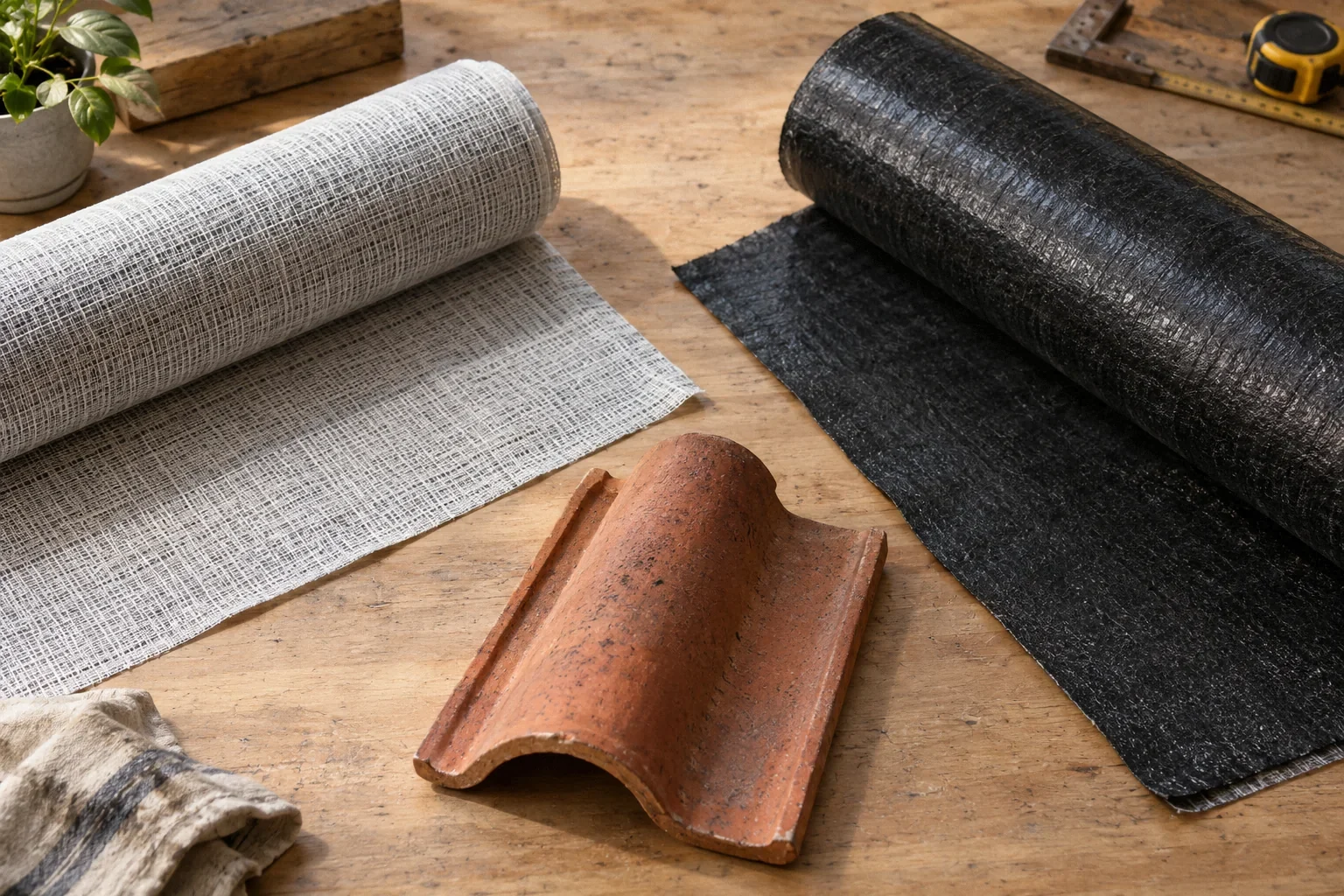
Lift-and-reset work removes tiles so underlying roof components can be renewed, then returns suitable tiles to service. Full tile replacement also changes the covering. Choose between them by evaluating tile condition, replacement availability, concealed-layer scope and handling risk. Keeping tiles is a separate decision from keeping old underlayment or flashing.
Separate covering reuse from concealed renewal
The tile covering and concealed water-control components form one assembly but do not necessarily need replacement at the same time. The TRI manual describes the installation relationships between these components. [1] A lift-and-reset proposal should reconstruct those relationships, not simply slide new material into selected visible areas. Tile identity, attachment and matching accessories affect what can reasonably be reused.
Matching is not only a color decision. TRIA’s discontinued-tile guidance identifies interlock incompatibility with current products as a repair concern. A replacement piece that looks similar may therefore need technical verification before it is treated as interchangeable. Identify the profile and supported replacement approach before counting a visually similar tile as usable salvage stock. [3]
Other explanations to distinguish
A proposal for new tile may be driven by widespread breakage, limited matching stock or a change in the owner's desired appearance. A proposal for reuse may preserve a distinctive covering while renewing the layers beneath. Neither choice proves that the contractor has included all required flashing or deck work. Ask whether the disagreement is about tile condition, concealed deterioration or the cost of handling and replacement units.
Evidence to request before choosing the work
Request a documented tile-condition assessment, identification of available matching replacements and the assumptions used for breakage. Clarify who supplies replacement pieces and how mismatches will be handled. The concealed work should be described independently: removal limits, deck inspection, underlayment, penetrations and wall transitions. Photographs taken during opening should identify locations and support any expanded scope.
Clarify where reused and replacement tiles will be placed when matching is imperfect. That can be an appearance decision for the owner, while the technical suitability of the pieces remains the contractor’s responsibility. Keep those discussions separate. A documented layout preference can prevent a later cosmetic dispute from obscuring the more important question of whether the concealed renewal work was completed as specified.
How the findings change the repair decision
Favor reuse when tiles are suitable, replacements are obtainable and the complete renewal scope is practical. Consider new covering when salvage uncertainty or condition makes reset unreliable. If changing material or weight, the project needs appropriate assessment of the supporting structure and other applicable constraints. Avoid treating a lower initial tile cost as the whole financial comparison when access and repeat mobilization may dominate later work.
A practical example and what it does not prove
An owner with valued clay tiles receives one estimate to reset a roof section and another to replace everything. The useful comparison separates the common concealed-layer work from the covering options. If both bidders agree that underlying material must be renewed, that portion should be comparable. The remaining choice concerns salvage reliability, matching and the consequences of phased work, not whether attractive tiles can somehow waterproof failed layers below.
Limits and when professional review matters
No inspection can guarantee that every existing tile will survive handling. The written scope should explain how unexpected breakage or concealed damage is documented and approved. Homeowner walking or lifting tiles can add damage and obscure the original condition. Use a professional assessment and require completion records that distinguish retained components from newly installed ones.
Account for matching and phased work
A reset project can retain much of the existing appearance while still needing replacement pieces. Ask how matching limitations will be handled and where new pieces may be placed. Those are reasonable owner choices, but they should remain separate from the technical suitability of reused units. Clarifying them early can avoid a cosmetic disagreement after the concealed work is complete.
Phased renewal needs a transition plan. The boundary between renewed and retained areas should be understandable, and future access should be considered. A smaller first phase may fit the budget while leaving predictable work elsewhere. The proposal should state that tradeoff openly instead of presenting partial renewal as proof that the entire roof has the same remaining condition.
- Suitable matching replacements are scarce: include that constraint in the reuse decision before handling begins.
- Only one roof section will be renewed: document the boundary and the condition assumptions about retained areas.
- More tiles break than expected during work: use the agreed record and approval process rather than an undocumented substitution.
Questions that resolve the remaining uncertainty
Discuss the treatment of accessories as well as the main tile field. Ridge pieces, edge details and other matching components can affect both the appearance and feasibility of reuse. If they are excluded from a salvage assumption, make that visible in the comparison. A statement that the tiles will be reused should not leave the owner discovering later which essential pieces were never included.
Reset work has a salvage boundary and a renewal boundary
The salvage boundary defines which covering pieces are suitable to return. The renewal boundary defines which concealed layers and details are reconstructed. These boundaries can differ. A contractor might reuse sound tiles across an area while replacing the underlying water-control components throughout it. Keeping the two decisions explicit prevents the word reuse from being interpreted as retaining every old component.
Matching also needs a practical plan. If replacement pieces are limited, agree how appearance differences will be handled without compromising technical suitability. Accessories should be considered alongside field tiles. A proposal that assumes only the main tiles can be salvaged may leave significant appearance and procurement questions at ridges or edges.
For phased work, identify the connection between renewed and retained areas. Ask how later access would affect the completed phase and which remaining conditions are outside it. A phased approach can be a reasonable owner choice, but it should not be described as giving the whole roof a uniform new condition. The comparison with full replacement should include salvage reliability, transition work and the consequences of repeating access, rather than rely only on the apparent savings from reusing the visible covering.
What to take away
- Separate the tile-reuse decision from concealed-layer renewal.
- Document matching availability and breakage assumptions.
- Compare phased reset with full work using transition and repeat-access risks.
Sources & further reading
Reddit links show the questions people ask; they do not establish a diagnosis or a legal requirement. Technical requirements depend on the product, building and jurisdiction. See our research approach.
- TRI concrete and clay manualTechnical / official reference
Tile assembly, slope and underlayment specifics; regional adoption applies
- Homeowner discussion: Tile roof underlaymentCommunity question · anecdotal
Anecdotal issue research, not technical authority or proof about another property.
- TRIA: Discontinued Tile Guide announcementTechnical / official reference
2026 bulletin identifies interlock compatibility and limitations of visual matching for discontinued profiles.
Planning a Bay Area project?
Explore YKCA’s website and discuss the scope and services you need directly with them.