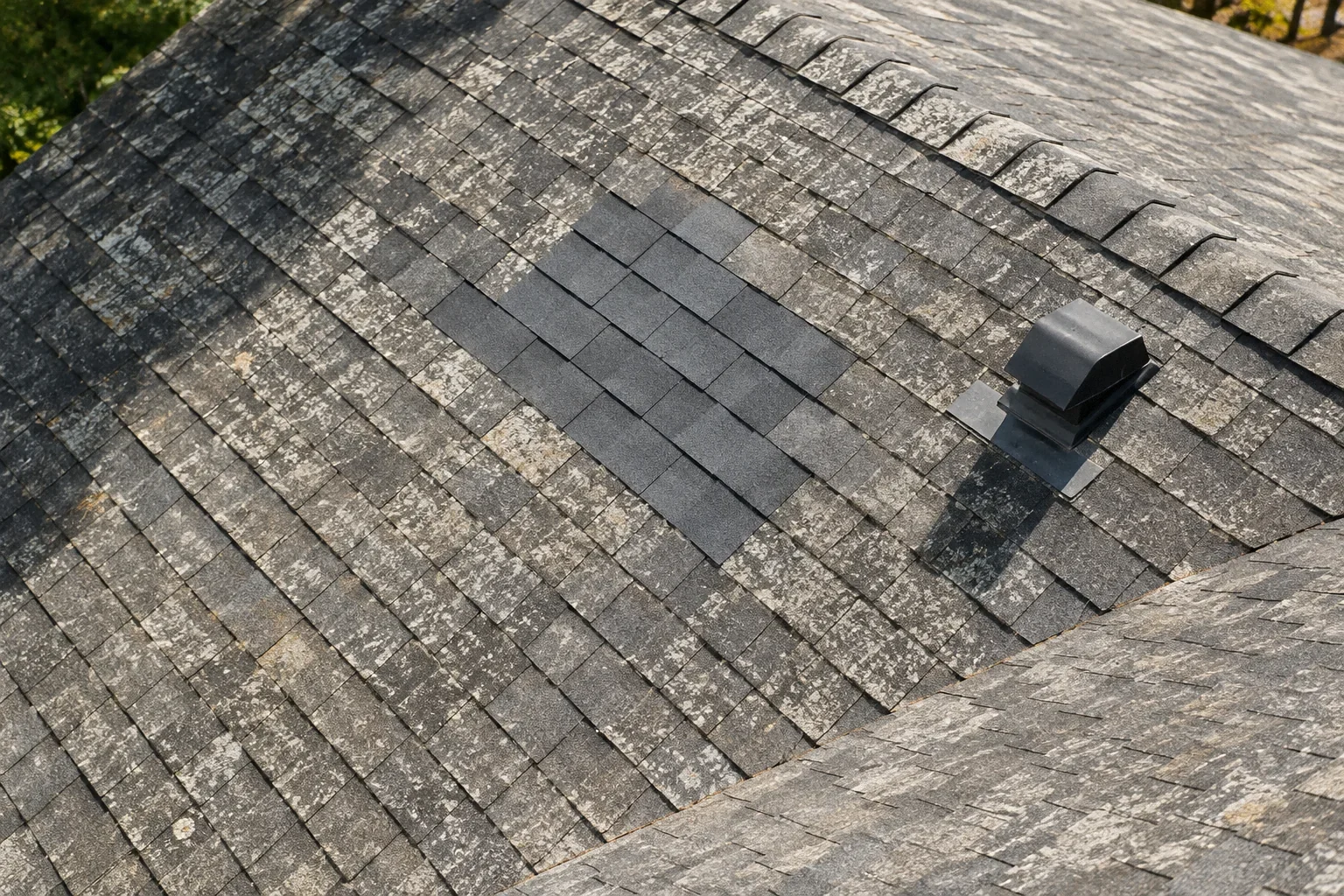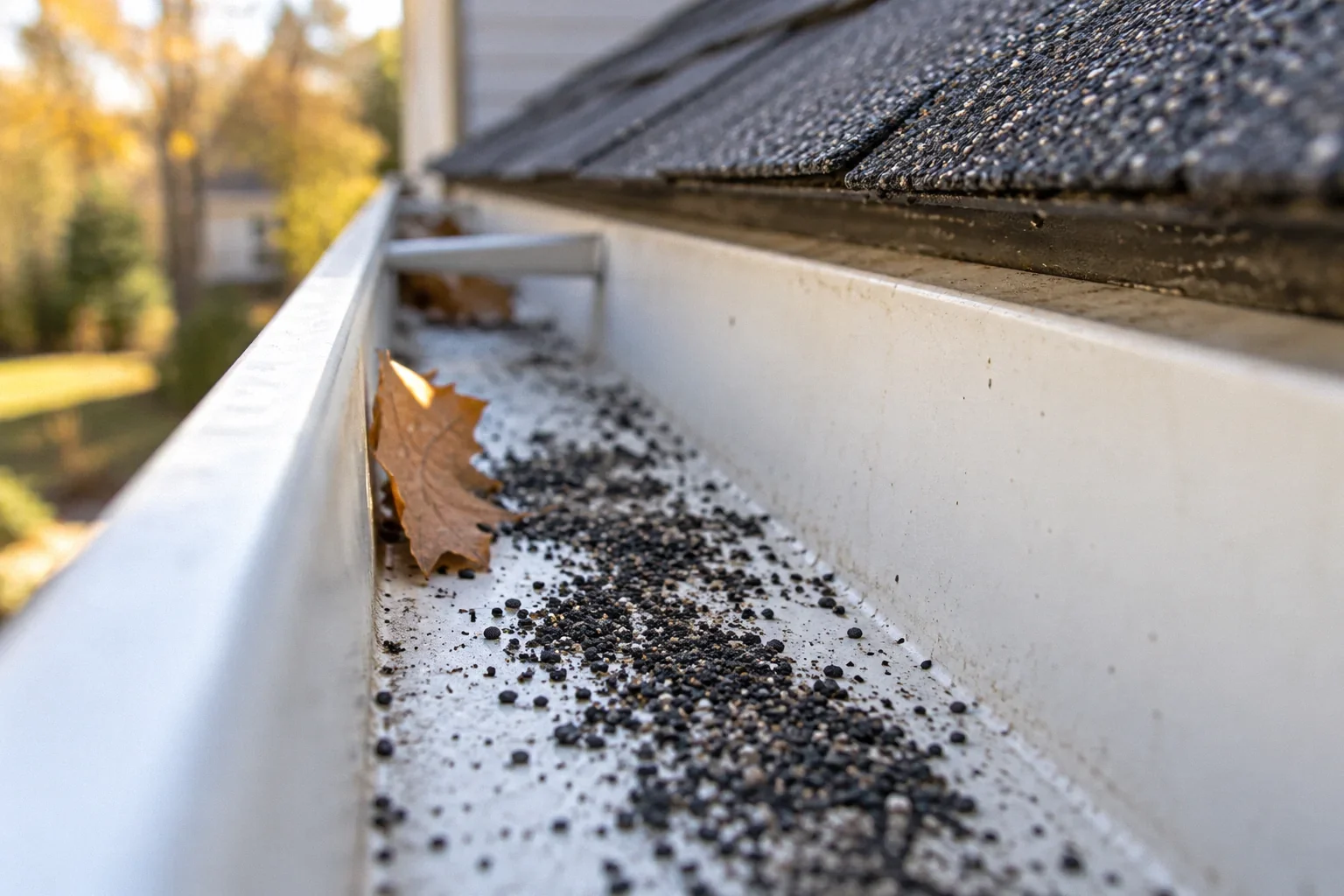
Granules in a gutter are an observation, not a diagnosis of roof failure or hail damage. Evaluate the roof's age and history, the distribution of surface loss, visible damage to the shingle body and changes over time. The amount found during one cleaning does not establish what caused it or when it occurred.
Interpret granules in their roof context
Granules are part of the shingle surface, and their displacement can accompany different conditions. IBHS identifies granule displacement among possible hail damage modes, alongside deformation and breaches. [2] Because a sign can have more than one cause, its presence should lead to closer assessment rather than an automatic storm attribution. A loose-granule sample lacks the roof-location context needed for a stronger conclusion.
Other explanations to distinguish
Weathering, localized abrasion, installation or service activity, and impact damage may be considered by an inspector. Uniform appearance and concentrated areas need different attention. A gutter accumulates material from its contributing roof area over time, so a large quantity after a long cleaning interval is not directly comparable with a small quantity after a short interval. Avoid claiming a trend from unmatched observations.
Evidence to request before choosing the work
Keep dated ground-level photographs and maintenance dates. Ask for roof photographs that show both broad distribution and specific areas of exposed or damaged shingle material. The report should distinguish cosmetic surface variation from a condition affecting the water-shedding assembly. If hail is proposed, request the independent observations supporting that conclusion rather than accepting gutter granules as the only evidence.
When comparing photographs over time, use similar roof areas and sufficient context to identify them. A close-up from one slope cannot establish deterioration on another. If gutter material is photographed, record when that gutter was last cleaned and which roof area contributes to it. Those details do not diagnose the cause, but they prevent an apparently dramatic image from losing the context needed for interpretation.
How the findings change the repair decision
A local damaged area may warrant repair while the surrounding roof remains serviceable. Widespread deterioration calls for a broader condition assessment, not merely a gutter cleaning. A replacement recommendation should explain repairability, the condition of adjacent shingles and any associated details. Conversely, a statement that granules are always normal should not substitute for inspecting clearly deteriorated or breached material.
A practical example and what it does not prove
A homeowner cleans gutters after an unusually long interval and sees a surprising amount of grit. A neighbor recently replaced a roof after hail, so the owner assumes the same cause. The more reliable next step is to document the actual roof condition and relevant weather history. The neighbor's project and the accumulated material are leads, not evidence that this roof has the same damage.
Limits and when professional review matters
Do not rub shingles, collect roof samples or walk the surface to test granule adhesion. Those actions can alter the condition being evaluated. Photographic opinions also have limits: lighting and image scale can obscure the shingle body. Use a professional inspection when deterioration appears significant or a major replacement decision depends on the diagnosis.
Avoid comparisons that mix different collection histories
Gutters collect material over time, so the cleaning interval belongs beside any photograph of accumulated granules. The contributing roof area matters too. A larger amount from a larger or less frequently cleaned area is not a controlled comparison. These facts do not prove the material is harmless; they explain why the image cannot establish a cause without roof-condition evidence.
Ask the inspection report to identify the shingle body condition in the areas of concern. Surface appearance, exposed material and a physical breach are different observations. If storm damage is asserted, the report should explain the connection rather than rely on the presence of loose grit. If ordinary wear is asserted, clearly damaged areas still deserve a repairability assessment.
- The gutter was not cleaned for an unknown interval: avoid inferring a sudden event from the accumulated quantity.
- One roof area shows concentrated change: inspect that location rather than generalize from all gutter material.
- The report identifies exposed or breached material: base corrective scope on that condition, not solely on the granule explanation.
Questions that resolve the remaining uncertainty
The relevant distinction is not simply granules present versus absent. Ask whether the inspector documented the condition of the shingle body and the extent of any affected area. That observation provides a better basis for discussing repairability. An owner should not be asked to accept a major scope solely because a handful of gutter material looks dramatic in a photograph.
A maintenance record can also prevent false comparisons. Note whether gutters serving different slopes were cleaned at different times or whether recent work disturbed one part of the roof. Those differences do not excuse actual damage, but they explain why accumulated material cannot be used as a controlled measurement of roof-wide deterioration.
Surface loss and repair scope answer different questions
Identifying why granules are present does not automatically determine how much roofing needs work. The inspector should document the current shingle condition and the extent of affected material. A localized damaged area and a broad surface pattern may lead to different scopes even when both involve granule loss. The repair decision should follow the condition that must be restored, not only the label applied to the cause.
Gutter photographs are especially sensitive to missing context. They combine material over a collection interval and contributing area. Record those limits rather than infer a sudden roof-wide event from a large pile. If recent service affected one slope, note that history too. These observations do not prove that all loss is harmless; they explain why the roof itself still needs assessment.
For a storm interpretation, ask which observations besides loose material support it. For an ordinary-wear interpretation, ask whether any exposed or breached areas still require action. Either explanation can be stated too broadly. A useful report separates the physical condition, probable cause and corrective boundary. That gives the owner a basis for deciding about repair without treating a dramatic gutter image or a reassuring generalization as a complete diagnosis.
What to take away
- Loose granules alone do not prove hail damage or roof failure.
- Compare observations with cleaning intervals and roof-location context.
- Base repair decisions on shingle condition and repairability.
Sources & further reading
Reddit links show the questions people ask; they do not establish a diagnosis or a legal requirement. Technical requirements depend on the product, building and jurisdiction. See our research approach.
- IBHS Roof 101Technical / official reference
Roof system performance and test-rating limitations
- IBHS hail mechanismsTechnical / official reference
Dents, breaches, granule displacement; cosmetic and functional distinctions
- Homeowner discussion: Hail damage?Community question · anecdotal
Anecdotal issue research, not technical authority or proof about another property.
- Homeowner discussion: Hail damage. Do I need a new roof?Community question · anecdotal
Anecdotal issue research, not technical authority or proof about another property.
Planning a Bay Area project?
Explore YKCA’s website and discuss the scope and services you need directly with them.