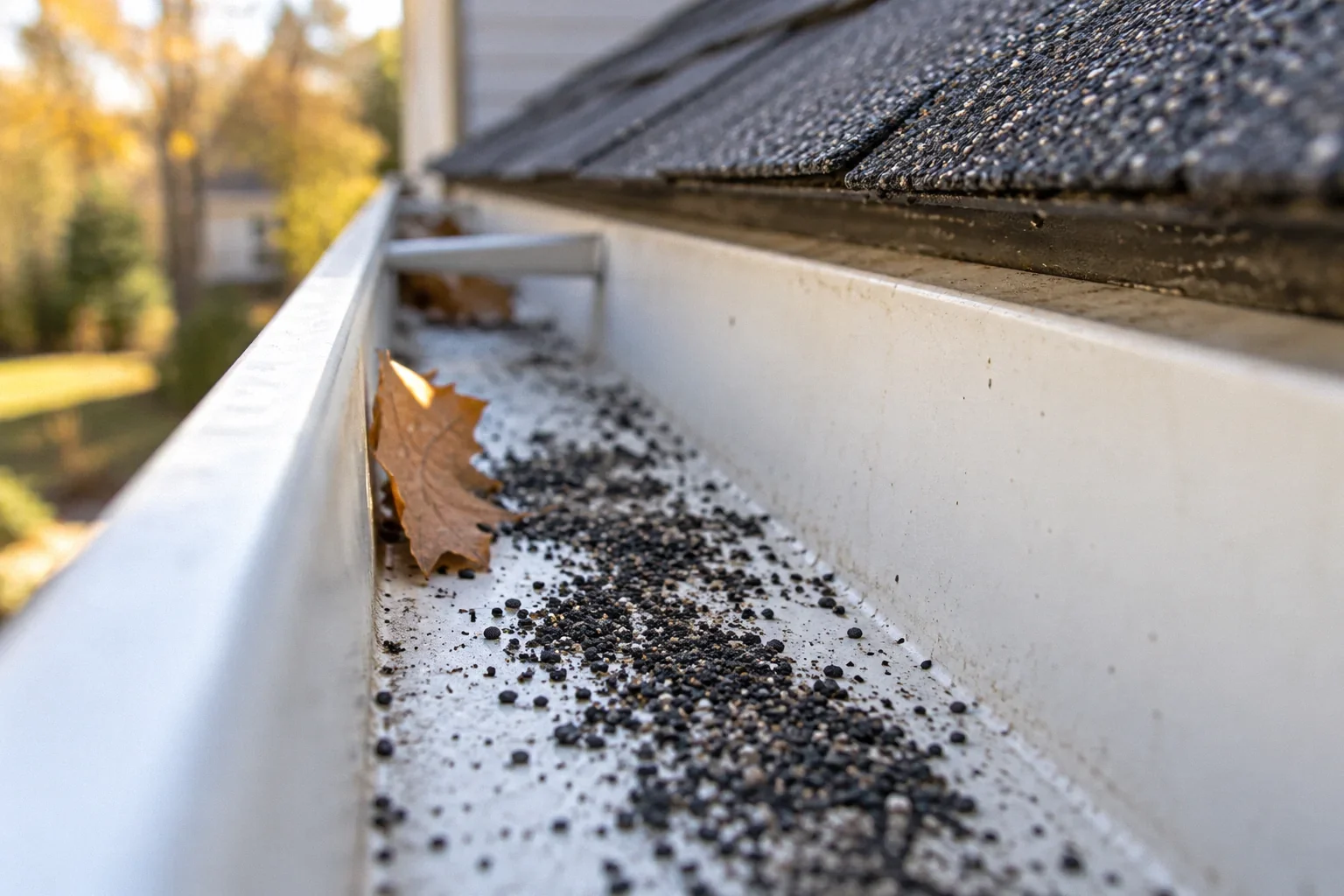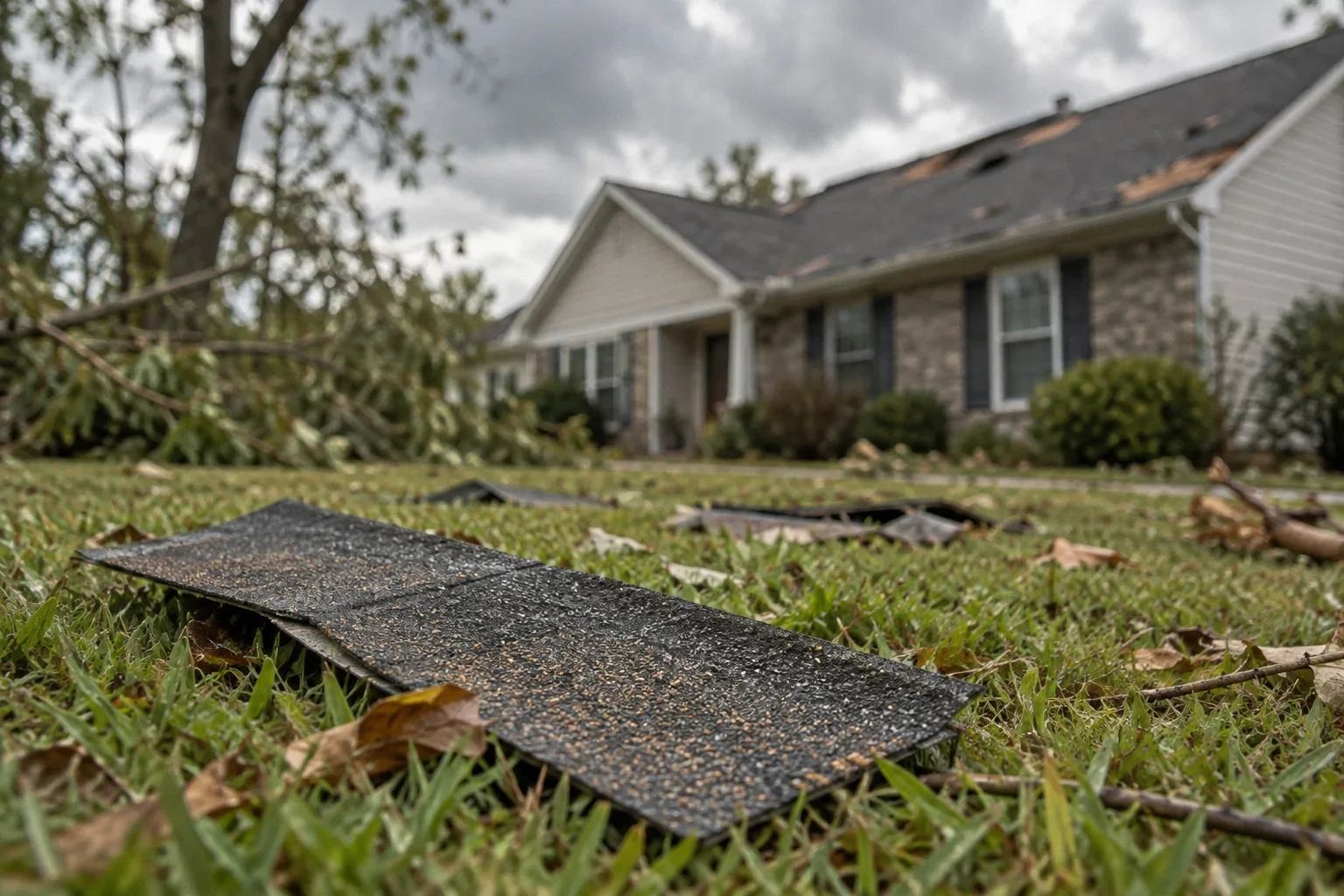
Lifted edges or sliding shingles call for an inspection of attachment, bonding and the supporting surface. The appearance alone does not establish whether wind, installation or aging is responsible. Ask the inspector to explain the mechanism and its extent before approving either a small patch or a complete reroof.
Assess the intended shingle connection
A shingle roof depends on the selected product's fastening and application arrangement. The cited GAF installation document provides product-specific requirements, while IBHS explains that roof performance involves more than a marketing wind-speed claim. [1][2] A displaced shingle is therefore a symptom to compare with the intended assembly, not merely a cosmetic piece to push back into place.
Other explanations to distinguish
Possible concerns include an unsuitable attachment location, deficient support, damaged material or a bond that has not performed as intended. Roof geometry and exposure can affect where symptoms appear. A storm can reveal a preexisting weakness without proving that every component was originally correct. Avoid assuming that all lifted corners share one cause simply because they are visible from the same side of the house.
Evidence to request before choosing the work
Request the exact shingle identification, installation date and documented pattern of affected areas. Close inspection should be performed by a qualified professional who can assess the relevant concealed relationship without causing unnecessary damage. The report should identify observed attachment conditions separately from inferred causes. Ask whether the surrounding shingles remain suitable for a supported repair and whether replacement pieces are compatible.
Ask whether the proposed inspection will document representative unaffected areas as well as displaced shingles. That comparison can help distinguish a localized condition from a repeated installation pattern. It should not involve homeowners lifting material to collect evidence. The professional should select an appropriate method and explain how the findings support the recommended extent of correction.
How the findings change the repair decision
A bounded local defect may be repairable when adjacent material can be worked and the correct assembly restored. Repeated installation problems across slopes may justify a broader scope, but that conclusion needs representative evidence. The proposal should address the cause of displacement rather than simply fasten visible tabs differently. Product-specific instructions govern any repair details.
A practical example and what it does not prove
Suppose a row appears to slide while the ridge and eave lines look straight. A homeowner concludes that the deck has moved. An inspection may instead identify a covering-attachment issue, or it may find that support requires investigation. The useful distinction comes from documented component relationships. A remote photo cannot resolve which hidden part is responsible.
Limits and when professional review matters
Do not lift tabs, add exposed nails or attempt to reseal shingles as a diagnostic test. That can damage material and change the evidence. A visible opening before forecast severe weather warrants prompt professional advice about protection, but emergency work should still be documented. A later permanent repair may need a different scope from the temporary measure.
Compare affected and representative unaffected areas
A displaced shingle is evidence that something needs assessment, but it does not establish how widely the same condition occurs. Ask the inspector to explain how representative observations support the proposed repair boundary. A report should not assume roof-wide installation failure from one location or assume a local defect without looking at the relevant surrounding pattern.
The permanent scope should also explain how the selected product can be repaired in its current condition. Matching appearance and restoring the supported connection are separate concerns. A replacement piece that looks right is not the whole detail. If adjacent material cannot be handled appropriately, the work boundary may need to expand for reasons that should be documented.
- A repeated pattern appears across representative locations: ask how the findings support broader correction.
- Only one bounded area is affected and adjacent material is serviceable: evaluate a supported local repair.
- The proposed repair adds a new visible fastening approach: request its product-specific basis before accepting it as equivalent.
Questions that resolve the remaining uncertainty
A useful inspection does not require the homeowner to decide whether a visible condition is a high nail, a bond problem or a deck issue. Those are technical hypotheses for the professional to assess. The owner can ask for the observation supporting the selected explanation and the product detail against which it was compared. That keeps the conversation concrete without encouraging intrusive homeowner testing.
If the displaced area is close to a penetration or transition, ask whether the covering movement and water-control detail are related or separate findings. Repairing a visible shingle may not answer a second concern at the interface. Conversely, the presence of a nearby pipe does not prove that its flashing caused displacement. The report should not merge neighboring defects simply because one photograph captures both.
Consider two possible inspection outcomes. In one, a bounded group of shingles has a documented connection problem and adjacent material is serviceable. The proposal can explain a localized correction. In the other, representative areas show the same deficient relationship and local repairs would depend on unreliable surrounding work. A broader scope may then be justified. The difference should be visible in the evidence, not merely in the contractor’s preference for repair or replacement.
After correction, request the product identification and photographs of the relevant connection before it is concealed. An after photograph of a flat-looking surface cannot show every underlying detail. Also retain a map of the repaired area so later storm or maintenance observations can be compared with the actual work boundary. This is more useful than expecting a future inspector to infer the repair location from subtle appearance differences.
A matching shingle is not the complete repair
Replacement appearance and restoration of the supported connection are separate requirements. A piece that looks similar does not establish that the surrounding material can accept the repair. The contractor should explain the current repairability and document any reason the boundary must expand.
What to take away
- Evaluate attachment, bond and support as separate possibilities.
- Compare observed conditions with the exact product instructions.
- Correct the displacement mechanism rather than only the visible symptom.
Sources & further reading
Reddit links show the questions people ask; they do not establish a diagnosis or a legal requirement. Technical requirements depend on the product, building and jurisdiction. See our research approach.
- GAF shingle installation instructionsTechnical / official reference
Product-specific fastening, deck and slope; verify chosen SKU revision
- IBHS Roof 101Technical / official reference
Roof system performance and test-rating limitations
- Homeowner discussion: Hail damage. Do I need a new roof?Community question · anecdotal
Anecdotal issue research, not technical authority or proof about another property.
Planning a Bay Area project?
Explore YKCA’s website and discuss the scope and services you need directly with them.