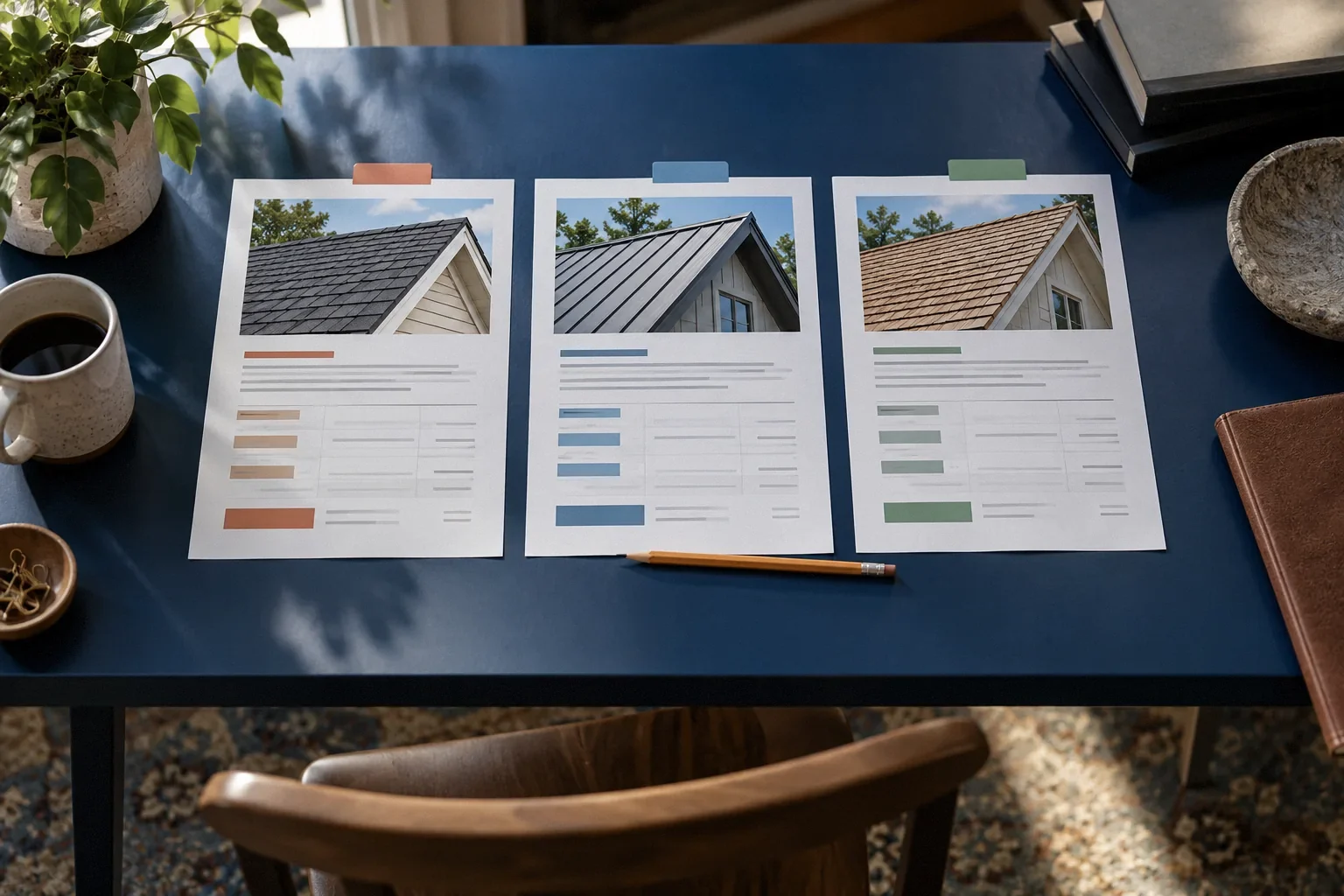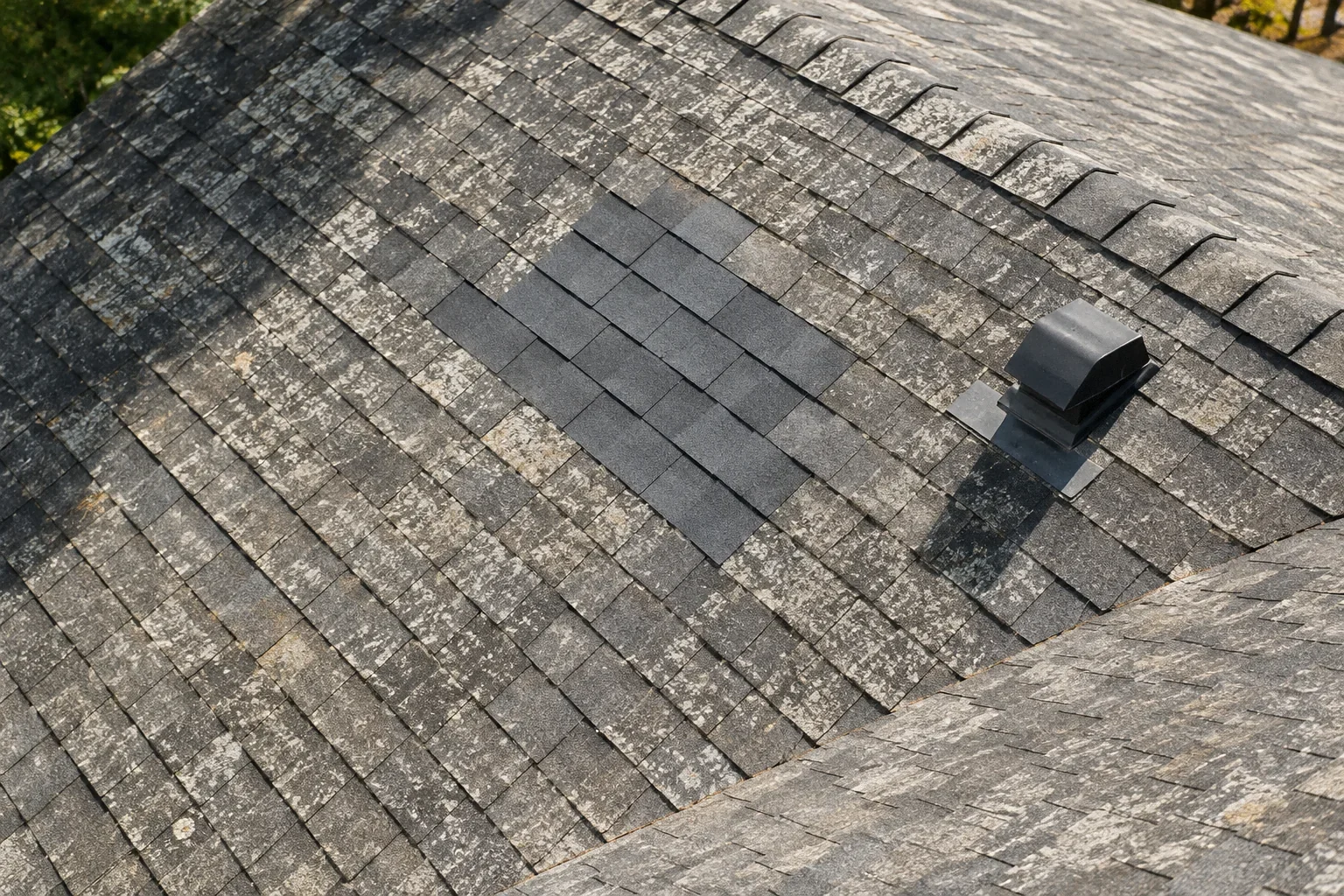
Repair versus replacement should follow condition, repairability and the extent of the problem. Roof age is useful context, but it does not establish that a local flashing leak requires a new roof or that an old assembly remains a good repair candidate. Ask what can be restored reliably and what evidence supports the proposed boundary.
Set scope from the assembly condition
Roof performance depends on the covering, concealed layers, penetrations and transitions working together. PNNL identifies these interruptions in the water-control layer as important inspection points. [1] A small defective detail can leak on a relatively new roof. Conversely, an apparently modest interior stain can accompany a larger concealed problem. The visible symptom and the appropriate work area are not automatically the same size.
Other explanations to distinguish
The alternatives may include a local detail repair, partial renewal, rehabilitation or complete replacement. They carry different assumptions about surrounding material and future access. Repeated unsuccessful patches suggest that either diagnosis or repair scope remains inadequate, but do not alone prove total roof failure. A broad replacement recommendation should explain why smaller supported repairs are unsuitable.
Evidence to request before choosing the work
Request a condition map showing defects, representative sound areas and inspection limitations. Ask whether nearby material can accept the intended repair and what concealed conditions might expand the work. Compare the same components in every proposal: deck assessment, wet-material removal, flashing, penetrations, drainage and completion documentation. A covering-only estimate cannot be compared fairly with a complete assembly renewal.
Ask each contractor to state the strongest reason against their own proposed option. For repair, it may be uncertainty about concealed extent or future access. For replacement, it may be that serviceable material will be removed. A candid explanation of the tradeoff helps the owner compare options without demanding an impossible guarantee. The recommendation should remain tied to evidence rather than a sales preference.
How the findings change the repair decision
A repair is more defensible when the source is identified, damage is bounded and surrounding components are serviceable. Replacement becomes more compelling when deterioration or defects are widespread, reliable transitions cannot be made or repeated access would create disproportionate disruption. The owner should understand the remaining uncertainty under each option. No contractor can remove uncertainty simply by assigning a confident remaining-life number.
A practical example and what it does not prove
An owner receives a full-replacement recommendation after a failed vent patch. A second inspection finds a local flashing defect with serviceable surrounding roofing. Another owner with several recurring tile-roof leaks has representative evidence of broader concealed deterioration. These two cases can lead to different choices even if the roofs are the same age. The difference is documented assembly condition.
Limits and when professional review matters
This is a technical decision framework, not a property-specific engineering opinion or cost estimate. Independent review may be worthwhile where proposals describe incompatible diagnoses or the consequences of error are large. Urgent protection and the final capital decision can be separated: stopping ongoing damage need not force acceptance of an unsupported complete-replacement scope.
Compare the strongest argument against each option
A repair option may preserve serviceable material while retaining uncertainty elsewhere. A replacement option may reduce some uncertainty while removing material that could have remained. Ask each bidder to describe that tradeoff rather than promise that their choice is always economical. The owner can then decide how much disruption, future access and uncertainty is acceptable with a clearer view of the alternatives.
Phased work deserves particular attention. It can make a project manageable, but its boundaries and retained components should be explicit. A completed phase does not establish the condition of every untouched area. Conversely, the existence of future work does not make a sound local repair pointless. Compare the expected role of each phase rather than treating repair and replacement as absolute opposites.
- A local source is confirmed and surrounding material is repairable: ask what broader replacement would additionally accomplish.
- Repeated defects prevent reliable local connections: document why the repair boundary must expand.
- A phased option is proposed: identify retained uncertainty and future access needs instead of assigning the whole roof a new condition.
Questions that resolve the remaining uncertainty
A cost comparison should use equivalent assumptions about hidden work. One estimate may include opening, deck assessment and flashing renewal, while another includes only the visible covering. The smaller total does not necessarily represent a cheaper way to achieve the same result. Ask each contractor to identify omitted or conditional items before discussing which option offers better value. This article supplies no universal price threshold because the relevant scope is property-specific.
The owner’s intended use of the building can legitimately affect the decision without changing the physical diagnosis. Planned equipment installation, a larger renovation or restricted future access may favor doing otherwise necessary work together. Those are coordination considerations. Keep them separate from statements that the current roof has failed, so the final record honestly explains both the condition evidence and the practical reason for the chosen timing.
Ask what remains after a local repair. The answer should identify retained components and unresolved areas, not promise that the whole roof is now equivalent to a new assembly. Ask the same question after replacement: retained walls, equipment and other interfaces may still matter. Both options benefit from clear boundaries. Neither should be sold as eliminating every possible future source of moisture in the building.
A second opinion is most useful when it examines the disputed assumption. If the disagreement concerns whether adjacent material can accept repair, ask the reviewer to address that directly. If it concerns the extent of concealed deterioration, ask what investigation would establish a reasonable boundary. Another generic estimate may add a price without resolving the technical uncertainty that made the original decision difficult.
Document the selected option and the specific uncertainty that the owner accepted.
What to take away
- Use condition and repairability to define scope.
- Normalize complete assembly work when comparing alternatives.
- Separate urgent protection from the final replacement decision.
Sources & further reading
Reddit links show the questions people ask; they do not establish a diagnosis or a legal requirement. Technical requirements depend on the product, building and jurisdiction. See our research approach.
- PNNL penetration flashingTechnical / official reference
Water-control continuity and penetration detailing; avoid treating illustrated assembly as universal code
- IBHS Roof 101Technical / official reference
Roof system performance and test-rating limitations
- Homeowner discussion: Moms roof is leaking at this vent looking thingCommunity question · anecdotal
Anecdotal issue research, not technical authority or proof about another property.
- Homeowner discussion: Tile roof underlaymentCommunity question · anecdotal
Anecdotal issue research, not technical authority or proof about another property.
- Homeowner discussion: Can this roof be repaired or need completely replaced?Community question · anecdotal
Anecdotal issue research, not technical authority or proof about another property.
Planning a Bay Area project?
Explore YKCA’s website and discuss the scope and services you need directly with them.