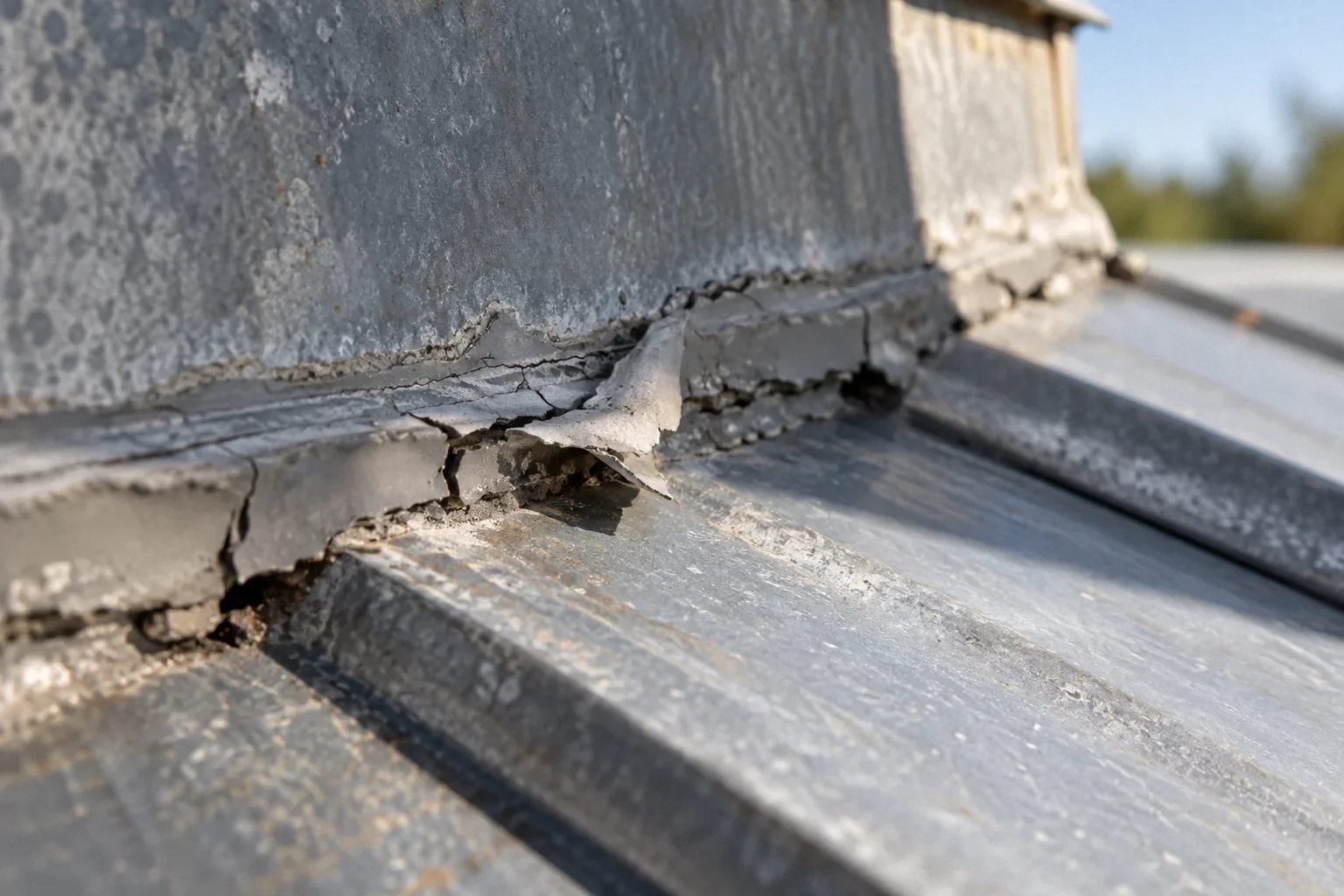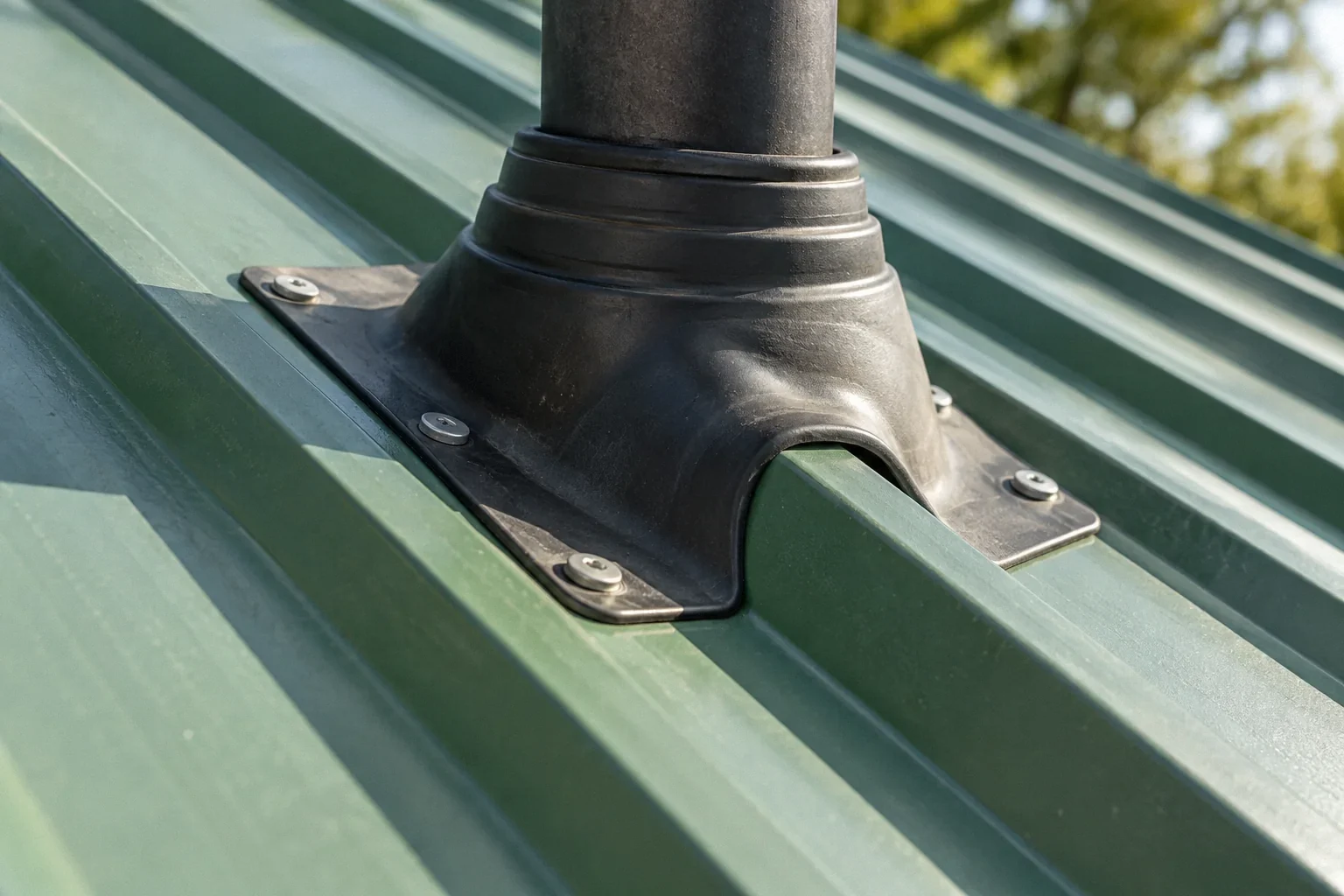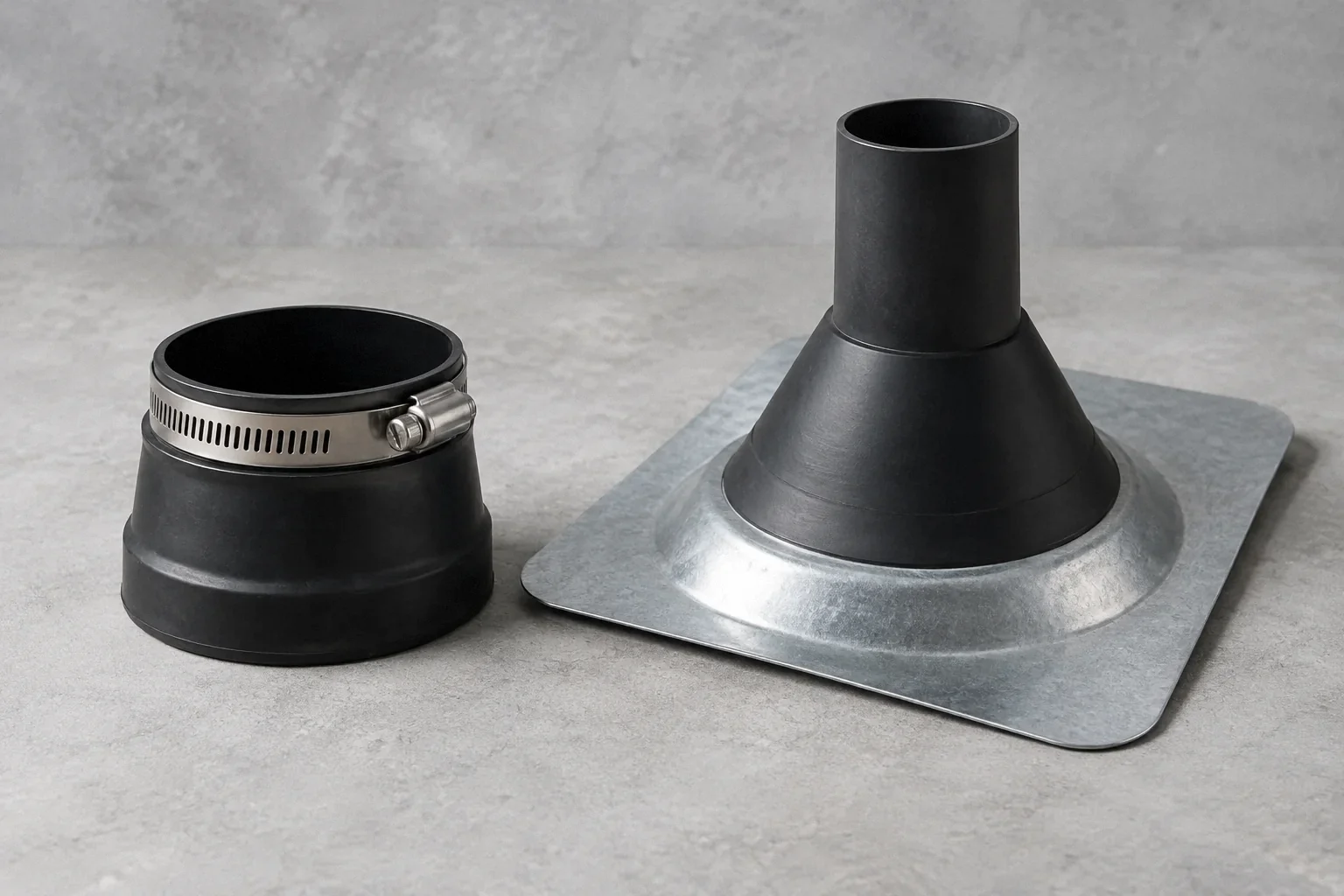
A repair collar can address a compatible, localized failure around a pipe, but it cannot correct a defective flashing flange or an incorrect relationship between flashing and roof covering. The choice depends on which part leaks. A boot that looks intact from one photograph can still conceal a failed component or a problem above it.
Inspect the collar and flange separately
A penetration creates more than one potential water path. There is the pipe-to-collar connection, the collar or boot body, and the flange integrated into surrounding roofing. These parts must work with the roof's water-control layers. [1] A cover placed over an old collar may address only one interface. It does not establish that the concealed flange, fasteners or nearby roofing remain sound.
Other explanations to distinguish
Water observed near the pipe could also be following it from a different roof opening or coming from the pipe system rather than around it. Cracking at the collar is one possible cause, not the entire checklist. Previous sealant can conceal the original condition. Multiple covers and patch layers deserve documentation because the visible top component may not be the component intended to manage water at the deck.
Evidence to request before choosing the work
Ask the roofer to identify the existing flashing material, pipe configuration, surrounding covering and precise evidence of leakage. Request photographs that show the whole detail in context, including the area upslope. If the flange cannot be evaluated while covered, the proposal should explain the limited removal needed. A useful inspection separates a visible defect from the assumption that correcting it will resolve all moisture observed indoors.
If the proposal is for a cover rather than removal, ask the contractor to identify exactly which existing components remain responsible for keeping water out. That question makes the limitation understandable without dismissing every cover repair. Also ask what finding would cause the roofer to abandon the collar-only approach. The owner can then authorize a bounded option with an explicit fallback instead of discovering its limitations after another leak.
How the findings change the repair decision
Choose a compatible repair component only when the rest of the detail can reasonably remain in service and the manufacturer supports the application. Full flashing replacement becomes more compelling where the flange is damaged, installation is incorrect, layers are improvised or surrounding material must be removed anyway. The professional should also explain how brittle adjacent shingles or inaccessible connections change the repair scope.
A practical example and what it does not prove
A homeowner sees water at a plumbing vent after torrential rain but no obvious tear in the visible boot. The sampled discussion raises the possibility of a cover over an older flashing. [2] That is a useful question to investigate, not a remote diagnosis. Comparing the visible assembly with its intended detail can establish whether a collar-only proposal is complete or merely another layer over the uncertainty.
Limits and when professional review matters
Plumbing vents and other roof pipes do not all perform the same function. Do not cap a pipe or change its height to solve a flashing concern without the relevant professional determining its purpose and requirements. Roof access and removal of adjoining materials belong to trained workers with suitable protection. The homeowner's most useful contribution is preserving the history of symptoms and repairs.
Compare two collar-only proposals carefully
One proposal may replace a deteriorated flexible collar while retaining a verified sound flashing base. Another may place a cover over an assembly whose lower portions have not been evaluated. Both can be described as a boot repair, but the uncertainty is different. Ask which components have been inspected and which remain assumptions. This is a scope question, not a blanket rejection of repair accessories.
A complete flashing replacement also needs a defined boundary. Ask how adjacent roofing will be handled and whether the resulting connection follows a supported detail. More removal is not automatically better if the work never addresses the actual water path. The best proposal explains why its selected boundary is sufficient and what finding would require expanding it.
- Collar damage is confirmed and the flange is documented as sound: compare a compatible limited repair with unnecessary broader removal.
- The flange is concealed beneath repeated covers: ask how its condition can be established or reconstructed reliably.
- Nearby material cannot accept the proposed repair: revise the surrounding scope rather than promise a collar-only solution.
Questions that resolve the remaining uncertainty
A useful collar-repair estimate identifies the component by name and describes the existing base it depends on. If the contractor cannot identify that base, ask whether the price includes enough access to establish its condition. This prevents a low initial quote from being mistaken for a verified complete solution when it actually purchases only a visible cover.
Collar-only and complete flashing scopes are different
A collar-only scope retains the existing flashing base and its relationship to the roofing. Its prerequisite is therefore more than a visible split around the pipe: the retained portions must be suitable for continued use, and the repair component must be compatible with the configuration. The proposal should identify those retained portions explicitly. Otherwise the owner may believe a complete penetration assembly is being renewed when only its upper connection is addressed.
A full flashing scope removes or exposes enough surrounding work to renew the base connection as well as the collar. Its benefit is access to a larger part of the water-control detail. Its additional uncertainty concerns the surrounding roofing and any concealed deterioration encountered during access. Ask how the new flange will integrate with those retained materials and what condition would require extending the repair area.
A third possibility is that neither option addresses the actual entry point. Water may arrive from another detail and emerge at the pipe opening. In that case, replacing the boot can consume money while leaving the original mechanism active. Compare the alternatives by the evidence each addresses: confirmed collar deterioration, deficient flange integration, or an unresolved travel path. The smallest adequate scope is the one that restores the verified mechanism, not necessarily the one that replaces the fewest visible pieces.
What to take away
- Distinguish collar failure from flange and roof-integration defects.
- A cover repair needs compatibility evidence and a sound underlying detail.
- Do not alter the pipe itself to compensate for a poorly understood flashing problem.
Sources & further reading
Reddit links show the questions people ask; they do not establish a diagnosis or a legal requirement. Technical requirements depend on the product, building and jurisdiction. See our research approach.
- PNNL penetration flashingTechnical / official reference
Water-control continuity and penetration detailing; avoid treating illustrated assembly as universal code
- Homeowner discussion: Leak at vent stackCommunity question · anecdotal
Anecdotal issue research, not technical authority or proof about another property.
- Homeowner discussion: Moms roof is leaking at this vent looking thingCommunity question · anecdotal
Anecdotal issue research, not technical authority or proof about another property.
Planning a Bay Area project?
Explore YKCA’s website and discuss the scope and services you need directly with them.