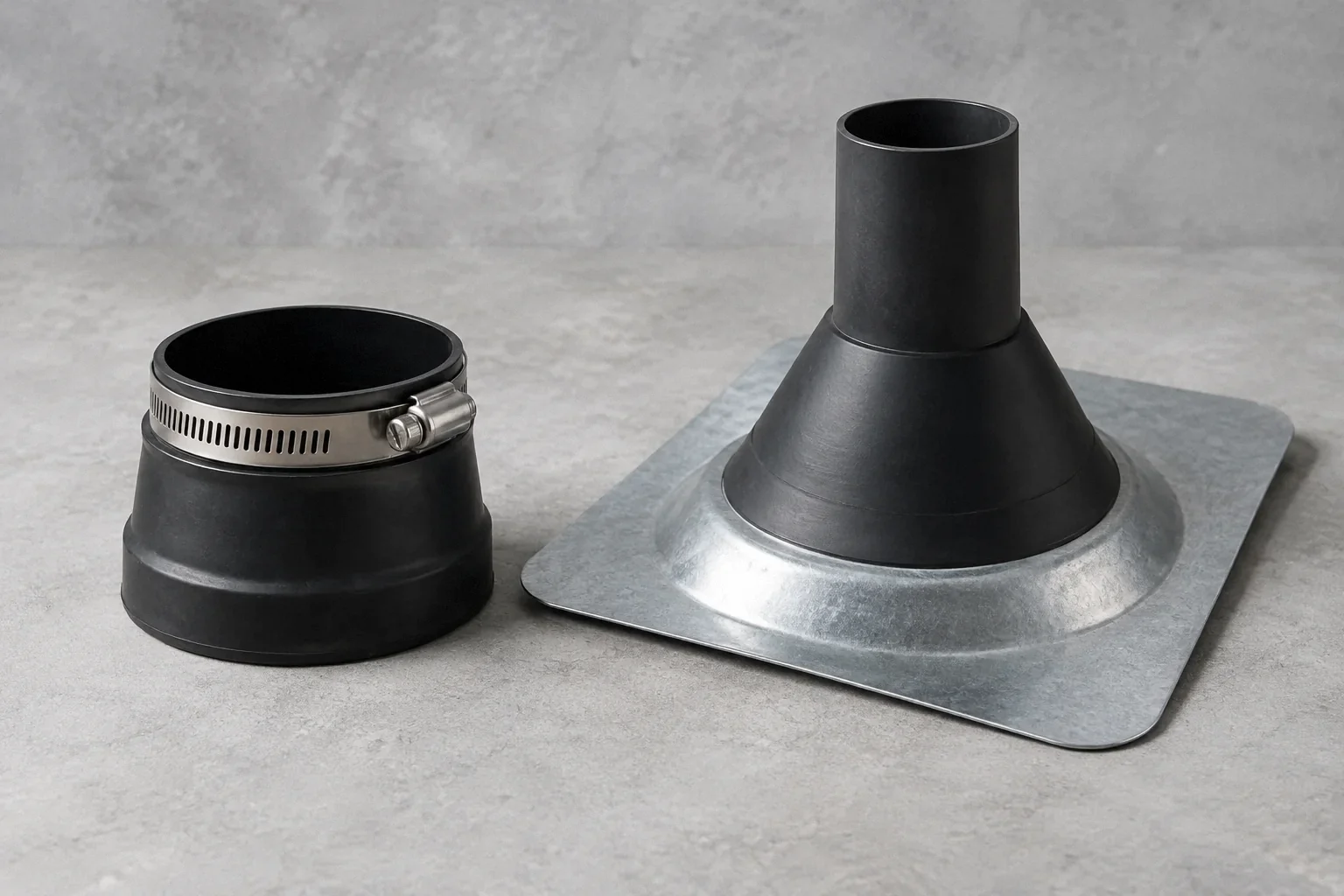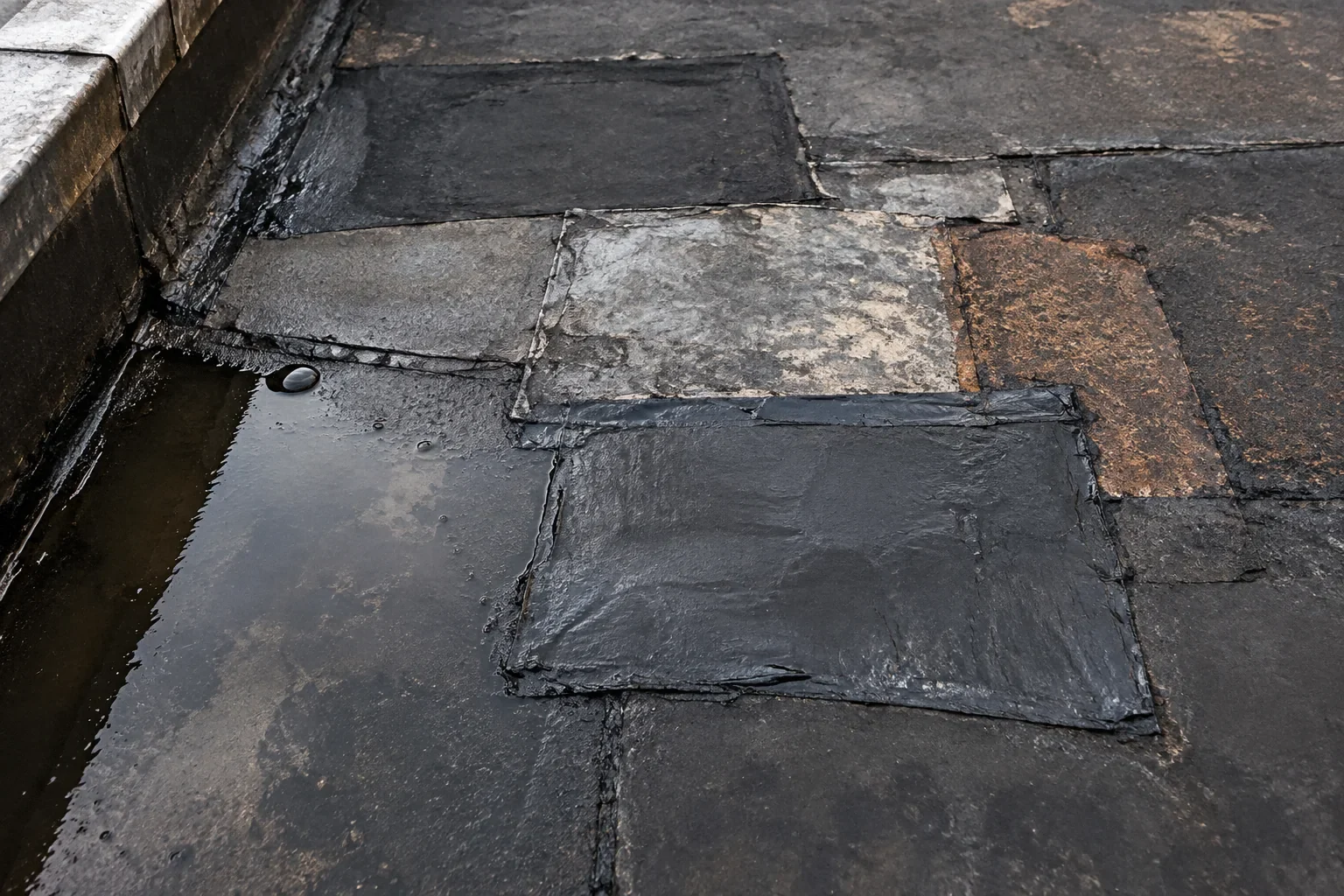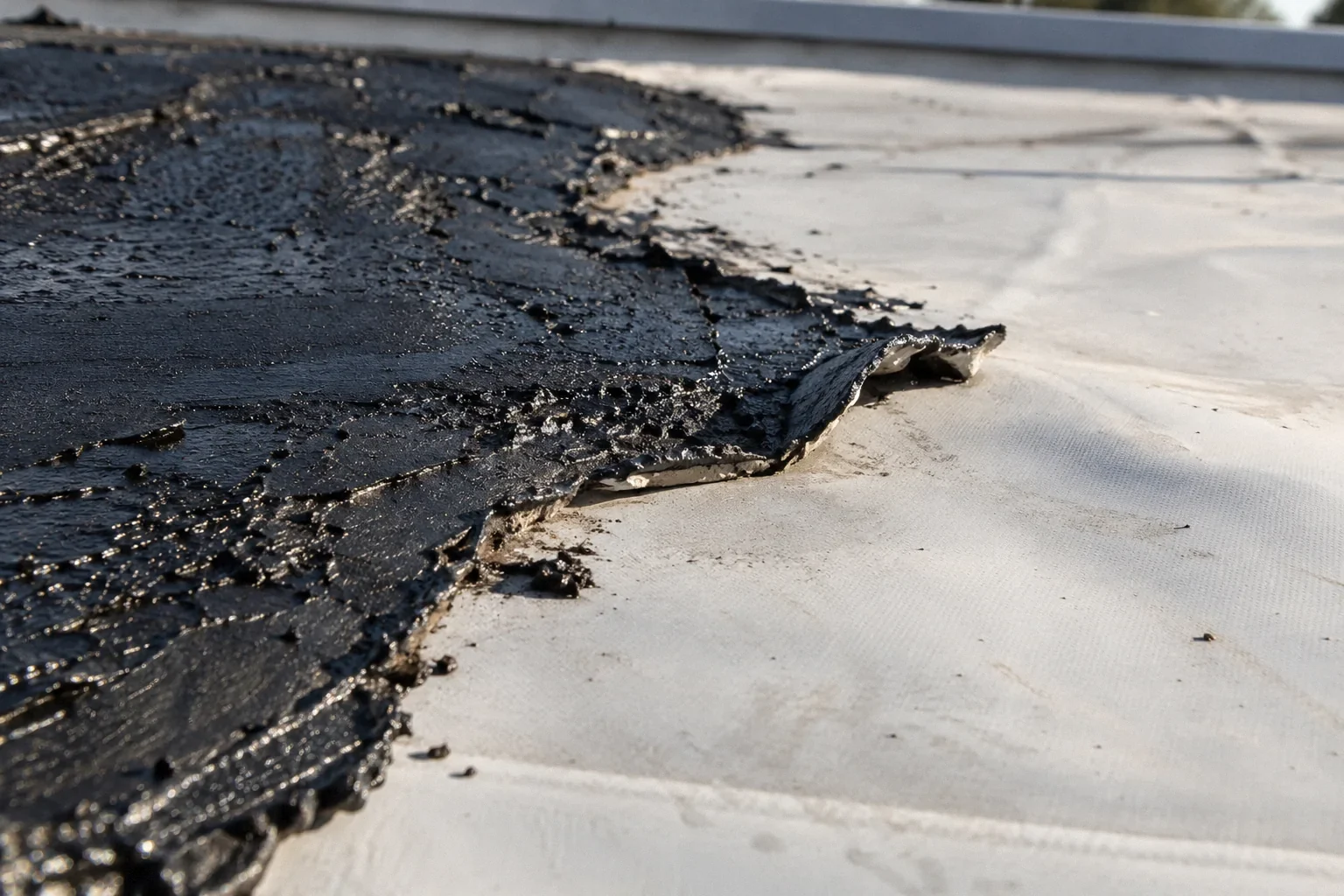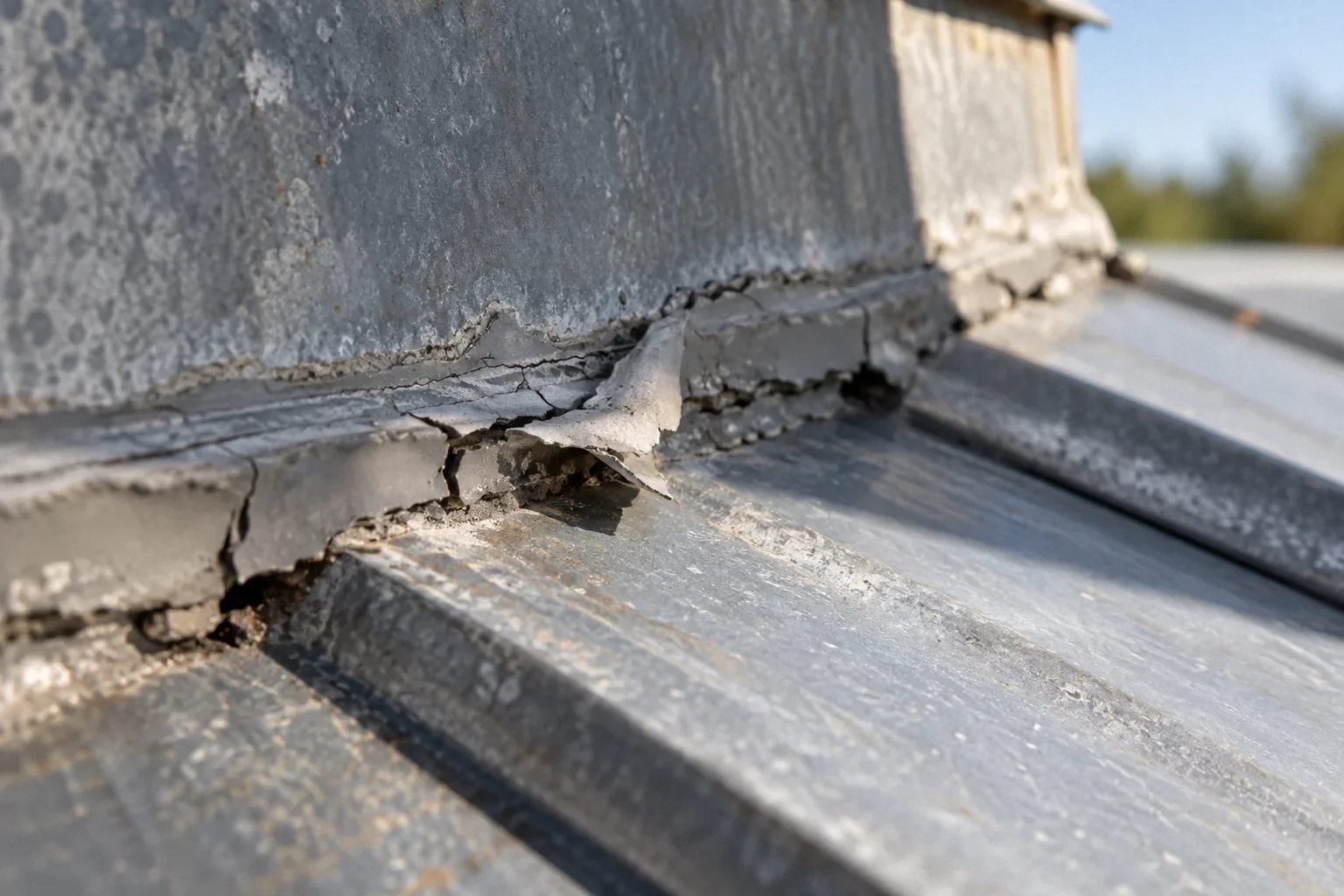
Repeated caulk failure usually means either the sealant joint was never suitable or the underlying drainage detail still directs water into a vulnerable location. Sealants have legitimate uses within specified roof systems. They are not a substitute for correctly integrated flashing, compatible materials and a route for water to leave the detail.
A sealant joint is not the whole drainage detail
A roof detail works as a sequence of water-shedding layers. At a pipe, wall or curb, the flashing must connect that sequence across the interruption. PNNL emphasizes overlapping or sealed water-control layers that direct water down and out. [1] A surface bead placed over an incorrect overlap can hide the defect temporarily without changing its geometry. Once the bead separates, the original entry path is still present.
Other explanations to distinguish
Not every failed sealant application means the flashing is wrong. Movement, incompatible products, contaminated surfaces, deteriorated substrate and an actual joint beyond the visible repair can all matter. Conversely, an apparently intact bead does not prove the area is watertight; water may arrive behind it. Avoid diagnosing product quality from color or appearance alone. The installer should identify both the substrate and the intended joint function.
Evidence to request before choosing the work
Collect the repair dates, product names if available, and photographs showing the detail before it accumulated layers of patching. Ask whether the flashing flange, laps and surrounding covering can be assessed without removal. A proposal should state what will be exposed, which components will be replaced and how the new detail will connect to existing materials. The fact that a roof was recently installed does not establish that every penetration was renewed.
A useful repair photograph shows the connection before fresh sealant hides it. Ask which interface the product is intended to seal and whether that interface is part of the supported detail. If the explanation cannot identify the joint, the product name alone adds little confidence. Preserve previous photographs because repeated applications can make the original water path progressively harder to see.
How the findings change the repair decision
A limited sealant renewal can be reasonable where the original detail is sound and the product is prescribed for that joint. Reflashing is the stronger option where the water path is incorrect, the flashing is damaged or its integration cannot be trusted. Whole-roof replacement needs its own condition evidence. The choice is not simply inexpensive caulk versus a complete new roof; a properly scoped local reconstruction may address the actual failure.
A practical example and what it does not prove
One owner reports that caulk around a vent did not stop a slow leak, then receives a recommendation to replace the entire roof. That sequence appears in the sampled Reddit discussion. [2] The question to resolve is whether the leak belongs to a local boot-and-shingle detail or to broader deterioration. A second investigation can request that distinction explicitly without assuming that either the patcher or the replacement salesperson is correct.
Limits and when professional review matters
Do not peel away old repairs, mix sealants or seal every visible opening as a homeowner experiment. Some exposed edges are part of intended drainage, and different roof systems have different detailing rules. Material selection should follow the actual manufacturer detail. Stop treating repeated failure as a maintenance routine when it is damaging interior materials; obtain a repair plan with an identifiable mechanism and verification scope.
Ask what the sealant is being asked to accomplish
There is a difference between renewing a specified joint and building an improvised barrier over a water path. The first has an identifiable interface and product requirement. The second often lacks an explanation of how the underlying assembly works. Ask the roofer to describe the detail before naming a product. A technically clear explanation can be brief, but it should identify the parts being connected.
The repair history matters when several different compounds overlap. The next contractor needs to know what remains and whether the chosen repair can connect to it. If the existing materials are unknown, state that uncertainty rather than assuming the newest compound can adhere to everything below. Local removal and reconstruction may provide a clearer endpoint than another layer of unspecified material.
- A supported joint has deteriorated while adjacent flashing remains sound: evaluate a specified renewal rather than assume reconstruction.
- The visible bead covers an incorrect overlap: ask for correction of the layer relationship, not a stronger bead.
- Several unidentified patches obscure the flange: define how the original detail will be assessed before selecting the next product.
Separate three different uses of a roof sealant
First, a sealant can be part of a specified connection between known materials. In that situation, the question is whether the joint and product conform to the intended detail. Second, it can be a temporary protective intervention whose limitations are understood. Third, it can be an improvised substitute for missing or incorrectly connected flashing. Those are different functions even if the material arrives in a similar container.
For a specified joint, ask what surface condition or movement concern explains the failure. For temporary protection, ask what permanent component still requires correction. For an improvised barrier, ask how the rebuilt detail will manage water without depending on the same unsupported geometry. This classification helps an owner understand why one sealant renewal may be reasonable while another merely repeats the earlier mistake.
The important evidence is therefore not the size of the bead. It is the relationship among the roof covering, flashing and penetration or wall. A repair proposal should identify which relationship changes. If all that changes is the product brand, the contractor should explain why product selection was the actual failure mechanism. If the geometry changes, the completed record should show that change before another surface layer hides it. This makes a local repair assessable without assuming that all sealants are bad or every failed patch requires a new roof.
What to take away
- Ask whether the joint or the underlying water-shedding geometry has failed.
- Request the product and detail specification rather than another unspecified caulk repair.
- Evaluate local reflashing before accepting an unsupported whole-roof replacement claim.
Sources & further reading
Reddit links show the questions people ask; they do not establish a diagnosis or a legal requirement. Technical requirements depend on the product, building and jurisdiction. See our research approach.
- PNNL penetration flashingTechnical / official reference
Water-control continuity and penetration detailing; avoid treating illustrated assembly as universal code
- Homeowner discussion: Moms roof is leaking at this vent looking thingCommunity question · anecdotal
Anecdotal issue research, not technical authority or proof about another property.
- Homeowner discussion: Leak around vent pipeCommunity question · anecdotal
Anecdotal issue research, not technical authority or proof about another property.
Planning a Bay Area project?
Explore YKCA’s website and discuss the scope and services you need directly with them.