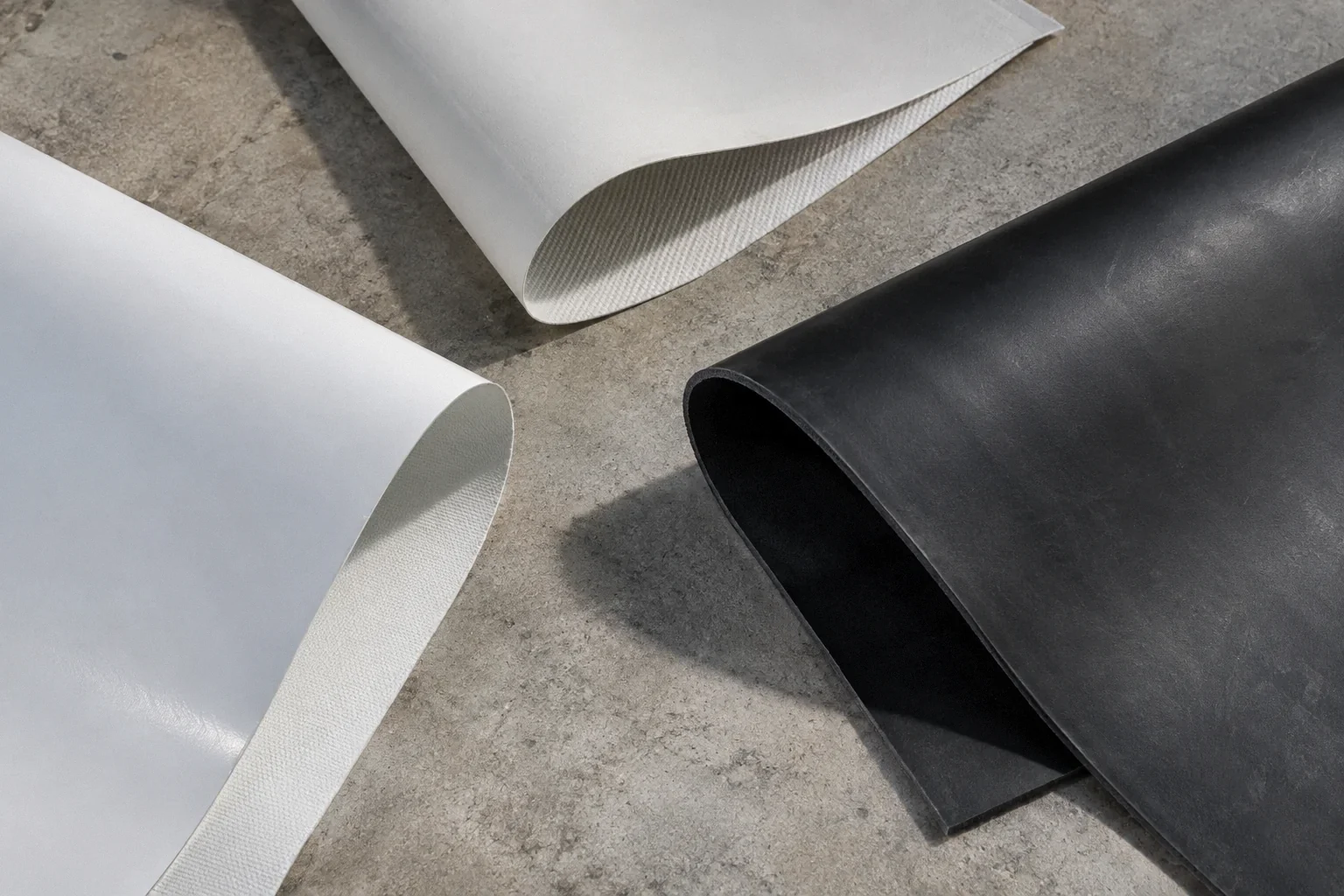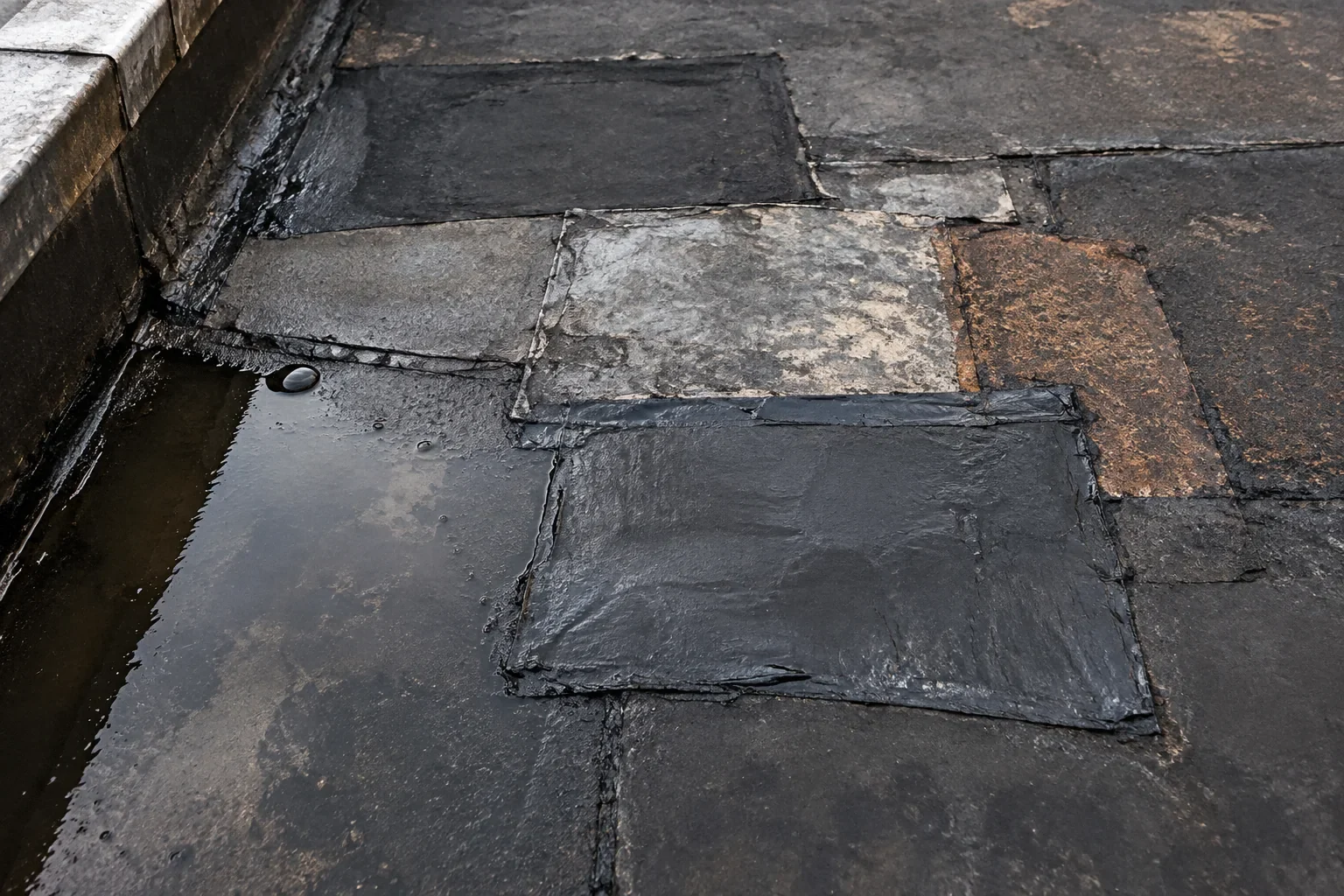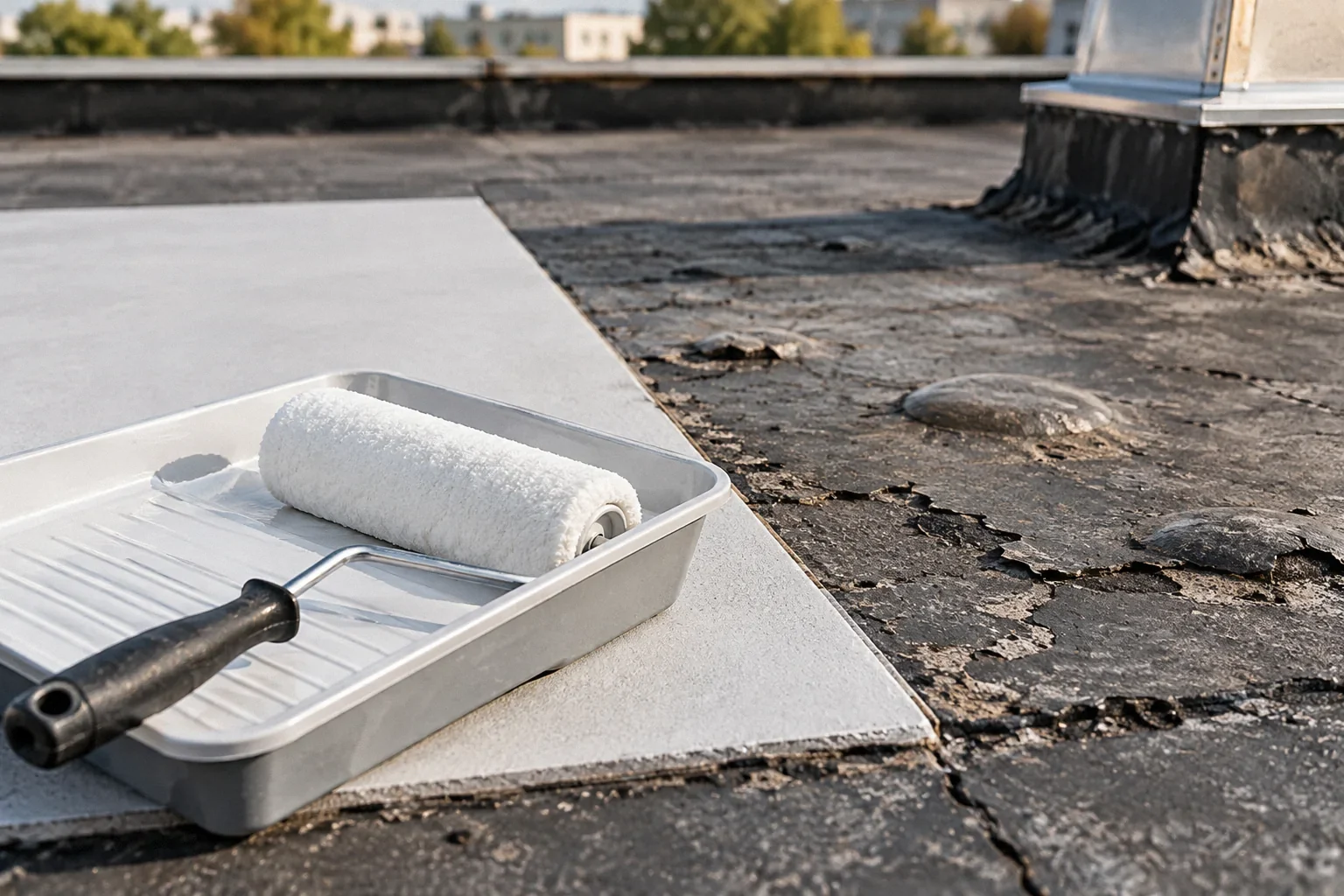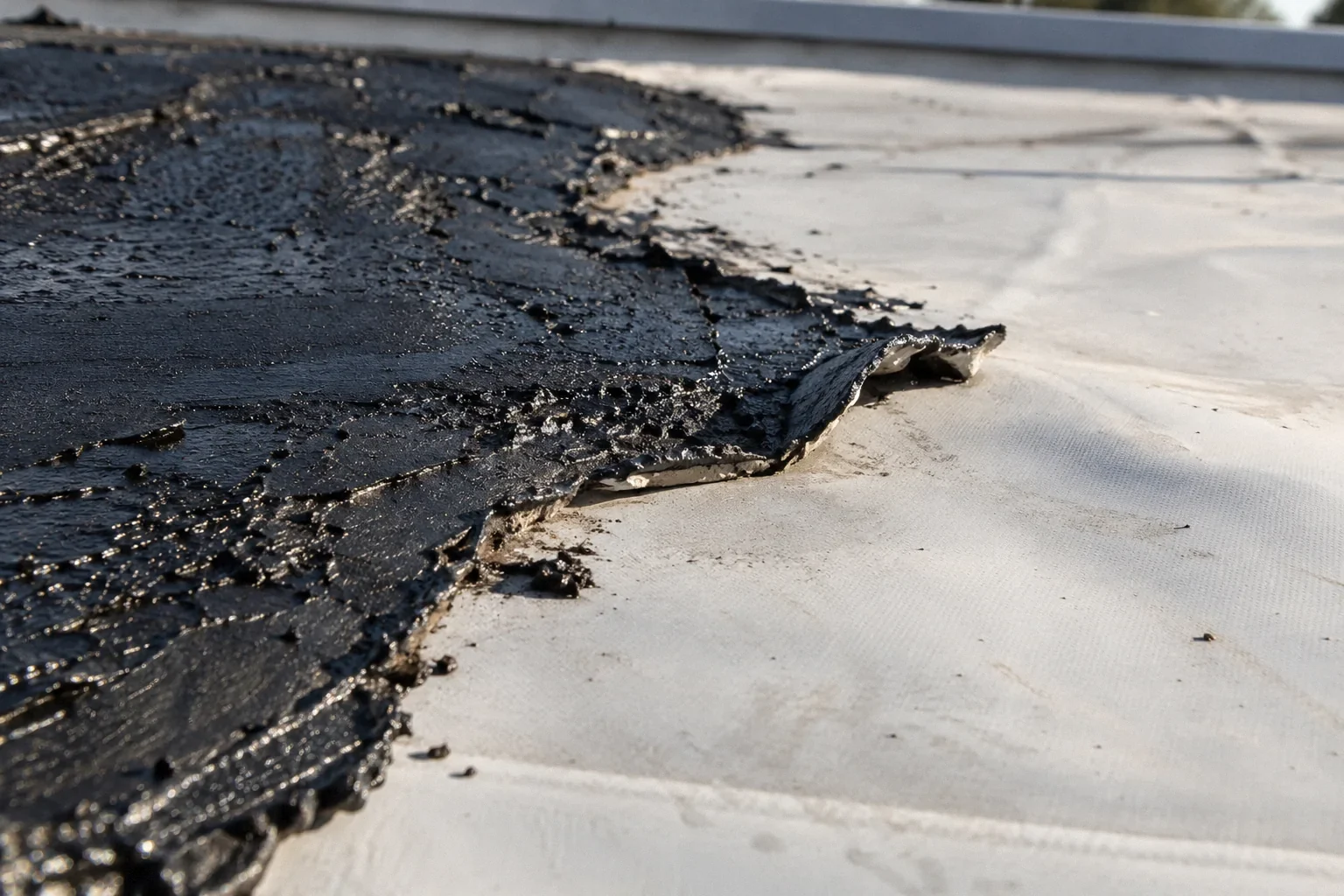
When an unknown tar, coating or sealant has been applied to a membrane roof, identify both the original roof and the repair material before choosing the next step. A visible patch may be unsuitable, but appearance alone cannot establish the chemical interaction or the full extent of damage. Ask the roof manufacturer or a qualified system specialist for an applicable repair method.
Identify the original layer before adding another
A membrane repair has to connect reliably to the existing water-control layer. [1] That requires knowing what the layer is and whether the surface is still suitable for the proposed connection. Additional coatings can obscure seams and product markings. Even when an incorrect patch stops the immediate drip, it may make later inspection or repair more complicated.
Other explanations to distinguish
Cracking, swelling, separation or continued leakage near a patch can reflect incompatible material, poor preparation, movement or a preexisting defect that was never corrected. The same visual symptom can have several causes. Do not turn a Reddit statement about one material combination into a universal chemical rule. The exact membrane, patch compound, exposure and condition matter.
Evidence to request before choosing the work
Collect invoices, labels, leftover containers and installation photographs if available. Ask the inspector to distinguish identifiable products from assumptions. The proposed investigation should address the area beneath and around the patch, including potentially affected insulation or substrate where relevant. A manufacturer response is most useful when it describes the actual materials and condition, rather than answering a vague question about black tar on a white roof.
If labels or invoices cannot establish the patch material, ask how the manufacturer or specialist proposes to resolve the uncertainty. The answer may change the practical repair boundary. Do not accept a definitive compatibility statement based only on a photograph. Recording an unknown honestly is better than assigning the wrong product name and passing that mistake to the next contractor.
How the findings change the repair decision
Possible outcomes include a supported local repair, removal and replacement of an affected section, or a broader project where damage is extensive. The contractor should explain why the proposed repair can bond or connect to the remaining material and how its perimeter will be detailed. Simply covering the old patch with a different product does not establish compatibility or remove hidden moisture.
A practical example and what it does not prove
In the sampled discussion, an owner described black patch material on a TPO roof followed by unusual cracks and bumps. [2] The editorial lesson is to seek product-specific assessment, not to repeat the commenter's chemical diagnosis as established fact. A reasonable second opinion would identify the roof, assess the altered area and compare local reconstruction with wider replacement using documented condition evidence.
Limits and when professional review matters
Do not scrape, solvent-clean or heat an unidentified patch yourself. These actions can damage the membrane and introduce exposure or fire hazards. Likewise, do not assume every black material is asphalt or every white sheet is TPO. The roof record should preserve confirmed product identity for future maintenance, because repeated guessing is itself a preventable source of poor repair decisions.
Product identity is part of the repair boundary
An owner may know the roof by a broad name while the existing patch remains unidentified. The specialist needs both identities, or an explicit method for handling the uncertainty. Ask whether the proposed connection relies on adhesion to the patch, to the original membrane or to a newly reconstructed area. Those are different repair assumptions and should not be hidden inside the phrase seal the roof.
If the manufacturer cannot support a connection to the existing material, the proposal should explain the alternative endpoint. This does not automatically require whole-roof replacement. It does require a reasoned boundary where the new work can connect to suitable remaining components. The surrounding assembly and potentially affected concealed materials belong in that assessment.
- The original membrane is known but the patch is not: resolve or explicitly account for that uncertainty before choosing a connection method.
- The proposal bonds new material directly to an altered surface: request the technical basis for doing so.
- Local reconstruction is recommended: ask how the contractor establishes a suitable perimeter beyond the affected area.
Questions that resolve the remaining uncertainty
A manufacturer response should be saved with the facts supplied to obtain it. Advice based on a named membrane and known patch is not automatically applicable when either identification changes. If the contractor discovers a different material during opening, the repair method may need review. Keeping the original question with the response prevents technical guidance from being applied outside the conditions it actually addressed.
Compatibility is a connection question, not a color test
The proposed repair may connect to original membrane, an existing patch or a newly reconstructed section. Identify which surface carries that connection. If the surface is unknown or altered, ask what supports the selected method. A product described as roof sealant does not establish suitability for every one of those interfaces, and visually similar membranes can belong to different systems.
Removal itself also needs a supported endpoint. A contractor should explain how the affected area will be bounded and how the new work will meet suitable retained material. That can lead to a local reconstruction without implying that the whole roof must be discarded. Conversely, a small visible patch does not prove that every material beneath or beside it remains suitable.
If the roof manufacturer gives advice, preserve the product identities and condition description used to obtain it. An answer based on a known combination cannot automatically be transferred to a different patch discovered during opening. The contractor may need to revise the method when the facts change. This is a reason to document the actual materials, not a reason to declare every uncertain repair chemically damaged from a photograph. A precise local repair plan should replace the uncertainty with an identified compatible connection.
What to take away
- Identify both the original membrane and the added repair product.
- Obtain a product-specific repair method rather than a color-based diagnosis.
- Base removal limits on affected material condition, not the visible patch outline alone.
Sources & further reading
Reddit links show the questions people ask; they do not establish a diagnosis or a legal requirement. Technical requirements depend on the product, building and jurisdiction. See our research approach.
- PNNL penetration flashingTechnical / official reference
Water-control continuity and penetration detailing; avoid treating illustrated assembly as universal code
- Homeowner discussion: Can this roof be repaired or need completely replaced?Community question · anecdotal
Anecdotal issue research, not technical authority or proof about another property.
Planning a Bay Area project?
Explore YKCA’s website and discuss the scope and services you need directly with them.