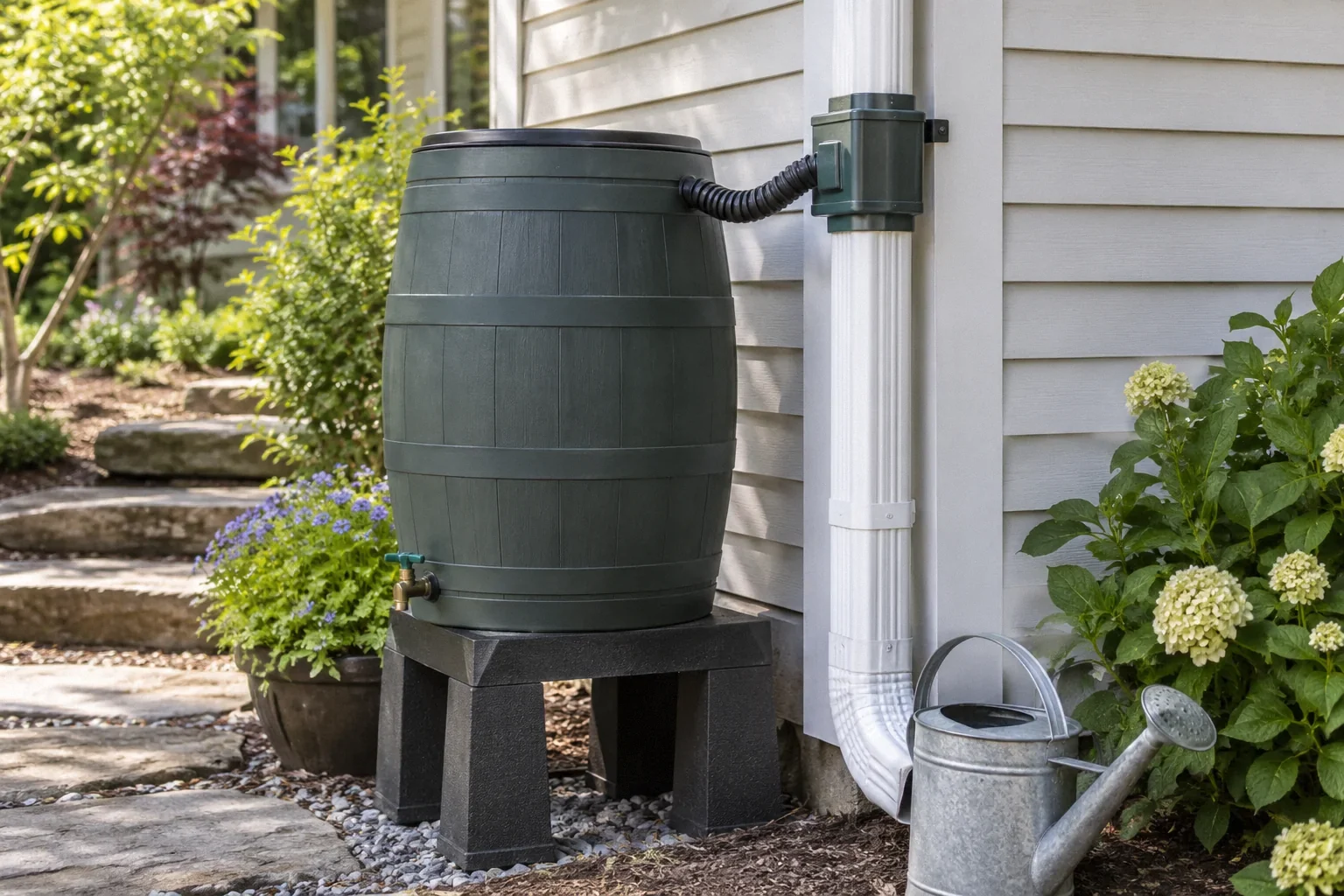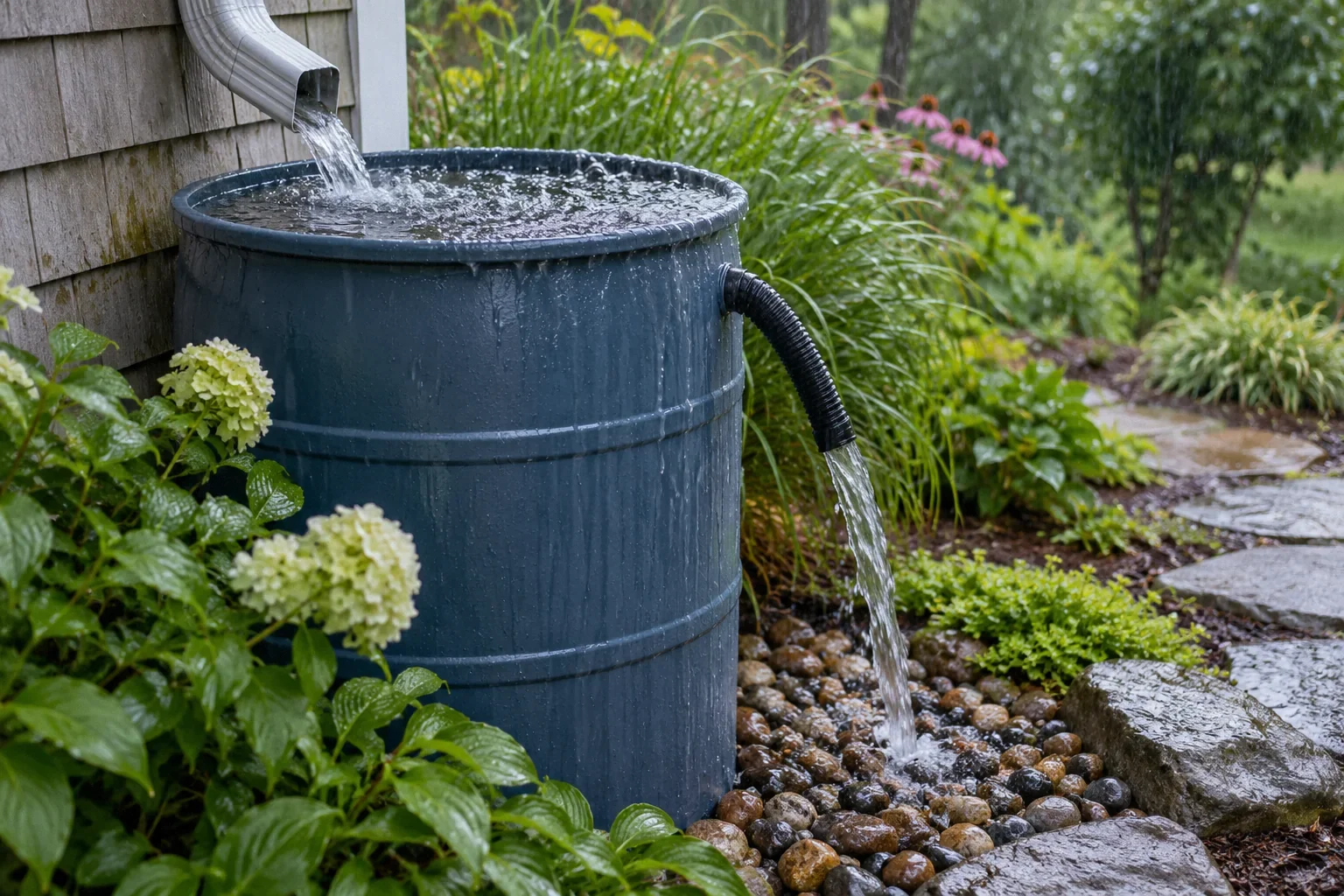
A rain barrel has finite storage and needs an appropriate overflow route once full. Calculate the roof area feeding it and consider whether stored water will be used between storms. A barrel should not replace a complete drainage plan for the full roof runoff.
Start with the full-barrel scenario
Imagine the barrel already full when the next storm begins. Where does incoming roof water go? If the answer is over the rim beside the foundation, the arrangement is incomplete. Ask the supplier or installer to show the product’s intended overflow or diversion detail and the route beyond it. Flows To Bay describes rain barrels as rainwater capture features. [1] Capture is valuable, but a limited container cannot accept unlimited inflow. The overflow route is therefore a primary design question, not a small accessory to add after installation.
The first-time barrel discussion recognizes that limited storage leaves the overflow destination unresolved. This Reddit account is anecdotal, not technical authority. [3]
Use transparent volume arithmetic
For an illustrative calculation, one inch of rain over a horizontal catchment of 1,000 square feet represents about 623 gallons before losses: 1,000 multiplied by 1/12 gives 83.3 cubic feet, then multiplied by about 7.48 gallons per cubic foot. This is geometric volume, not a measured yield from your roof. Actual collection depends on the contributing area and losses. A 55-gallon barrel serving that example catchment would store only a small fraction of the event. The example explains why overflow planning matters; it is not a sizing specification for an unknown property.
Count only the roof feeding that downspout
The whole house footprint may not match the relevant catchment. Valleys, roof levels and outlet locations determine which roof planes contribute. Ask for a simple sketch and use the appropriate horizontal projected area in any volume estimate. If several barrels are linked, the connection arrangement and usable storage still need product-specific review. Do not assume nominal container volumes all remain available before every storm. Water left from the previous event reduces available storage, which is why actual use between storms matters.
Choose the overflow destination before the barrel location
A convenient corner near a garden may be unsuitable if overflow returns toward the house or crosses an access route. PNNL explicitly includes overflow management in rainwater-harvesting arrangements. [2] Ask how water behaves when the receiving area is saturated and whether local requirements affect the discharge. Connecting a small hose to a convenient opening does not prove it can serve the intended overflow function. The product and complete route should be reviewed together, including how the system behaves if an opening becomes obstructed.
Separate conservation goals from flood-control expectations
A barrel can provide useful irrigation water without solving a yard’s drainage problem. Decide what success means: reducing some runoff, supplying nearby plants or supporting a broader capture system. Avoid promising large summer savings from a small winter-only storage arrangement without a water-use and rainfall analysis. Also consider access for maintenance, stable support and the manufacturer’s requirements for openings and screening. Use local program guidance for appropriate uses of collected roof water rather than assuming it is suitable for every household or garden use.
Observe and maintain the entire connection
After installation, inspect accessible connections and the receiving area from safe ground during rain. Confirm that overflow follows the intended route when storage fills. Keep the product instructions and a maintenance schedule. If the barrel repeatedly overflows at the rim, investigate the diversion or overflow arrangement rather than simply draining it more often. Emptying storage before a storm can increase capacity, but it is not a substitute for an appropriate full-condition route. Any release also needs a suitable destination.
Compare storage options without overselling the result
A larger container or linked set can increase storage, but the useful amount depends on how much space is available before rain and how the water will be used. Ask whether the proposed arrangement solves your conservation goal, drainage goal or both. A modest barrel may be worthwhile for convenient irrigation while remaining too small to change a major runoff problem substantially. That is a valid outcome if the expectation is clear.
For a seasonal climate, consider the timing of supply and demand. Water collected during wet periods may not remain available through a long dry season unless storage and use are planned accordingly. Do not infer annual savings from nominal barrel size alone. The calculation would need rainfall, contributing area, available storage and actual demand assumptions.
Keep the overflow design independent of optimistic use estimates. Even a conscientious owner may leave the barrel full before a storm. The installation should have an appropriate route in that condition. This makes the system more robust in everyday use and avoids turning routine irrigation into a required emergency drainage action.
When reviewing the numerical example, keep rainfall depth separate from rainfall rate. Total depth helps estimate event volume, while how quickly water arrives affects collection and overflow behavior. The simple volume calculation does not establish the size of an overflow connection or the capacity of a diverter. Those require the relevant product information and site-specific design basis. Ask the installer to explain that distinction if a storage calculation is used to justify the whole system. Also avoid treating the roof’s nominal area as exact when only a rough sketch was used. Label approximate inputs and use the calculation to understand scale, not to claim measured performance. This keeps a helpful arithmetic example from becoming a false guarantee about how a particular barrel will behave during a particular storm.
| Decision area | Question or evidence |
|---|---|
| Nominal storage | Container volume, not guaranteed available space |
| Available storage | Capacity remaining when rain begins |
| Useful yield | Water actually collected and used under stated assumptions |
| Overflow | Route required after storage fills |
Example: a barrel beside a narrow entry
Imagine a barrel placed by the front door because the downspout is convenient. It fills, and water spills onto the entry paving and toward the wall. Adding a second barrel may delay the same event but does not establish a safe overflow route. The better review starts with where excess water can appropriately go, then checks whether the barrel location and product arrangement support that route. If the desired location cannot accommodate it, a different capture point may be more practical than increasingly complicated connections at the doorway.
Keep the assumptions with the installation
Record the catchment used for any calculation, nominal storage, intended use and full-condition route. Keep the actual product instructions and identify maintenance access. This makes later additions easier to evaluate without assuming the first installation was designed for extra connected roof area.
- What happens when storage is full before the next storm?
- Which roof planes feed the barrel?
- Where does overflow go when the receiving landscape is wet?
What to take away
- Design for a barrel already full when rain starts.
- Use the actual contributing roof area in volume estimates.
- Separate useful water storage from complete drainage control.
Sources & further reading
Reddit links show the questions people ask; they do not establish a diagnosis or a legal requirement. Technical requirements depend on the product, building and jurisdiction. See our research approach.
- San Mateo Countywide Water Pollution Prevention Program: Rain Barrels & Rebate ProgramTechnical / official reference
Capture, maintenance and regional water-quality context; avoid quoting incentive amounts.
- DOE/PNNL: Gutters and DownspoutsTechnical / official reference
Roof-water system components, material tradeoffs, separation from footing drain; program-specific distances are not universal local code.
- Reddit discussion: Advice for first timers?Community question · anecdotal
Anecdotal homeowner discussion used to identify the question; not technical authority or evidence of this property’s condition.
Planning a Bay Area project?
Explore YKCA’s website and discuss the scope and services you need directly with them.