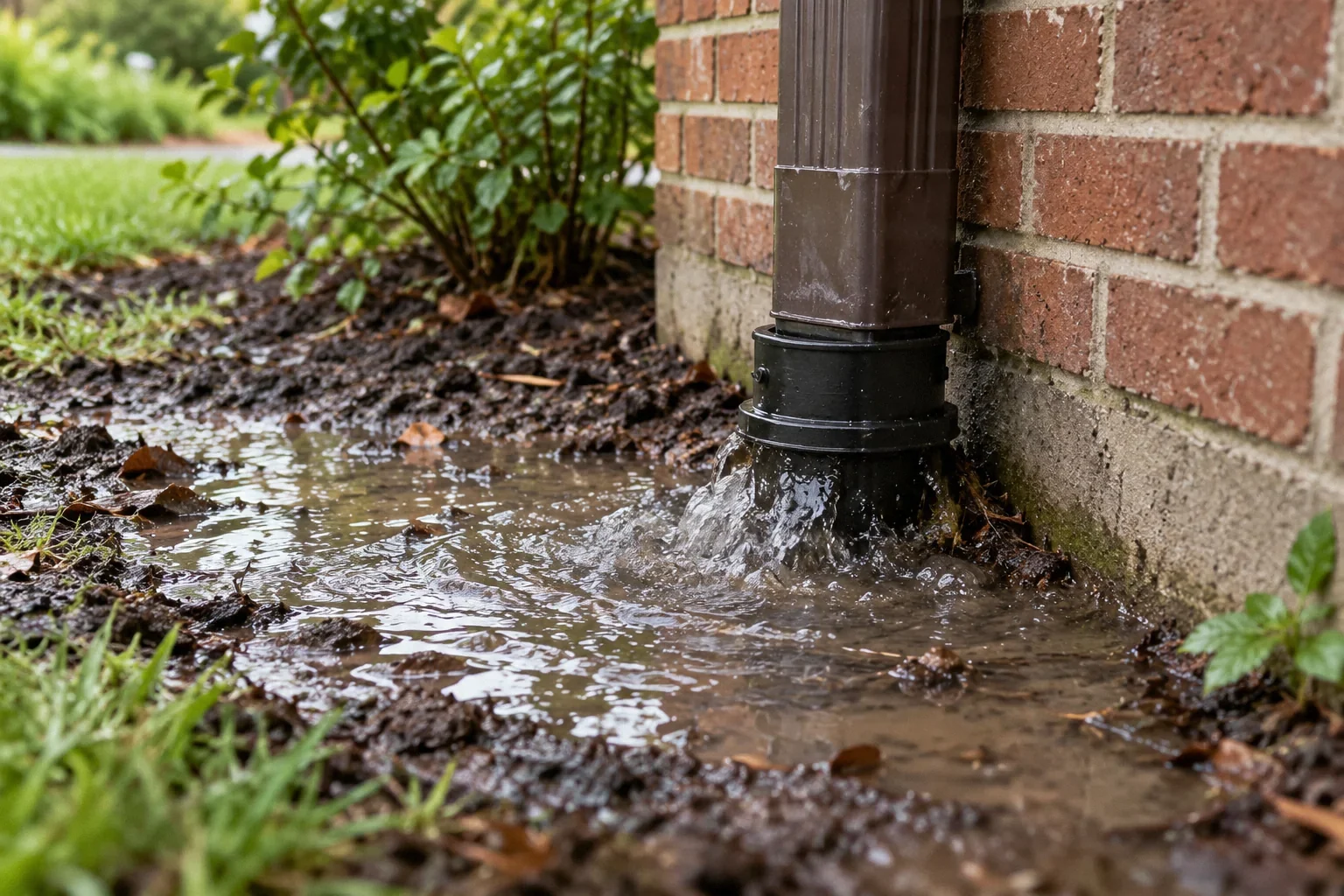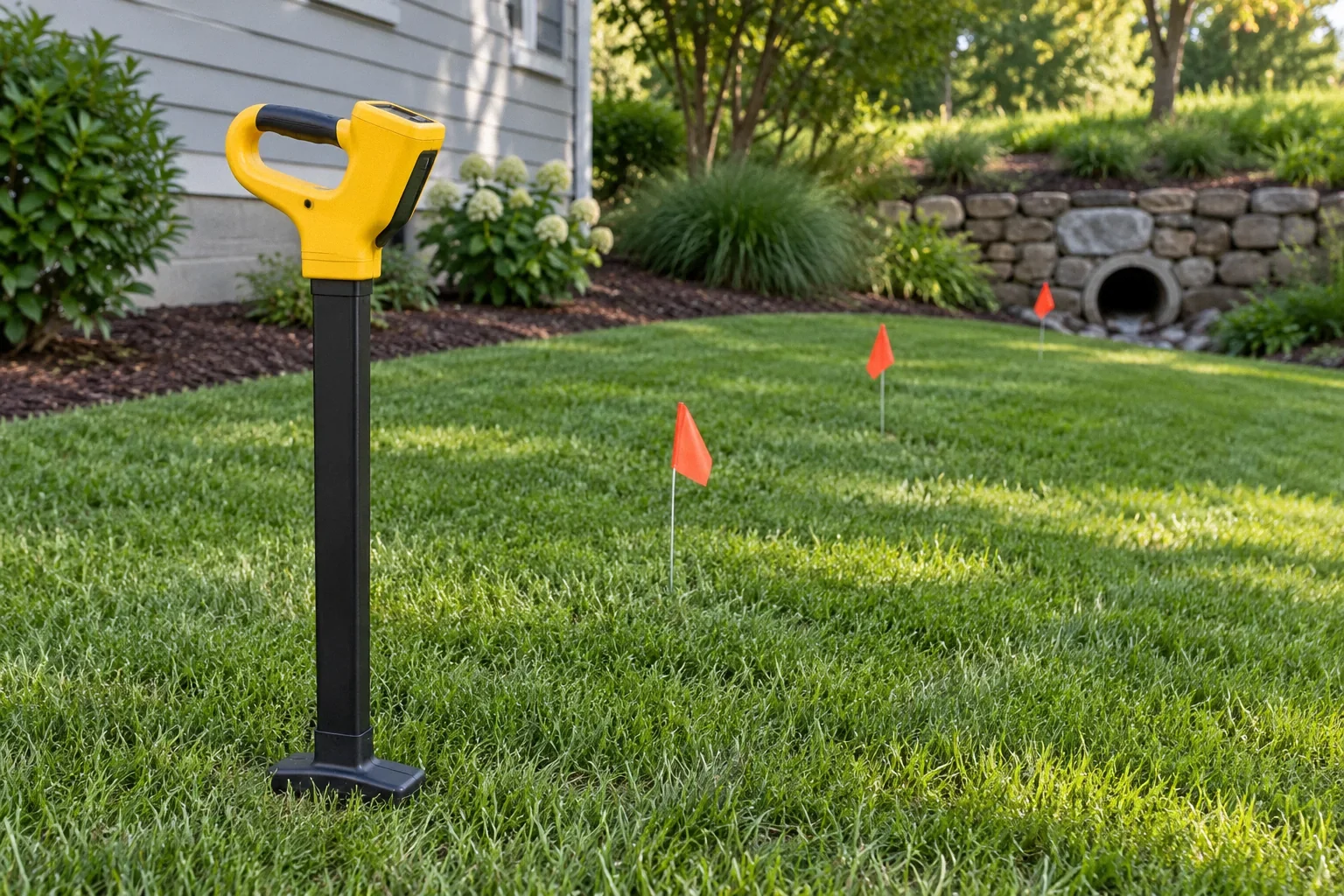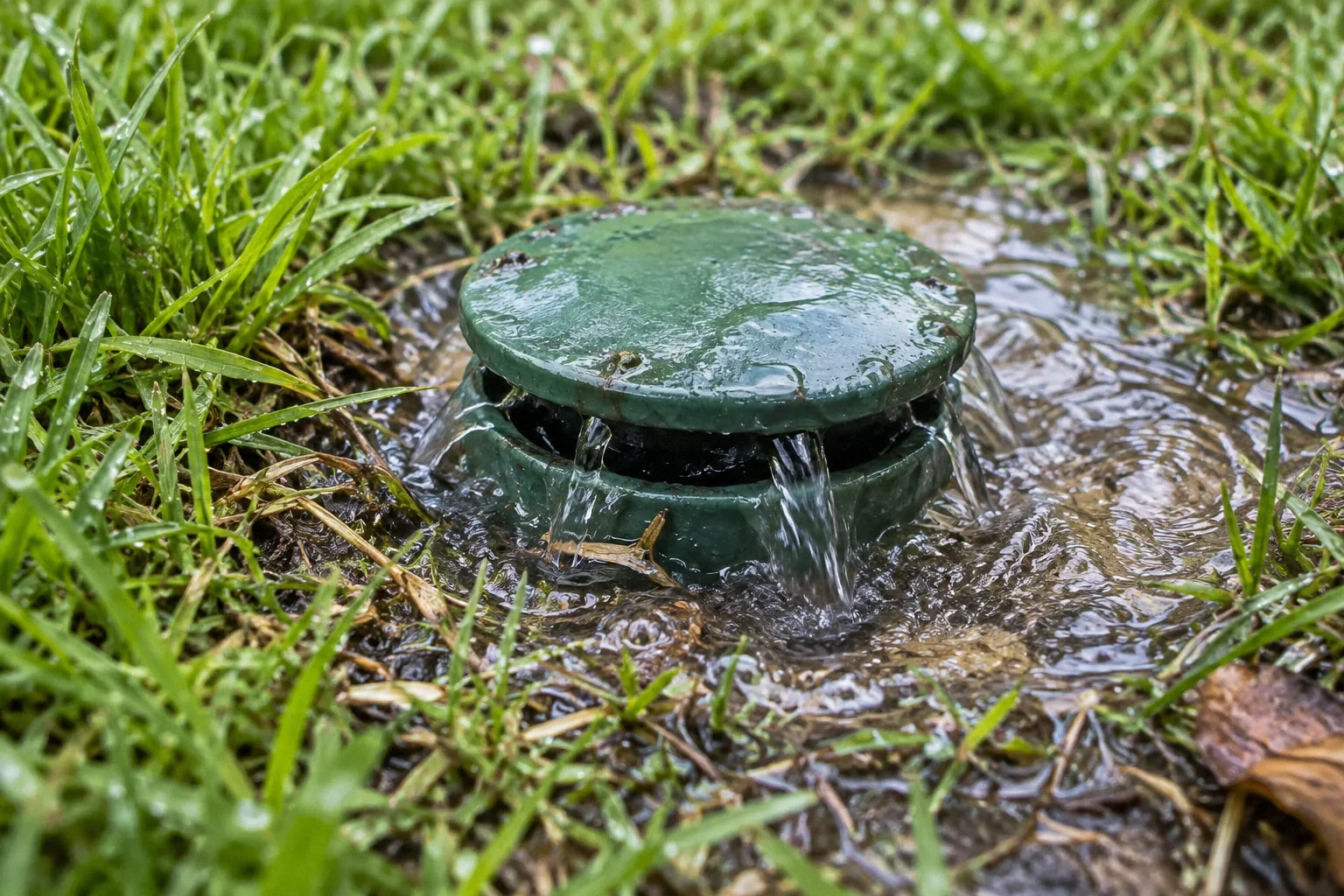
A pop-up emitter is the discharge end of a drainage route. If water remains upstream, inspect the cap, surrounding grade, sediment and receiving conditions along with the pipe. Replacing the visible top cannot correct every upstream or outlet problem.
Identify the component and its route
Find the installed model if possible and determine which inlets feed it. A green round cover in the yard may be familiar, but do not assume its exact operation from appearance alone. Keep the manufacturer’s instructions with the drainage records. NDS describes emitters as discharge components. [1] The practical implication is that the visible cap is only one part of the system. An assessment should connect it to the upstream pipe and the surrounding surface rather than treating it as an isolated accessory.
The buried-drain discussion leaves its outlet unidentified, a question that must precede choosing an emitter remedy. This Reddit account is anecdotal, not technical authority. [2]
Observe whether discharge occurs during the complaint
From safe ground, note whether the emitter opens and water leaves while an upstream inlet is backing up. If the yard around it is already flooded, document that condition too. A dry-weather check may not reproduce the receiving conditions of a long storm. Do not conclude that the cap is defective just because it remains closed when little or no water is arriving. The useful observation includes both ends of the route and the timing of the reported problem.
Keep the surrounding surface part of the inspection
Grass, soil, mulch and later landscape changes can affect a discharge area. Ask whether the emitter’s location and surrounding grades remain consistent with its intended installation. A decorative border or raised bed added after the drain can alter where released water travels. The goal is not simply to make the cap visible; it is to preserve an appropriate receiving route. If water returns toward the house or collects over the outlet, the assessment needs to consider the site beyond the plastic component.
Distinguish cap maintenance from line service
Accessible debris at the emitter may be a local maintenance issue, while sediment farther upstream or damaged piping requires a different response. Ask the provider to identify which condition was found. Manufacturer instructions should guide any removal or reassembly of the specific component. Do not force unfamiliar parts or insert improvised tools into the route. If the cap repeatedly becomes obstructed, review how debris enters upstream rather than replacing the same part repeatedly. A clean visible top does not establish that the buried carrier is clear.
Ask what happens after water is released
An emitter can operate while the receiving landscape erodes or remains saturated. Record the downstream surface path and its relationship to buildings, paths and property boundaries. A rain garden or other receiving feature may be suitable only after site-specific review; adding one is not simply a matter of planting around the outlet. If the discharge creates a recurring off-property problem, consult the appropriate local authority and drainage professional. Changing the cap does not resolve questions about where the water is allowed or able to go.
Document a meaningful completion check
After service, request a record of what was cleaned or replaced and whether water was observed at the emitter. Note the test conditions and the upstream access point used. A later natural-rain observation should compare the original backup and the receiving area. If the line still surcharges, retain the possibility of an upstream or elevation problem. The completion record should avoid claiming full system capacity from a brief demonstration that only showed the cap opening once.
Avoid treating the cap as the entire outlet
An emitter’s visible opening, the connected pipe and the receiving landscape work together. A replacement part can be correctly installed while the area remains unable to carry released water away. Ask the service provider to identify which of those three elements was evaluated. The answer should distinguish product maintenance from a site-drainage recommendation.
If a cap appears damaged, retain the model information and ask for a compatible replacement rather than selecting by color alone. If the component appears intact but the line backs up, ask what evidence points to a cap problem. A symptom at the outlet can reflect insufficient arriving flow, an upstream restriction or receiving conditions; the inspection needs to separate them.
After a landscape change, compare the outlet’s position with the new surface. Even when the cap remains visible, edging or soil can redirect water after it leaves. Keep the outlet area in the maintenance plan and inform landscape workers of its role. This is especially useful where seasonal mulch or plant growth gradually changes the apparent ground level.
If the emitter is replaced, ask what changed besides the visible part. A new cap may be appropriate for a damaged component, but the invoice should not imply that the connected line was inspected if it was not. Conversely, a line-cleaning service may leave the existing emitter in place because it remains suitable. The completion record should separate those outcomes. When the problem occurs only after prolonged rain, a later observation of the receiving area is particularly useful. Note whether water surrounds the outlet before the upstream backup begins. That timing can help the professional assess the next question without proving a cause by itself. Keep the photographs wide enough to show surrounding ground and nearby structures, since a close image of an open cap omits the conditions most relevant to discharge.
| Decision area | Question or evidence |
|---|---|
| Visible cap | Identify model, condition and accessible obstruction |
| Connected route | Confirm upstream connections and service limits |
| Receiving area | Observe where released water travels |
| Landscape changes | Check new borders, soil and plant growth |
Example: new landscaping changes an old outlet
Suppose a drain worked before a raised planting bed was installed around its emitter. Afterward, water collects near the cap and an upstream basin drains slowly. A replacement cap may look like the easiest repair, but the timing points to the changed receiving conditions as a relevant lead. The inspection should compare the old and new grades and determine whether the outlet remains appropriately placed. That does not rule out debris or pipe damage. It establishes a specific change worth investigating before treating the component itself as the only suspect.
A small maintenance record prevents repeated guessing
Photograph the emitter in relation to fixed landscape features and label the inlets that feed it. Keep product information and service dates. If the surrounding yard is altered, include the outlet in the planning discussion so its function is not accidentally buried or obstructed.
- Which upstream inlets connect to this emitter?
- Can water leave the receiving area without returning or eroding it?
- What exactly was verified during the service test?
What to take away
- Observe the emitter and upstream inlet during the same event.
- Review landscape changes around the discharge area.
- Separate cap service from buried-pipe and receiving-area problems.
Sources & further reading
Reddit links show the questions people ask; they do not establish a diagnosis or a legal requirement. Technical requirements depend on the product, building and jurisdiction. See our research approach.
- NDS manufacturer: What Is a Pop-Up Emitter?Technical / official reference
Outlet operation and sediment/leaf maintenance.
- Reddit discussion: Underground drain filled with roots - Do I keep digging?Community question · anecdotal
Anecdotal homeowner discussion used to identify the question; not technical authority or evidence of this property’s condition.
Planning a Bay Area project?
Explore YKCA’s website and discuss the scope and services you need directly with them.