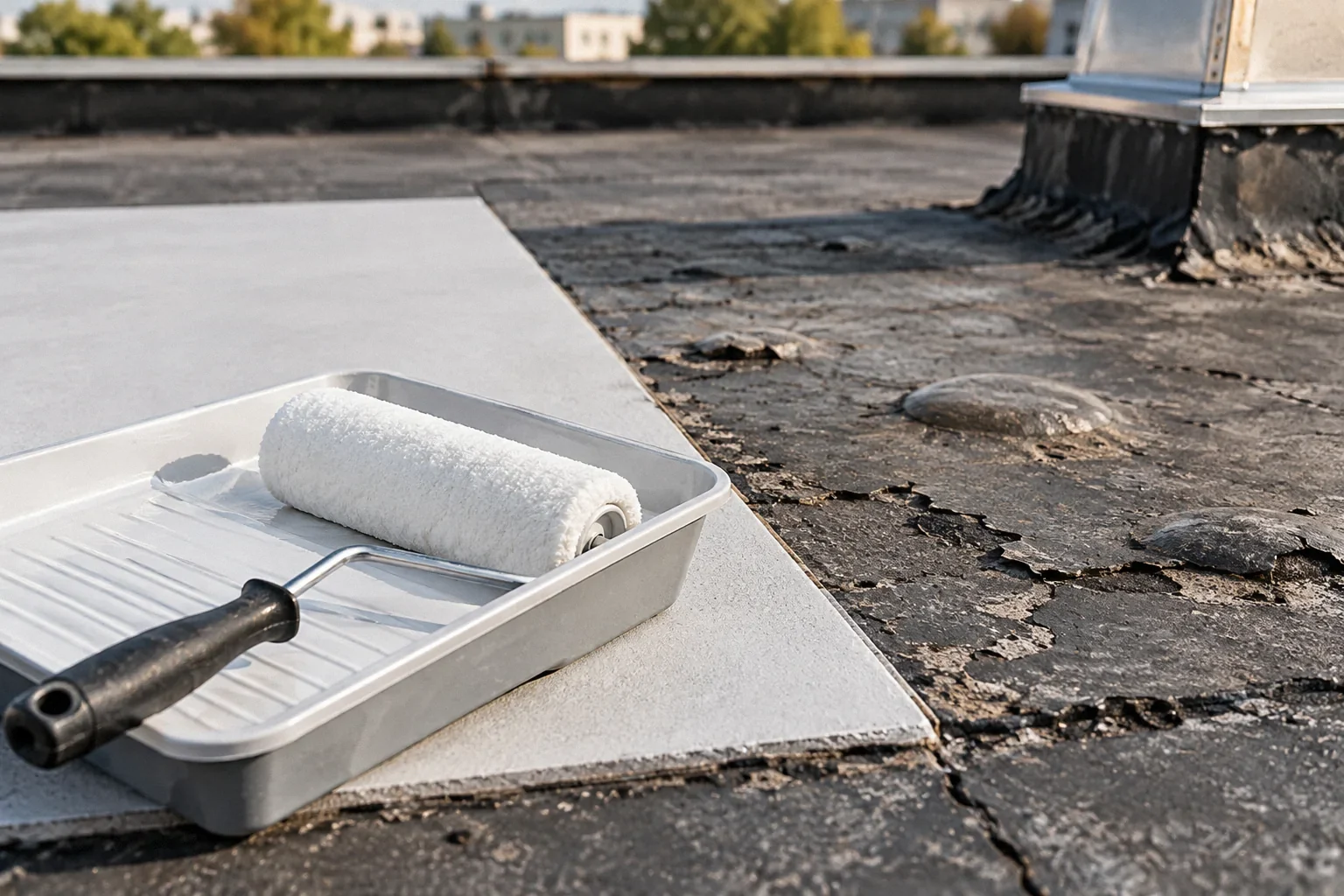
A roof coating should be evaluated as part of a rehabilitation system, not as proof that an existing roof is dry, stable or properly drained. Before approval, establish the substrate condition, water-entry defects, drainage performance and compatibility of the proposed coating. Unresolved problems beneath the surface do not disappear when the finish becomes uniform.
Assess the roof beneath the coating proposal
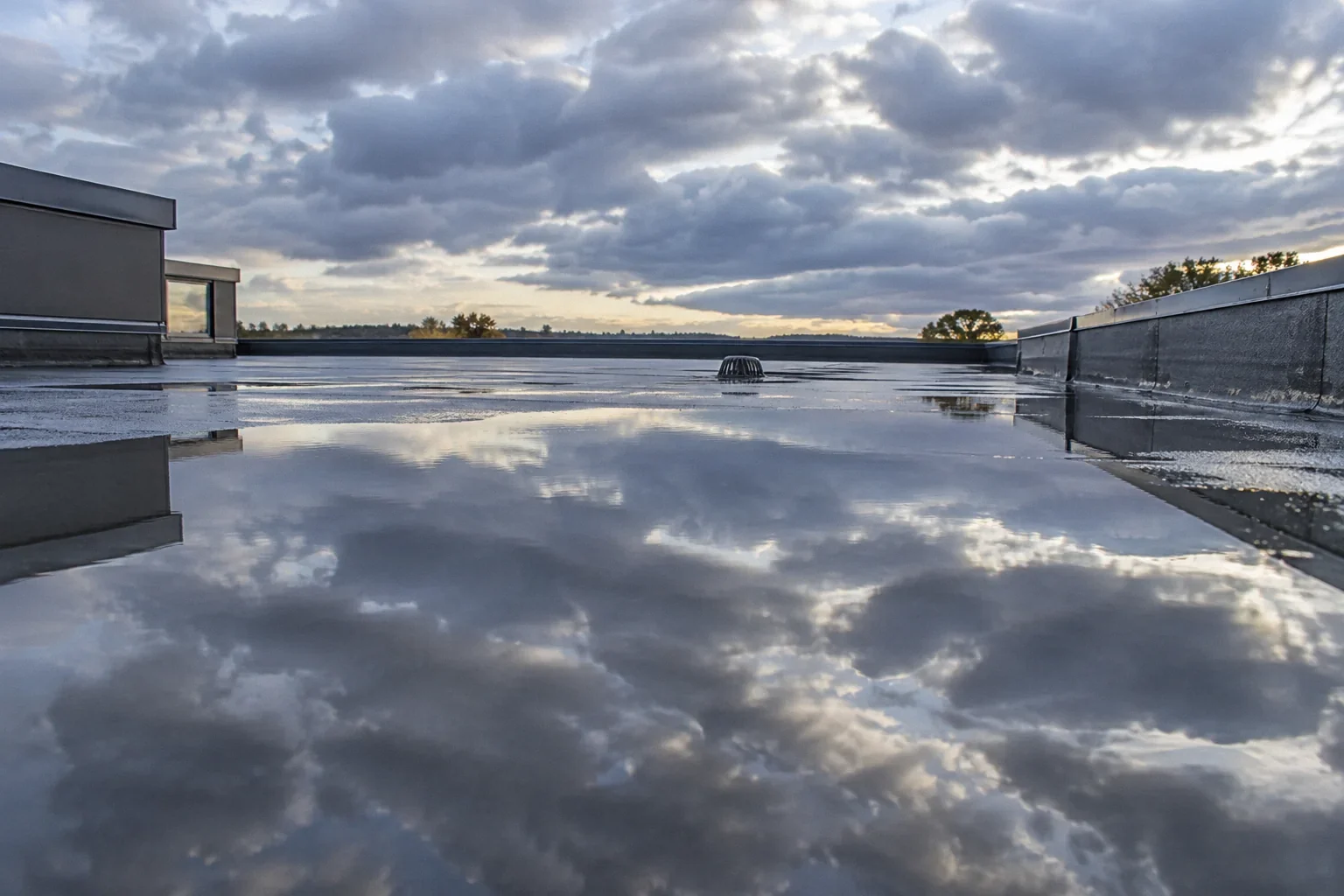
The roof must maintain a continuous water-control layer across seams, edges and penetrations. [1] A coating proposal therefore needs more than a field-area application description. It must explain detail repairs, surface suitability and treatment of existing materials. Drainage remains a separate function: Carlisle's maintenance guidance identifies restrictions and accumulated water as assembly concerns. [2] A coating does not by itself redesign the water path.
Other explanations to distinguish
Recurring leakage may be caused by open details, concealed wet materials, unsupported movement or a problem outside the roof field. A coating can be appropriate on some serviceable assemblies while being unsuitable on others. The decision should not turn on whether the existing surface looks aged. An attractive finished appearance is not evidence of adhesion, concealed dryness or successful correction at curbs and walls.
Evidence to request before choosing the work
Request the exact proposed system and its substrate acceptance requirements. Ask how moisture conditions and adhesion suitability will be evaluated and how suspect areas will be confirmed. A thermal survey may help identify areas for further investigation when the assembly and conditions are suitable, but the camera image needs interpretation. [3] The proposal should specify what happens when the investigation finds material that cannot remain.
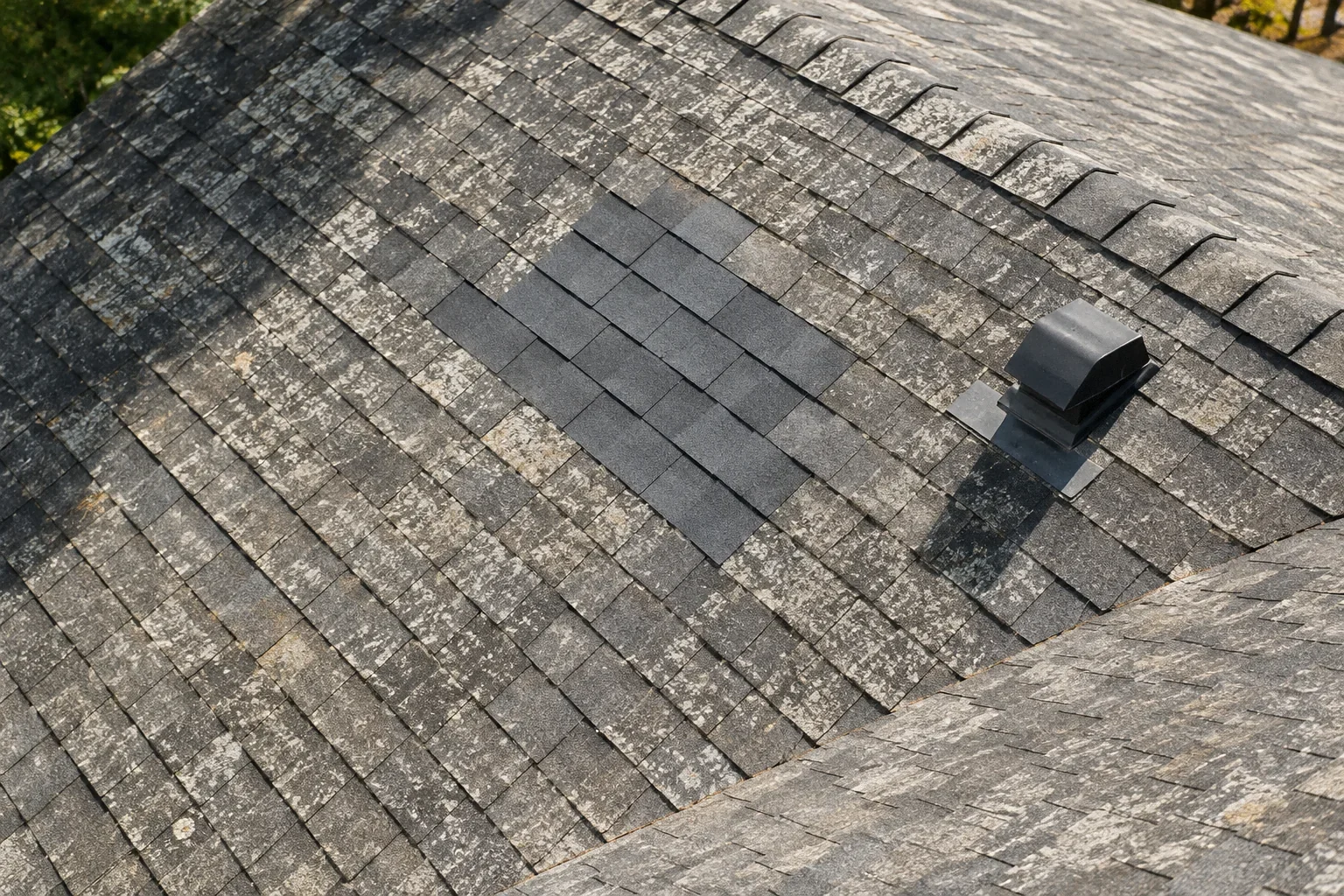
Ask whether the coating proposal includes treatment of every existing repair or assumes that old patches can remain. The response should distinguish identified compatible surfaces from uncertain ones. Also request the sequence for correcting details before the field application. This makes it possible to document preparation while it is still visible, instead of trying to infer its quality from the uniform finished coating.
How the findings change the repair decision
Proceed when the underlying assembly can meet the selected system's requirements and identified defects are included in the preparation scope. Compare a rehabilitation option with replacement when large portions require removal or the roof geometry needs major correction. Avoid a proposal that treats every unknown as a future extra while marketing the coating as a complete leak solution. Define the investigation and preparation before comparing prices.
A practical example and what it does not prove
Imagine a roof with several patched curbs and persistent ponding. A contractor offers a coating across the entire field. The owner asks for a moisture assessment, detail schedule and drainage explanation, then discovers that the curb repairs were excluded. The comparison now changes: the meaningful option is coating plus necessary corrective work, not coating alone versus a complete replacement scope.
Limits and when professional review matters
This article does not prescribe a coating chemistry, thickness or application method. Those choices depend on the actual product and substrate and require verified instructions. Do not conduct homeowner adhesion tests or open the membrane to check for moisture. Qualified investigation should leave the roof protected and document any openings or samples so the diagnostic work does not become a new defect.
Do not confuse a uniform finish with verified preparation
A finished coating can conceal the preparation decisions that determine whether the proposal was appropriate. Ask to see important findings before application, especially where old patches or uncertain substrate conditions exist. The completion record should show what was removed, repaired and retained. A broad after photograph cannot recreate those concealed decisions.
Compare rehabilitation with replacement using the same underlying corrections. If either option needs drainage work or curb reconstruction, include those items on both sides of the comparison. Otherwise the apparent price difference may come from omitted work rather than the coating decision itself. The owner should understand which existing components the rehabilitation plan depends on retaining.
- Suspect wet material has not been resolved: require an investigation outcome before treating the roof as ready for coating.
- Old repairs have different or unknown products: identify how each is handled in the selected system.
- The coating bid excludes drainage correction: compare it as a limited scope rather than a complete solution to the existing problem.
Questions that resolve the remaining uncertainty
Ask how equipment and roof details will remain identifiable after coating. The finished record should preserve product information and repaired-location references that may no longer be apparent from appearance. This helps later maintenance avoid guessing whether a visible seam or patch is original, repaired or intentionally incorporated in the rehabilitation. The record supports future compatibility decisions as well as immediate acceptance.
Coating selection follows substrate acceptance
A coating proposal needs two decisions: whether the existing assembly can remain, and whether the selected coating system is suitable for that remaining surface. A positive answer to one does not supply the other. A roof can be locally repairable yet require preparation that was omitted from a coating estimate. A compatible coating product can also be inappropriate to apply before unresolved wet-material or drainage concerns are addressed.
The preparation schedule should identify how seams, curbs and earlier repairs are treated. These locations differ from uninterrupted field membrane, so a broad application description may leave the most relevant leak details unspecified. Ask for the sequence and completion evidence while those details remain visible. The final uniform appearance cannot demonstrate every concealed preparation decision.
When comparing replacement with coating, normalize the necessary underlying corrections. Drainage changes or equipment-curb reconstruction may be needed under either option. Excluding them from one proposal creates an artificial comparison. The owner should also know which existing components the rehabilitation plan continues to depend on. A coating can be evaluated fairly as a supported intervention without being presented as a new roof assembly or a universal answer to unidentified leakage.
What to take away
- Verify substrate condition before choosing a coating system.
- Separate drainage correction and detail repairs from field coating.
- Require a plan for suspect wet materials and unsupported substrate conditions.
Sources & further reading
Reddit links show the questions people ask; they do not establish a diagnosis or a legal requirement. Technical requirements depend on the product, building and jurisdiction. See our research approach.
- PNNL penetration flashingTechnical / official reference
Water-control continuity and penetration detailing; avoid treating illustrated assembly as universal code
- Carlisle drainage maintenanceTechnical / official reference
Drainage blockages, ponding loads and edge support
- FLIR airborne roof inspectionsTechnical / official reference
Thermal inspection application; manufacturer marketing, anomalies require corroboration
- Homeowner discussion: TPO Roof Leak due to Pooling Water?Community question · anecdotal
Anecdotal issue research, not technical authority or proof about another property.
- Homeowner discussion: Can this roof be repaired or need completely replaced?Community question · anecdotal
Anecdotal issue research, not technical authority or proof about another property.
Planning a Bay Area project?
Explore YKCA’s website and discuss the scope and services you need directly with them.