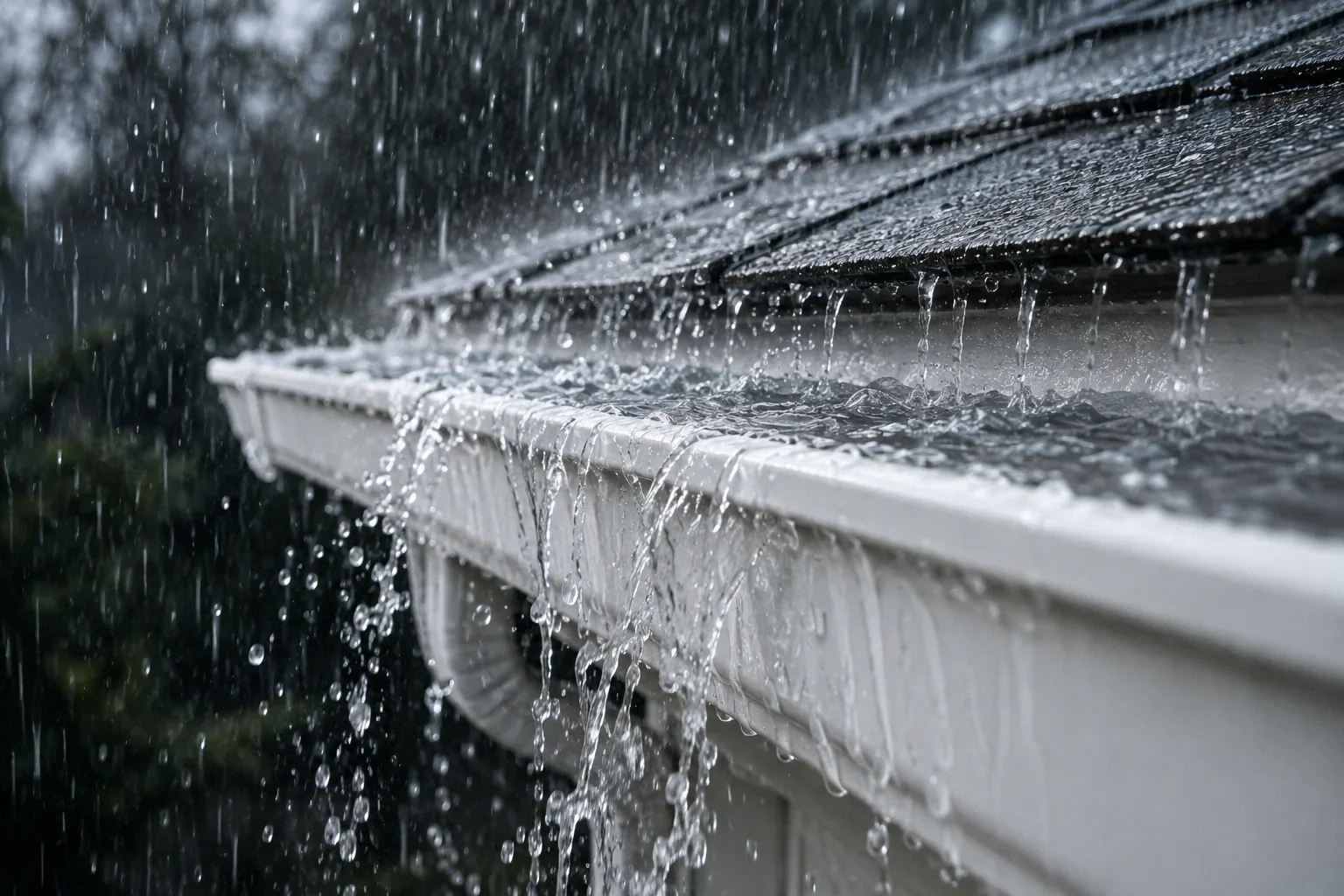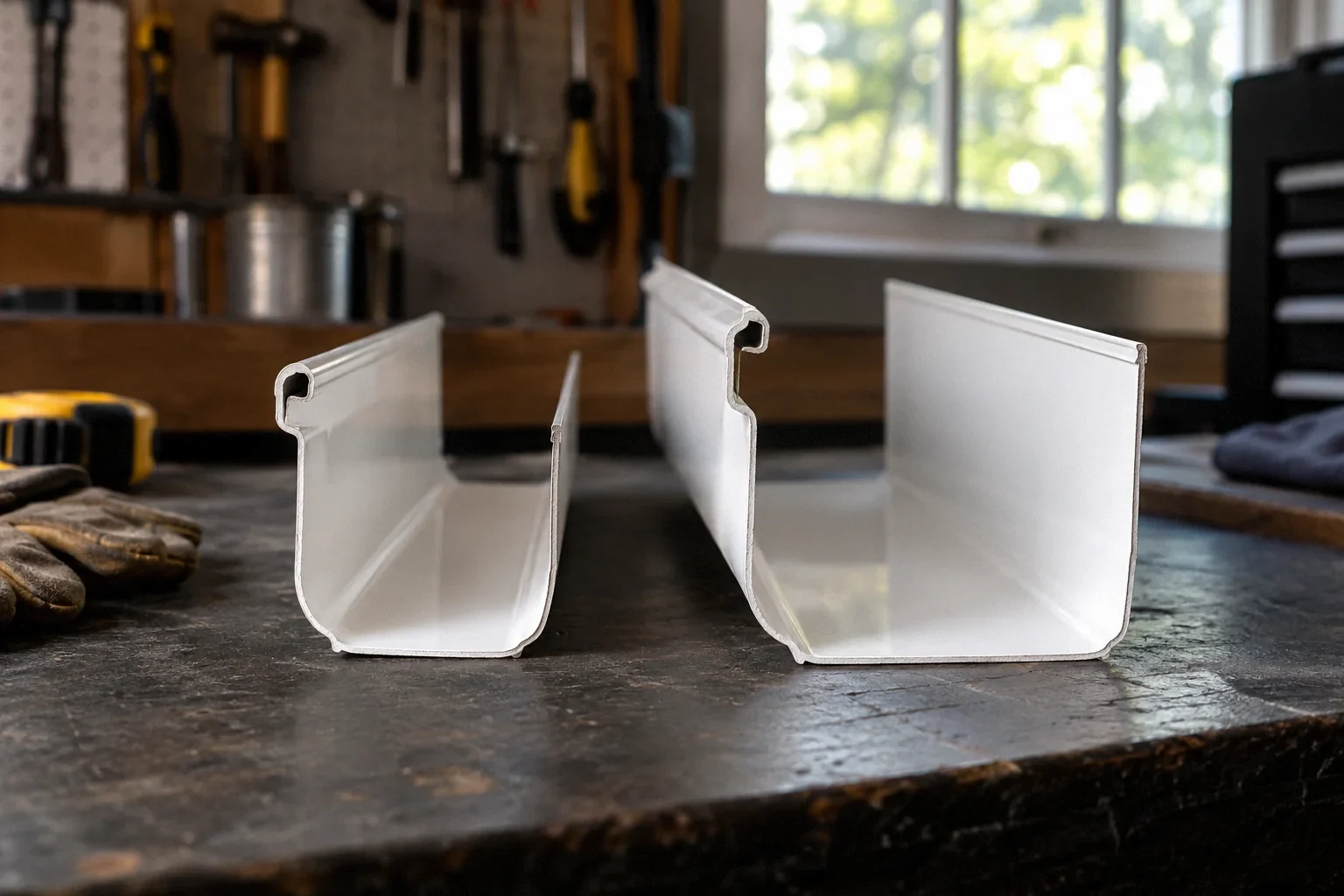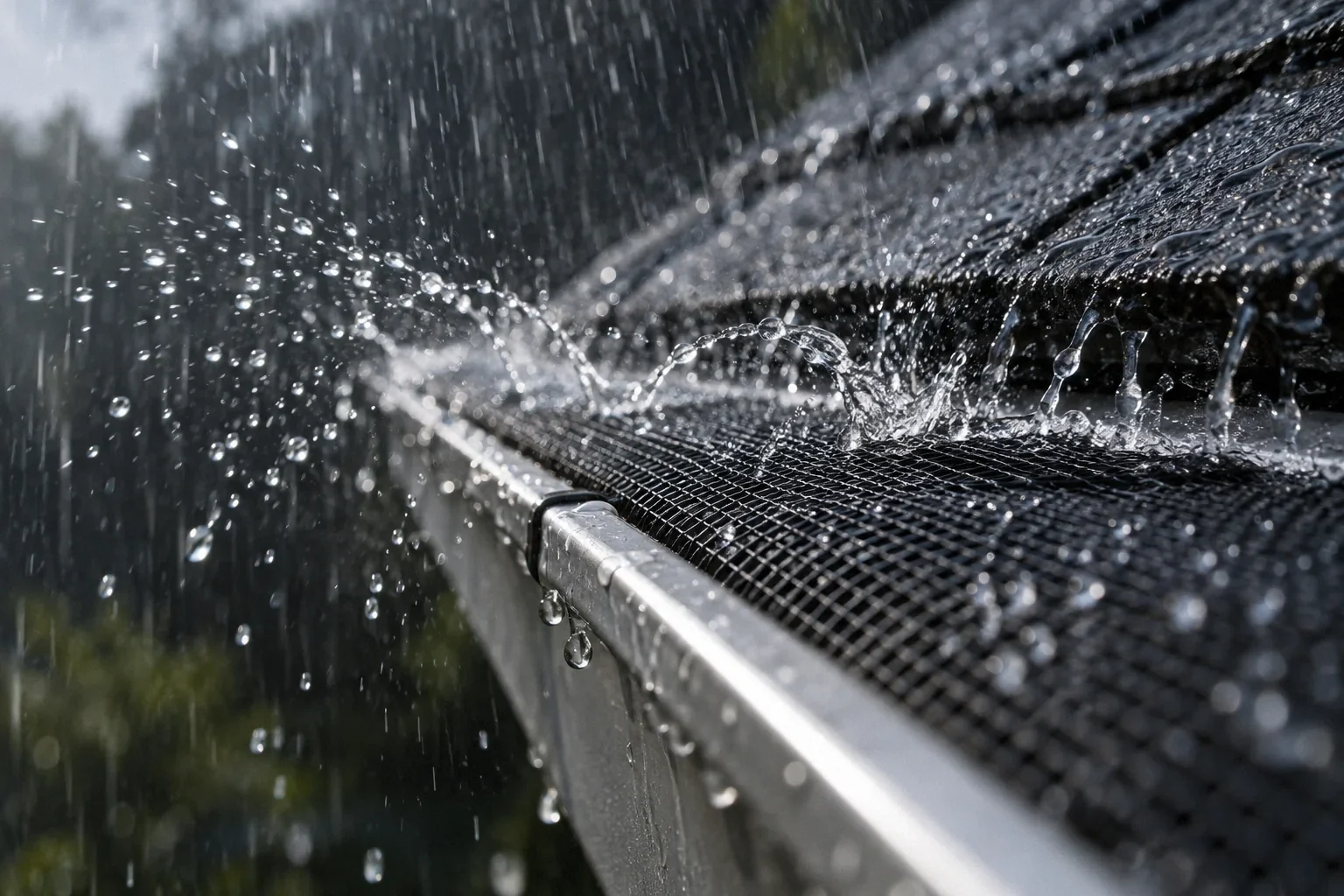
Gutter guards reduce some debris entry but do not eliminate inspection or maintenance. Water can skim over a dirty or unsuitable surface, arrive as a concentrated stream, or back up beneath it. Evaluate the guard together with the roof, gutter and outlets.
Separate water skipping from water backing up
Watch whether water appears to slide directly over the guard or rises from a full trough below. These can look similar from a distance but suggest different inspections. Skipping prompts questions about surface debris, guard angle and concentrated runoff. Backing up prompts questions about outlet restrictions and the available drainage route. Both can coexist. Ask for footage or photographs that support the contractor’s explanation. Do not remove sections during a storm to experiment; the purpose of a safe observation is to define the question for someone equipped to inspect the system.
The guard discussion focuses on concentrated upper-roof discharge, not only ordinary leaf accumulation. This Reddit account is anecdotal, not technical authority. [2]
Match the debris problem to the product
Large leaves, small seeds and fine debris create different maintenance challenges. Ask what accumulates at your property and where it collects. A product demonstration using clean water does not reproduce a season of actual debris. Request the manufacturer’s maintenance instructions for the installed model, including how the top surface and the gutter below can be accessed. A warranty or marketing promise should not replace those instructions. Also ask who can service the guard later and whether removal and reinstallation require proprietary parts or a particular installer.
Concentrated roof water changes the test
An upper downspout or roof valley can send a large localized stream toward one small area. The rest of the guard may work satisfactorily while that location sheds water outward. Document whether the overflow occurs beneath a particular roof feature rather than along the entire elevation. PNNL describes coordinated roof-water collection and discharge. [1] A product change might help, but the inspection should also consider the delivery path and the capacity of the gutter and downspout receiving that stream. Avoid judging the whole installation from either its best or worst single location.
Maintenance access has a real cost
Compare the complete service process, not just the purchase price. Can the trough and outlet be inspected without damaging the guard? Is the system practical on an elevation that already requires difficult access? Will a roof replacement require removal? These questions do not make guards a poor choice; they reveal the maintenance arrangement you are actually buying. Ask for a written description of periodic service and the conditions that trigger an additional visit. A proposal that relies on the phrase never clean again leaves important work undefined.
Keep warranties and roof integration specific
Guard installation may touch roof-edge components, fascia or existing gutter hardware. Ask exactly how the system is attached and whether the roof or gutter manufacturer has relevant requirements. Do not assume every guard affects a roof warranty, or that none does. The applicable documents and attachment method matter. If the installer proposes changing roof-edge details, have that work reviewed by the appropriate roofing professional. Separate the guard’s product warranty from workmanship and from any claim about preventing water intrusion into the building.
Try to resolve the failure mode before full replacement
If a new guard overflows at one corner, ask whether the installer has inspected surface condition, entry geometry and the outlet before proposing removal everywhere. A localized adjustment might be appropriate, or the product may be a poor match for that location. Conversely, repeated cleaning that leaves the same overflow pattern should trigger a design review. Document the original symptom and the change made. The meaningful outcome is controlled roof runoff under observed conditions, not simply a cleaner-looking screen or a new brand name.
Compare guard proposals with a maintenance scenario
Ask each bidder to explain what happens after the actual debris around your house accumulates. Who inspects the surface, how is the outlet reached, and what service is expected after a problem is reported? This turns a product comparison into an ownership comparison. The answers can differ even when two screens look similar from the ground.
Then ask about a concentrated-flow scenario at the most difficult roof location. A demonstration on a short clean sample does not establish performance beneath your valley or upper downspout. The contractor should either explain the proposed detail there or acknowledge that it needs closer evaluation. Keep that location in the installation photos and acceptance observations.
Finally, separate the reasons for choosing guards. Reducing some debris entry, changing cleaning access and improving appearance are different benefits. None automatically guarantees elimination of overflow. A proposal can be worthwhile without making that promise. The most credible comparison states the intended benefit, maintenance obligation and unresolved site conditions in ordinary language.
If the sales proposal includes a cleaning reduction claim, ask how that claim relates to your actual access conditions and debris. A house beneath small seeds may need a different service discussion from one exposed mainly to large leaves. Avoid assuming that a product’s ability to exclude one debris type demonstrates performance with every material on the roof. The owner should also know what happens when a roof contractor needs to work near the guards. Removal, storage and reinstallation can become part of another project’s scope. Keeping the model and attachment instructions available reduces the chance that another crew improvises. These ownership details are often more useful than a comparison of screen appearance, because they determine whether the system can be maintained as intended after the original installer leaves.
| Decision area | Question or evidence |
|---|---|
| Debris reduction | What still accumulates and where? |
| Service access | How are the trough and outlet inspected? |
| Difficult inflow location | What detail addresses the concentrated stream? |
| Warranty | Which maintenance conditions and exclusions apply? |
Example: one troublesome section under an upper roof
Consider guards that remain dry on the outside along most of a house but spill beneath an upper-level downspout. Replacing all the guards with a finer mesh may not answer the specific problem. The first inspection should document the stream’s landing point, debris accumulation and whether the receiving gutter fills. Depending on that evidence, the appropriate work may involve the upper discharge route, local guard configuration, gutter capacity or outlet condition. This example is hypothetical; the useful lesson is the sequence of questions, not a promise that one accessory will solve every valley or upper-roof problem.
Questions to ask before accepting a guard proposal
Request the exact model, installation method and maintenance process. Ask the bidder to identify difficult roof-water entry points on your house rather than showing only a generic demonstration. Keep a copy of the product instructions with the gutter records so future cleaning crews know what can be removed and how it should be restored.
- What debris must still be removed, and from where?
- How are the trough and downspout outlet accessed?
- What will be checked if water crosses the guard in rain?
What to take away
- Distinguish skimming over the surface from backup below it.
- Read the installed model’s maintenance instructions.
- Evaluate concentrated inflow and downstream capacity together.
Sources & further reading
Reddit links show the questions people ask; they do not establish a diagnosis or a legal requirement. Technical requirements depend on the product, building and jurisdiction. See our research approach.
- DOE/PNNL: Gutters and DownspoutsTechnical / official reference
Roof-water system components, material tradeoffs, separation from footing drain; program-specific distances are not universal local code.
- Reddit discussion: Water flowing over gutter guardsCommunity question · anecdotal
Anecdotal homeowner discussion used to identify the question; not technical authority or evidence of this property’s condition.
Planning a Bay Area project?
Explore YKCA’s website and discuss the scope and services you need directly with them.