A recurring corner leak deserves more than another layer of sealant. Check joint movement, fit, fastening, retained water and product compatibility. A sound repair scope explains which parts will be corrected and how the joint will be prepared.
Confirm that the seam is the escape path
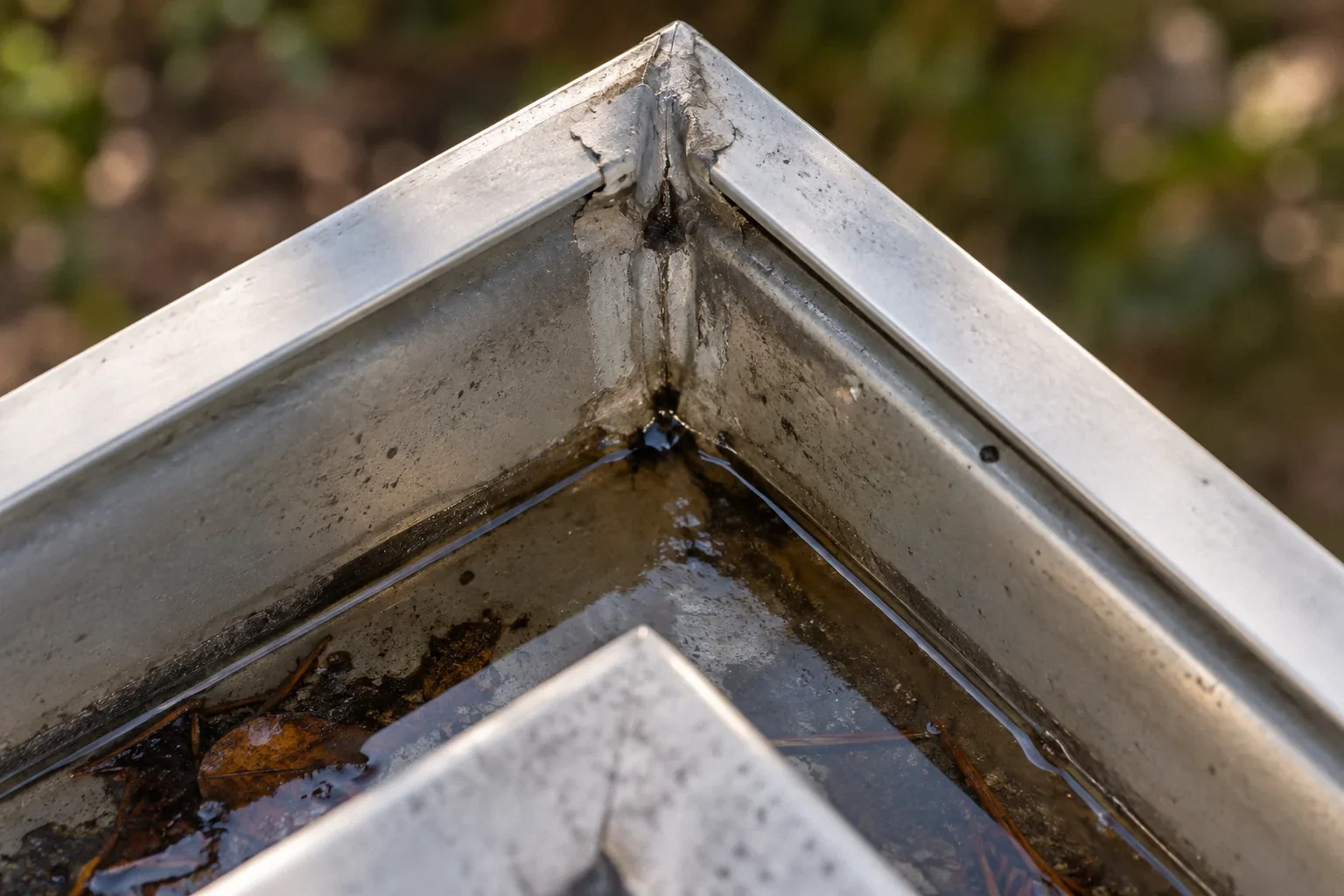
Water falling at a corner may originate from overflow or a roof-edge path above it. Ask the inspector to establish whether water actually passes through the joint. The difference matters because a well-sealed seam will not prevent a full trough from overtopping. Preserve photographs from earlier repairs if available. They can show whether the joint has shifted or whether layers of different products have accumulated. Your description should include when the leak returns: immediately after work, after a season, or only during particular storms.
The repeated corner-repair account motivates reviewing the joint rather than simply choosing another sealant. This Reddit account is anecdotal, not technical authority. [2]
A joint needs mechanical stability
Sealant is not a substitute for an assembly that holds its intended shape. Ask whether the connected sections fit properly and whether their fastening and support remain sound. A corner affected by sagging on either adjoining run may move differently from the rest of the gutter. That possibility should be assessed before deciding the sealant was simply a bad brand. PNNL treats roof runoff as a system requiring effective collection and discharge. [1] At a corner, that means looking at the supporting runs and outlet behavior as well as the visible bead.
Preparation is part of the scope
A quote that says reseal corners can describe very different work. Clarify whether failed material will be removed as appropriate, whether the underlying joint will be inspected, and how surfaces will be prepared for the selected product. Weather and curing requirements should come from that product’s instructions. Avoid specifying a household sealant based only on a recommendation from another property. Existing coatings, metals and previous repair products may affect compatibility. Ask the contractor to record the product used so a later repair does not begin with an unknown stack of materials.
Retained water can complicate a localized repair
A leaking corner may also be the lowest part of the run. If so, the proposal should address whether water remains there after rainfall and why. Correcting a seam while leaving a drainage defect may not deliver the intended result. That does not mean every corner leak requires wholesale realignment. It means the inspection should distinguish a joint defect in an otherwise functioning run from a joint exposed to unresolved retention or movement. Ask for photographs of the surrounding channel and the outlet, not only a close-up of the leaking line.
Decide when rebuilding the connection is justified
If the joint is distorted, poorly fitted or repeatedly repaired without success, a more complete reconstruction may be worth comparing with another surface patch. Request alternatives that identify what each leaves in place. A temporary repair can be a reasonable choice when access, weather or planned replacement constrains the schedule, but it should be labeled temporary. Do not equate a longer warranty with a better diagnosis. The stronger proposal explains the observed defect and how the chosen work removes or manages it.
Judge success against the original symptom
Keep the original leak location and timing in the completion record. A limited water check can establish whether the joint leaks during that demonstration, but it does not prove future movement has been eliminated. A later natural-rain observation adds useful evidence. If water continues to wet eaves or wall materials, have the extent of that wetting assessed rather than focusing indefinitely on the metal seam. Recurrent building damage calls for coordination between the gutter contractor and the relevant building-envelope professional.
Use the repair history as evidence
Make a short timeline of prior corner work: approximate date, product if known, what was removed or rebuilt, and how long the symptom changed. Do not invent missing details. Unknown is a useful entry because it explains why the next contractor may need closer inspection. If the repair lasted only until the next rain, that differs from a joint that performed for years before another problem appeared. Neither interval proves the cause, but both help frame the investigation.
Ask whether the next proposal changes the underlying method or merely repeats it. A repeated method can be reasonable if the previous preparation was demonstrably deficient. It is less persuasive when no one has examined movement, fit or retained water. The contractor should explain what new evidence supports confidence in the result.
A temporary patch can remain a deliberate option when replacement is already scheduled. In that case, record the purpose and limits, and continue observing any building materials below. Calling a patch temporary is useful only if there is an actual plan for the remaining issue.
Ask the contractor to distinguish a repair of the existing joint from replacement of the corner assembly. The two can involve different preparation, retained materials and appearance. If the proposal uses the same word reseal for both, request a clearer description. Also ask how adjoining finishes will be protected and whether evidence of water damage below the joint needs another inspection before it is concealed. The gutter repair may stop one source without establishing the condition of previously wetted wood. Where access is difficult, photographs taken during the work are especially valuable. They allow the owner to understand the actual condition and make a later service visit more focused. Keep them with the repair date and product information rather than relying on memory of what the technician said.
| Decision area | Question or evidence |
|---|---|
| Immediate recurrence | Review diagnosis, preparation and uncorrected water path |
| Recurrence after movement appears | Review support and joint geometry |
| Unknown prior materials | Document compatibility and preparation uncertainty |
Example: a corner repaired every winter
Imagine a corner that stops dripping after each service visit and starts again months later. Photos show the same joint beneath a slightly sagging adjoining run. Another bead may reduce the immediate drip, but the next inspection should assess whether that run is moving and whether the joint remains properly fitted. If support is sound and the previous product was poorly bonded, preparation may be the central issue instead. The repeated symptom does not identify which explanation is correct. It does justify asking the next contractor for evidence that distinguishes them before repeating the same intervention.
Make a localized repair reviewable
Ask for a marked photograph of each corner included in the price. State whether alignment, attachment repairs and removal of old products are included or excluded. Keep the product documentation and a completion image taken before the contractor leaves. Those records help establish what was repaired if another corner develops a similar symptom later.
- Which defect caused the recommendation to reseal or rebuild?
- Were adjoining supports and retained water assessed?
- What limitation remains after this repair?
What to take away
- Verify a through-seam leak before resealing.
- Ask whether joint movement and support were checked.
- Record preparation, product and any unresolved low spot.
Sources & further reading
Reddit links show the questions people ask; they do not establish a diagnosis or a legal requirement. Technical requirements depend on the product, building and jurisdiction. See our research approach.
- DOE/PNNL: Gutters and DownspoutsTechnical / official reference
Roof-water system components, material tradeoffs, separation from footing drain; program-specific distances are not universal local code.
- Reddit discussion: Leaky gutter seamCommunity question · anecdotal
Anecdotal homeowner discussion used to identify the question; not technical authority or evidence of this property’s condition.
Planning a Bay Area project?
Explore YKCA’s website and discuss the scope and services you need directly with them.