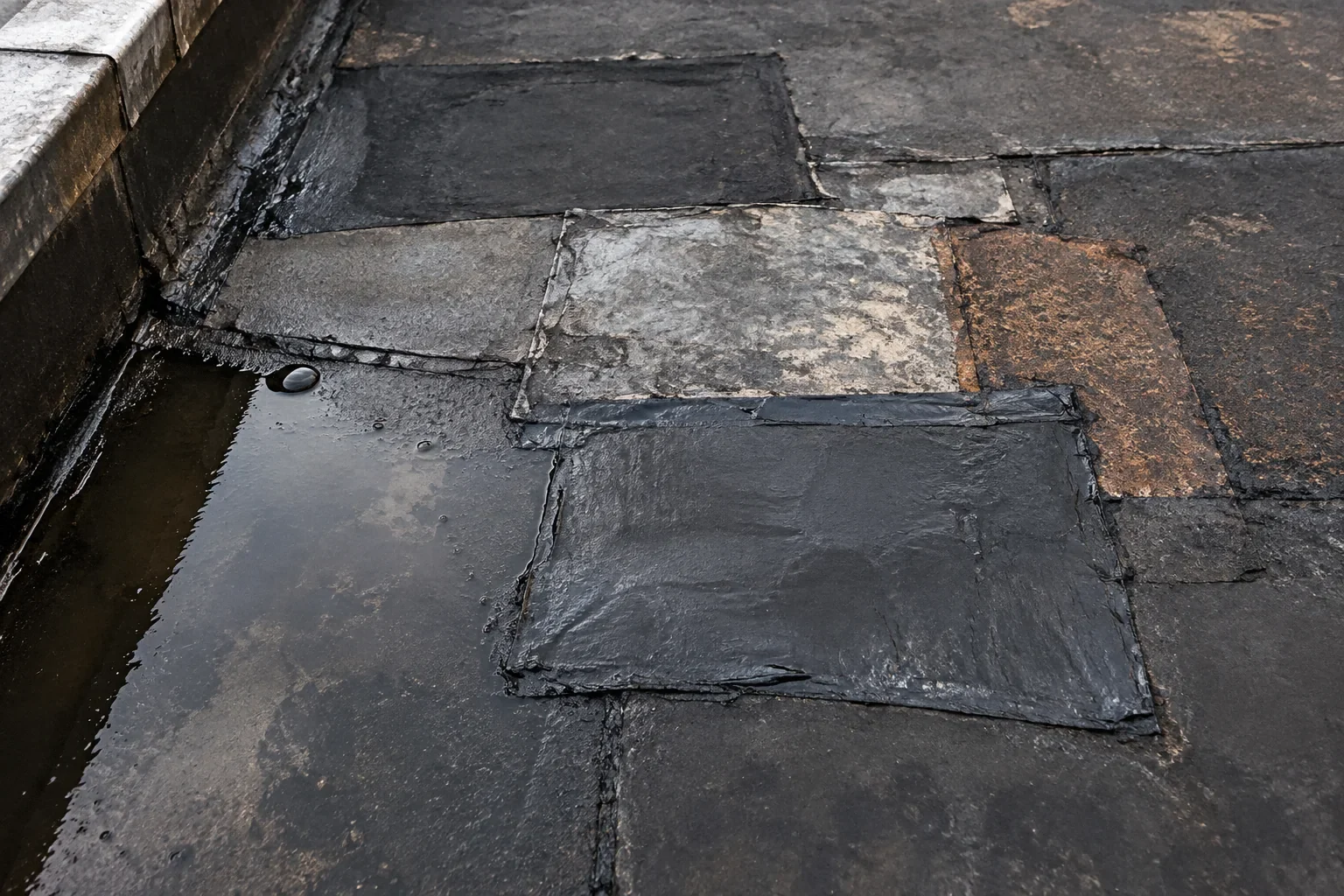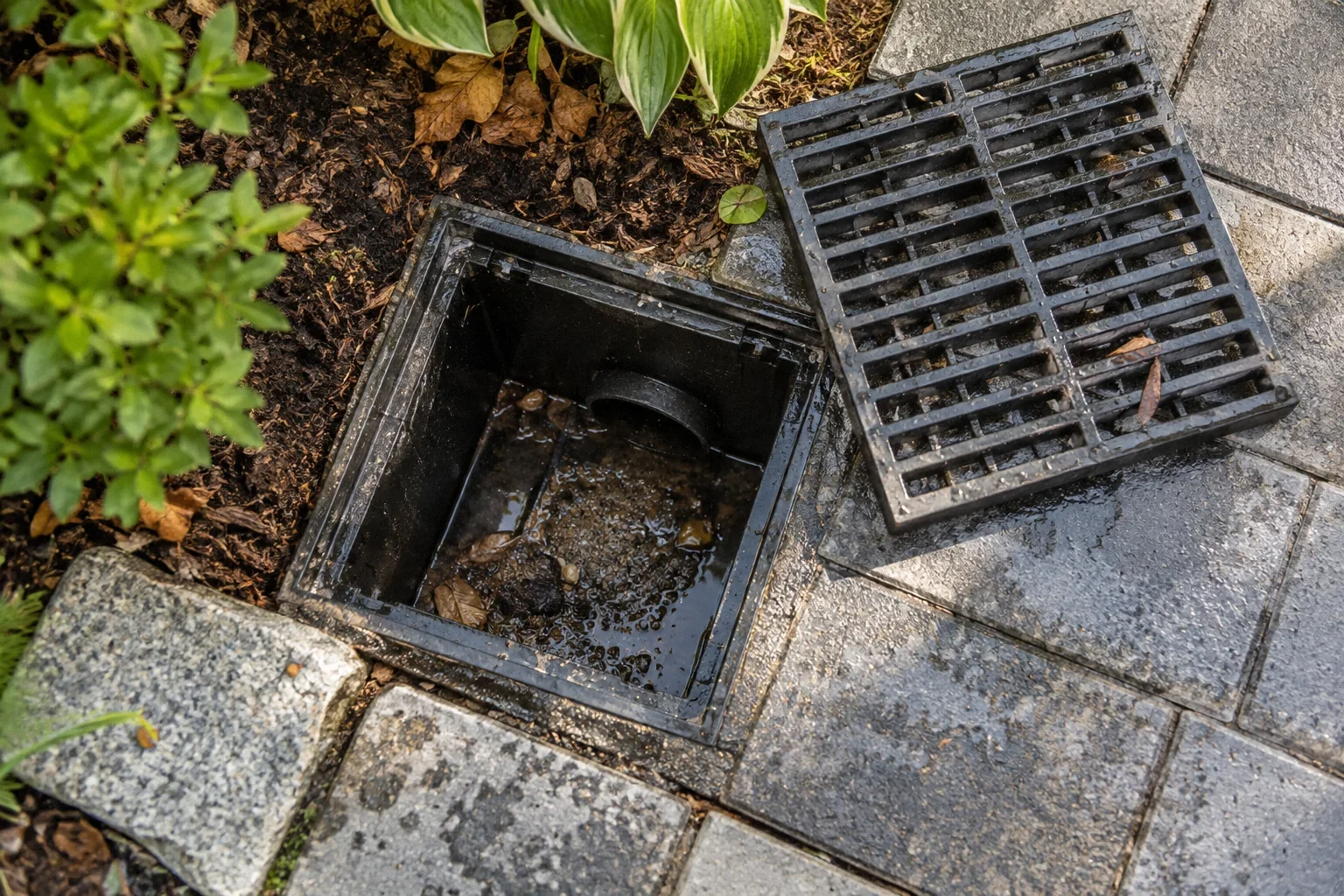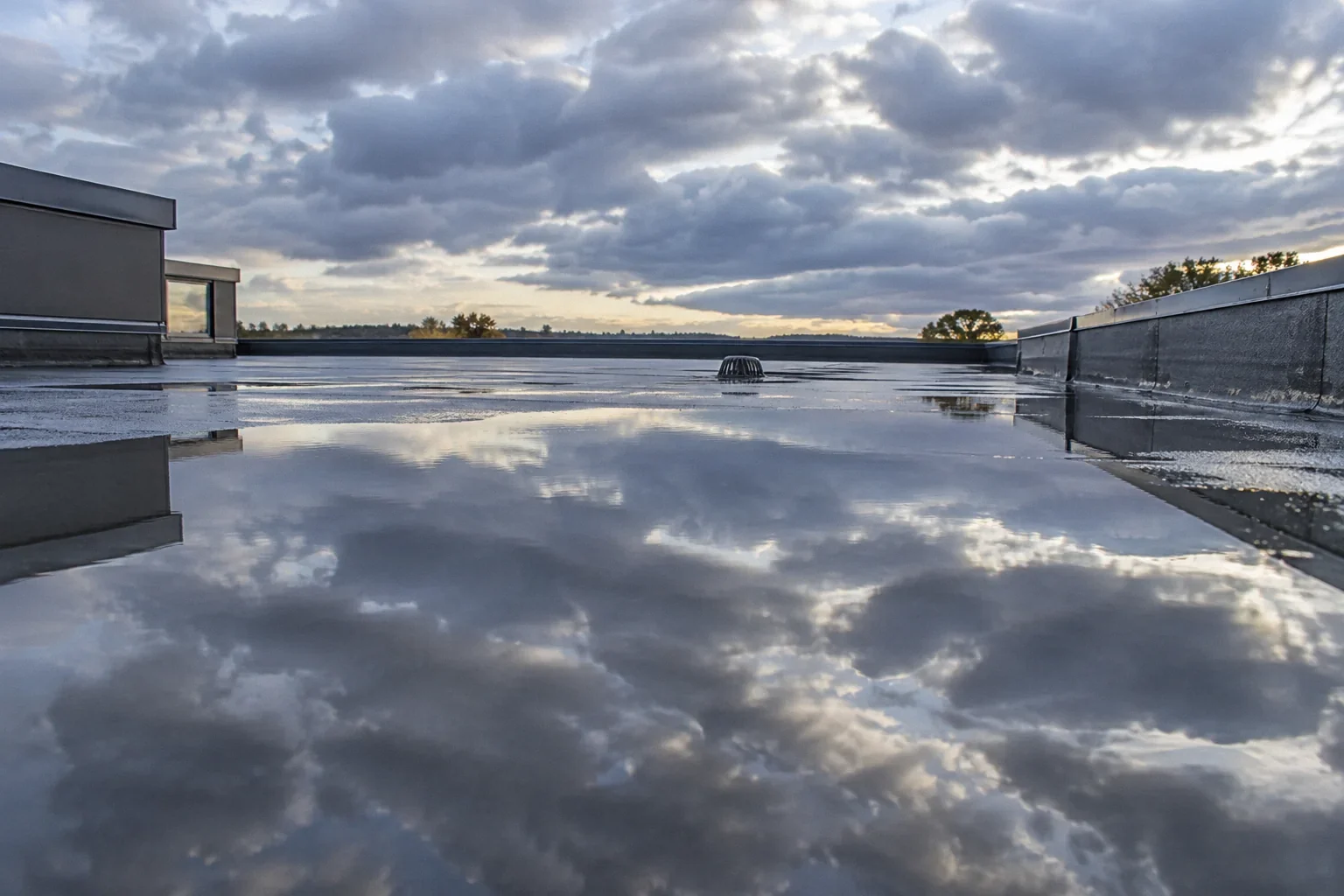
Standing water on a low-slope roof is a condition to investigate, not enough by itself to declare the membrane defective or the roof acceptable. Document where water collects, how extensive it is, how it changes after rain and whether drainage or structural conditions contribute. The repair depends on that cause.
Separate water tolerance from drainage
A low-slope roof still needs a route to drains, scuppers or edges. PNNL describes drainage as a basic roof-design function, while Carlisle notes that accumulated water can impose additional load and increase exposure at details. [1][2] The important distinction is between the membrane's behavior under water and the assembly's ability to drain. A favorable statement about one does not settle the other.
Other explanations to distinguish
Potential causes include debris-restricted outlets, local depressions, an incomplete slope design or changes in the supporting assembly. A stain left after evaporation is not the same as current water depth. Water at an outlet may reflect a poorly positioned transition rather than a blocked drain. Broad roof movement or ceiling distress requires a different response from a small localized collection area.
Evidence to request before choosing the work
Request a dated plan showing ponding areas, outlets and observed changes after rain. A qualified professional should assess elevations where needed and explain the likely cause of each low point. Record what weather preceded the observation, rather than treating a single photograph as a drainage test. Ask whether moisture has entered the assembly and whether the supporting deck requires further assessment.
Distinguish a new ponding observation from a new pond. Owners may notice a condition for the first time after a purchase or drone photograph even though it existed earlier. Conversely, a documented change in its location or extent can be important evidence. Ask the investigator to compare available earlier records rather than assume the current image establishes when the drainage condition developed.
How the findings change the repair decision
Cleaning addresses an obstruction; it does not create missing slope. A designed drainage modification can address geometry, but adding isolated crickets without reviewing the complete path may shift water into another low point. If deflection is suspected, obtain appropriate structural evaluation before adding materials. A proposed coating should not be accepted as the drainage solution simply because it covers the wet area.
A practical example and what it does not prove
A sampled homebuyer discussion describes ponding on a recently renewed TPO roof and disagreement over whether additional crickets would solve it. [3] The unresolved question is the drainage plan, not whether someone can name a membrane that tolerates water. A map of existing and proposed flow paths gives the buyer a way to compare recommendations on a common basis.
Limits and when professional review matters
There is no universal acceptance time supplied by this article. Limits can depend on the applicable specification, product documents, roof conditions and jurisdiction. Ask the contractor to identify the requirement being applied. Do not climb into ponded areas, puncture the membrane or add weight to investigate. Sudden accumulation with structural symptoms requires prompt professional attention.
Separate where water collects from why it collects
A pond is a location on a drainage map, not a complete explanation. Ask whether the outlet, the route toward it or the supporting surface creates the collection. Those possibilities can call for different work. If the investigator cannot distinguish them from a single visit, the report should define what further measurement or observation would resolve the uncertainty.
Do not confuse a proposed local diversion with a complete drainage design. Water moved away from one low point must arrive somewhere else. Ask for the receiving route and its relationship to existing outlets. Where changes in support are suspected, adding material should follow appropriate assessment rather than serving as a way to hide the visible depression.
- Water remains beside an apparently clear outlet: examine the transition and elevations rather than assume cleaning is sufficient.
- The ponded area changes after maintenance: retain the comparison and assess remaining low points.
- A proposed cricket redirects flow toward another detail: evaluate that destination before accepting the isolated modification.
Questions that resolve the remaining uncertainty
Do not use a photograph of a dry roof to conclude that a ponding concern has been resolved. The useful comparison includes the conditions preceding each observation and the specific area that previously collected water. A completed drainage modification should have a documented intended path even before another suitable rain event occurs. The later observation then checks that plan rather than replacing the need for one.
If the report mentions structural movement, ask which observation led to that concern and which professional should assess it. A roofer can identify a suspicious condition without being able to determine its cause. Keeping the referral explicit is better than assuming that a layer added above the surface resolves every possible explanation for the depression.
Drainage correction, membrane repair and support review differ
An obstruction-removal scope restores an existing route. A slope-modification scope changes that route. A membrane-repair scope restores a damaged water-control surface. A support review investigates why the geometry may have changed. These actions can be related, but none should be silently substituted for another. Ask the proposal to identify which of them the observed condition actually requires.
A ponding photograph cannot establish its own cause or duration. The same visible area could be photographed soon after rainfall or after a much longer interval. The record should state what is known rather than assign an assumed acceptance time. It should also locate outlets and transitions so an investigator can assess whether water is being held by an obstruction, a local elevation relationship or another condition.
When a contractor proposes additional tapered material or a local diversion, ask where the displaced water will go. The repair should not merely reduce one visible pond while producing another at an unreviewed detail. If support movement is a concern, obtain the appropriate assessment before treating the surface shape as only a roofing-material problem. The owner can then compare actual corrective functions rather than decide whether a particular membrane is supposedly designed to hold water.
What to take away
- Separate membrane condition from drainage performance.
- Determine whether blockage, geometry or deflection creates each pond.
- Require a documented flow path before accepting isolated drainage modifications.
Sources & further reading
Reddit links show the questions people ask; they do not establish a diagnosis or a legal requirement. Technical requirements depend on the product, building and jurisdiction. See our research approach.
- PNNL penetration flashingTechnical / official reference
Water-control continuity and penetration detailing; avoid treating illustrated assembly as universal code
- Carlisle drainage maintenanceTechnical / official reference
Drainage blockages, ponding loads and edge support
- Homeowner discussion: Flat roof pondingCommunity question · anecdotal
Anecdotal issue research, not technical authority or proof about another property.
- Homeowner discussion: TPO Roof Leak due to Pooling Water?Community question · anecdotal
Anecdotal issue research, not technical authority or proof about another property.
Planning a Bay Area project?
Explore YKCA’s website and discuss the scope and services you need directly with them.