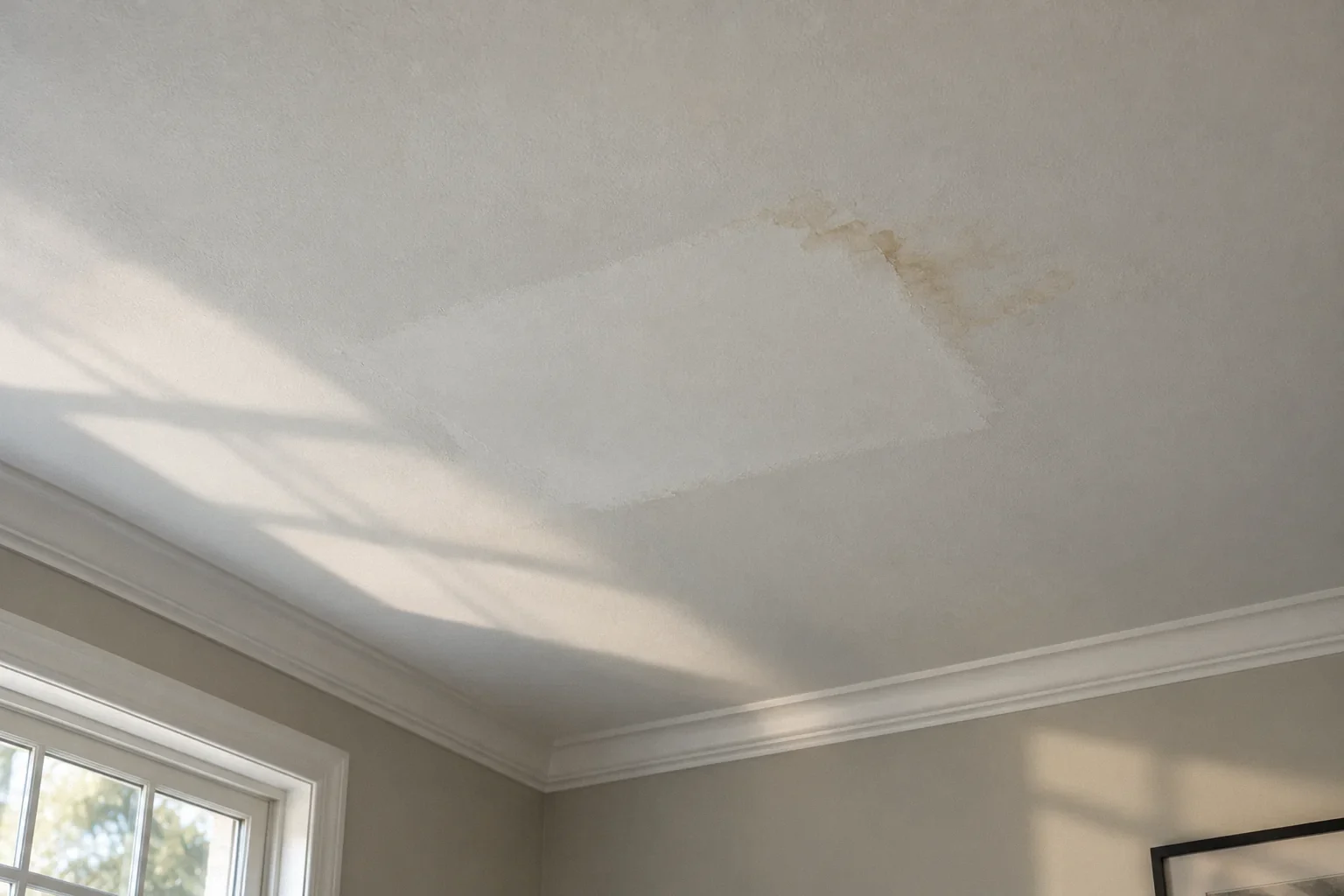
Verify a home's roof history with permits, invoices, repair records, warranties, and an appropriately scoped inspection. Treat a listing's roof age as a statement to check, not a substitute for evidence of what was replaced and how the roof currently performs.
Ask what 'new roof' actually means
The phrase may describe a complete tear-off, an overlay, a partial replacement, or a repair. Request the date, roof areas, materials, and contractor. Separate work on the house, additions, and detached structures. A single age can be misleading when several roof sections were installed at different times.
Build a chronological record
Arrange permits, invoices, warranty documents, repairs, and known leaks by date. Look for consistent addresses and matching scope. If the invoice says shingles only, do not assume decking and all flashing were replaced. Missing paperwork creates uncertainty; it does not by itself prove that the seller or contractor acted dishonestly.
Read the inspection limitations
Find out how the roof was observed, what areas were inaccessible, and whether attic or specialist review was included. A visual inspection on a dry day is not a guarantee against seasonal leaks. Ask the inspector to explain findings that conflict with other records and determine whether additional evaluation can occur within the purchase timeline.
Investigate prior damage without guessing coverage
A Reddit owner reported a later claim dispute involving damage allegedly paid for under a prior owner's policy.[3] That story does not establish a universal insurance rule. It does show why repair completion, photographs, and accurate roof history matter. Discuss uncertain condition and underwriting questions directly with the prospective insurer or agent.
Separate age from current condition
A documented older roof may have a clear maintenance history, while a recently covered roof may have unresolved interfaces or hidden defects. Ask for condition-based findings, repair needs, and areas of uncertainty. Avoid treating a stated remaining-life number as a promise about performance or a precise countdown to replacement.
Use transaction professionals for disclosure questions
California DRE's disclosure booklet provides background but warns readers to verify current requirements.[1] Ask the real estate professionals and, where needed, legal counsel how the particular facts should be addressed. Do not assume a generic article settles exemptions, seller knowledge, deadlines, or remedies for a specific transaction.
Make the unresolved risk visible before commitment
Create a list of confirmed work, unresolved history, recommended investigation, and potential scope needing quotes. Use qualified written assessments to inform negotiations. The decision may involve further inspection, a defined repair, a credit, or accepting documented risk, but those choices should not be based on a reassuring adjective in a listing.
Build a roof-history confidence table
Divide the history into confirmed, reported, and unknown information. A dated invoice identifying the property and scope belongs in the confirmed column for that work. A seller's recollection without documents belongs in the reported column. An inaccessible roof section with no records remains unknown. This simple distinction prevents repeated statements from acquiring false certainty as they move from the listing to the inspection summary and finally into the buyer's insurance application.
For each roof area, record the covering type, reported age, documented work, known leaks, permit status, and warranty information. A house with an addition may need several rows. Compare the specialist's current observations with those records. If they conflict, ask a focused follow-up: does the invoice describe an overlay, was only one slope replaced, or is the apparent age based on a component that remained? The goal is to resolve discrepancies without automatically assuming deceit.
Use missing history to shape the inspection scope. If no one can establish the deck condition or prior repairs around a chimney, ask what can be observed safely and what remains concealed. The specialist may recommend targeted investigation or describe the uncertainty that cannot be removed within the transaction. A buyer can then evaluate that risk deliberately. Do not ask for a certificate promising that unknown history cannot cause a future problem.
Keep insurance and purchase representations accurate. If an application asks for roof age and the history is mixed or uncertain, ask the insurer or agent how to report it truthfully. Do not select the newest date simply because it appears more favorable. Similarly, ask transaction professionals how unresolved roof findings should be incorporated into the purchase decision. A documented uncertainty can be managed; an unsupported precise answer can create another problem later.
- Mark roof facts as documented, reported, or unknown so uncertainty remains visible throughout the transaction.
- Use separate rows for additions, garages, and roof systems with different histories instead of one misleading installation date.
- Report mixed or uncertain roof age honestly to the relevant professionals and ask how the information should be recorded.
A practical example
A listing calls the roof 'five years old,' but the invoice shows replacement only over the main house and the garage has an older covering. The buyer should document those separate areas and obtain an inspection that includes both. If a warranty applies only to the main roof, say so in the file. This prevents the listing's shorthand from becoming an unsupported assumption about the entire property.
Use uncertainty to ask better purchase questions
Ask what finding would materially change your decision. An undocumented small repair may be acceptable with a sound current assessment, while an inaccessible roof area with recurring interior staining may justify further investigation. This helps prioritize limited inspection time. Do not spend the whole process proving a minor installation date while leaving the actual leak question unanswered.
When the records remain incomplete, ask the specialist to describe the likely scope and the limits of confidence rather than inventing precision. Ask the transaction professionals how the uncertainty affects your options and deadlines, and ask the insurer how to report the condition accurately. The buyer's decision can then reflect a known uncertainty instead of a false assurance. Keep the final report, seller responses, and agreed transaction terms together. If a problem emerges later, that record shows what was investigated and represented before closing, while still leaving legal conclusions about responsibility to an appropriate case-specific review.
Request clarification when a report uses broad wording such as 'roof replaced' without identifying the components. Ask whether the statement refers to the visible covering, underlayment, flashing, or structural repairs and what evidence supports it. A contractor may be able to clarify its own invoice even years later. If not, keep the statement limited to what the available record shows. Precision about scope often matters more than an apparently exact age that describes only one portion of the system.
What to take away
- Verify which roof areas and components were actually replaced.
- Compare age claims with permits, invoices, and current condition.
- Resolve major unknowns during the transaction's investigation period.
Sources & further reading
Reddit links show the questions people ask; they do not establish a diagnosis or a legal requirement. Technical requirements depend on the product, building and jurisdiction. See our research approach.
- California DRE: Disclosures in Real Property TransactionsTechnical / official reference
General disclosure background. Older booklet explicitly requires current statute checks; no promise on legal outcomes.
- California DOI: Residential Property Claims GuideTechnical / official reference
2025 revision; mitigation, claim records, valuation and claim dispute channels.
- Insurance denied my roof claim, the prior owner filed a claim years ago and never replaced it.Community question · anecdotal
Anecdotal discussion used to identify reader questions. Not verified incident evidence or legal, insurance, or technical authority.
- Sellers didn’t disclose leak they probably knew aboutCommunity question · anecdotal
Anecdotal discussion used to identify reader questions. Not verified incident evidence or legal, insurance, or technical authority.
Planning a Bay Area project?
Explore YKCA’s website and discuss the scope and services you need directly with them.