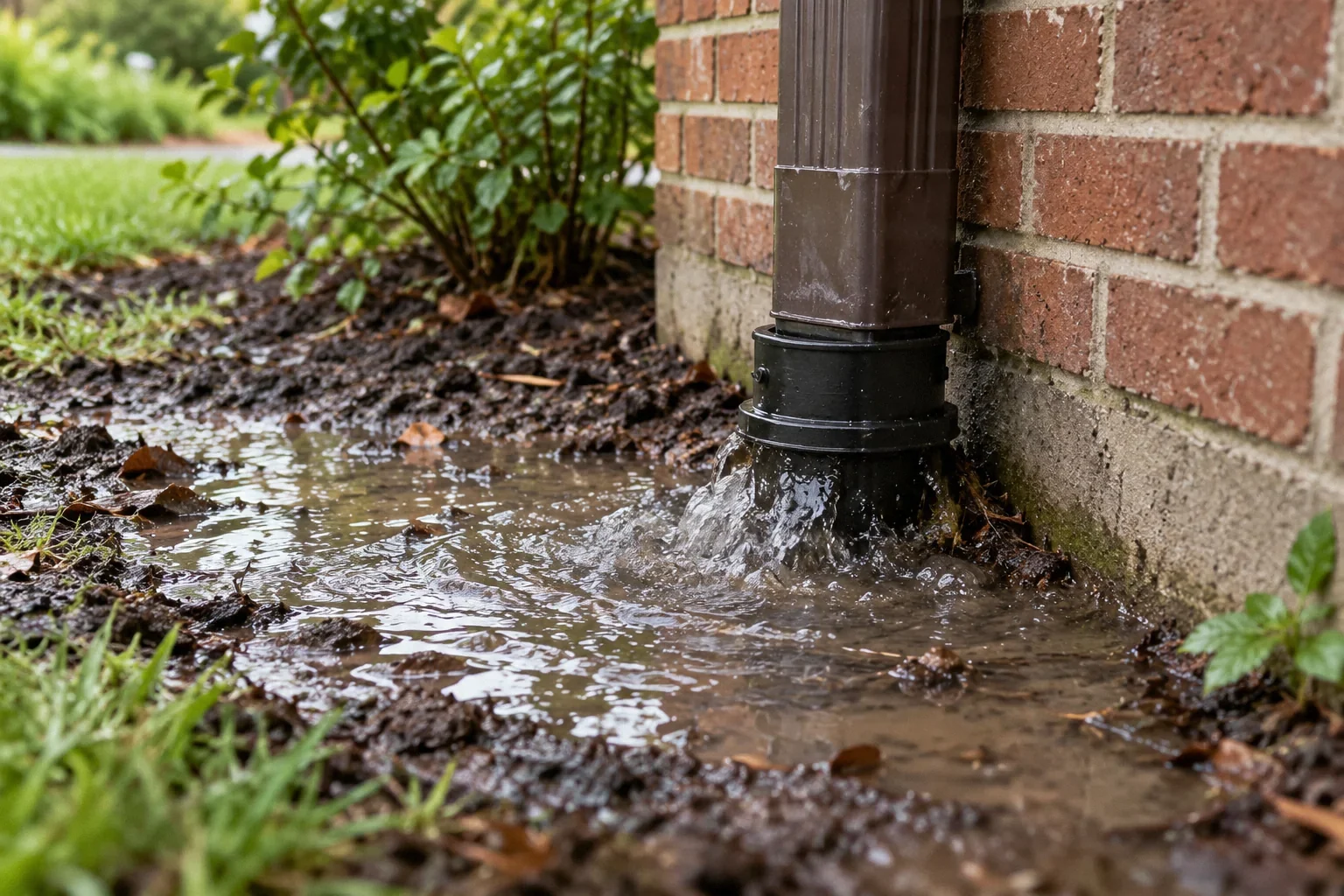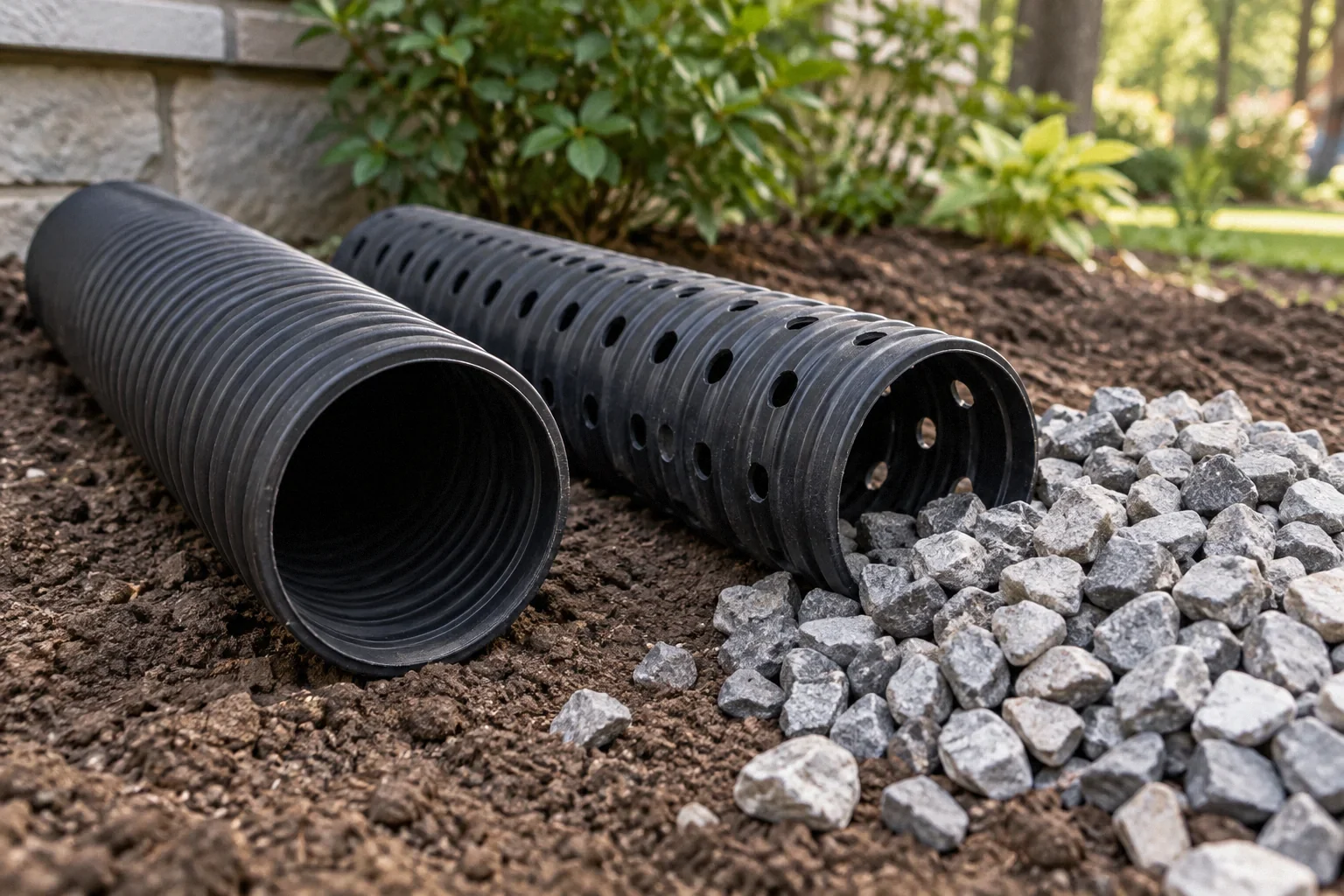
A buried downspout carrier transports roof runoff. A French drain collects water from surrounding soil through a permeable collection assembly. A footing drain serves the foundation. Identify the actual pipe and its destination before approving cleaning, connections or replacement.
Name the job before naming the product
Ask what water the system is intended to receive: roof runoff, water entering a surface grate, water in surrounding soil or moisture near a foundation footing. A single property can have several systems, sometimes with connections that are not documented. The visible inlet alone does not identify every buried component. A downspout disappearing into a pipe proves only that roof water enters there. It does not prove the pipe is solid, intact, appropriately routed or connected to an approved destination. Start the inspection with that limited statement rather than a confident label.
The sediment discussion uses the term French drain without establishing whether the line collects soil water or carries roof runoff. This Reddit account is anecdotal, not technical authority. [3]
Recognize the distinction between collection and conveyance
A collection system admits water from a particular source; a carrier moves collected water along a route. Perforated and nonperforated pipes therefore serve different purposes. PNNL distinguishes roof-water piping from foundation drainage. [1] This distinction matters when someone proposes connecting a downspout to an existing line simply because it is nearby. Ask the contractor to identify the line’s function and explain why the added connection is compatible. An undocumented assumption about pipe type should remain an open issue until evidence resolves it.
Surface drains add another source
A grate or catch basin can receive water flowing across paving or soil and discharge it through a buried carrier. That does not automatically make the whole installation a French drain. Ask for a sketch showing each inlet, any soil-collection segment and the outlet. The sketch should distinguish what is observed from what is inferred. This is useful when several surface basins feed a line that also receives roof runoff, because sediment entry and maintenance access may differ from a roof-only route.
Identify the destination without blind excavation
Look for existing plans, invoices, visible outlets and accessible cleanouts. A qualified inspection may include a camera and location equipment where suitable. Do not dig along an assumed route or enter drainage structures to investigate. Underground utilities, structural foundations and tree roots can constrain investigation and repair. If the destination remains unknown, the report should say so. A functioning-looking inlet during a small test is not enough to establish where the water went or whether the route remains appropriate during prolonged rain.
Choose maintenance for the identified system
A soil-collection assembly may have issues outside the pipe, such as its surrounding collection zone, while a solid carrier may be blocked at a connection or outlet. Clearing the pipe cannot automatically restore every form of drainage failure. Ask the service provider what portion their method can reach and what evidence will show improvement. NDS’s exterior drainage guide distinguishes system components and their roles. [2] Use it as background, not as proof that an unknown existing installation matches a standard diagram or a particular product.
Keep foundation work out of casual assumptions
An unidentified line beside a house should not be treated as a convenient stormwater connection. A foundation drainage assessment may require different expertise and greater care than clearing an accessible yard inlet. If water is entering a basement or crawlspace, investigate roof runoff, surface grading and possible non-storm sources as part of the overall assessment. The right escalation follows the observed problem and the system’s role, not the colloquial name used by a previous owner or service company.
Translate common labels into inspection questions
When someone says drain tile, French drain, storm drain or downspout drain, ask them to point to the source and destination rather than debating terminology alone. Different regions and contractors may use labels differently. A functional description is harder to misunderstand: this solid pipe carries water from this downspout to this observed outlet, or this assembly collects water from surrounding soil along this area.
For an undocumented system, the report may contain several confidence levels. The inlet can be confirmed, the route partly located and the destination still unknown. Preserve those levels instead of forcing a single definitive label. That record is particularly useful before connecting additional roof water or choosing a cleaning method.
If the line lies near a foundation, ask explicitly whether it has any role in foundation drainage. Do not let proximity become the answer. Plans, inspection and qualified interpretation should establish the function. The cost of clarifying identity can be more useful than paying for a repair designed around the wrong type of system.
When several systems join, ask the inspector to identify the connection rather than infer it from simultaneous flow. Two inlets responding during the same storm may simply receive water at the same time. Evidence of a shared route can come from records or appropriate inspection, with limitations stated. This distinction matters when one branch is proposed for reuse or when a new downspout connection is being considered. The contractor should explain whether the added source changes the intended function of any retained component. If the system identity remains uncertain, a staged investigation can be a complete and useful scope in itself. Its deliverable should be a clearer map and recommendation, not an unsupported declaration that all buried drainage is equivalent. Do not allow terminology alone to settle a design decision.
| Decision area | Question or evidence |
|---|---|
| Roof carrier | What roof source and final outlet are confirmed? |
| Surface network | Which grates or basins share the route? |
| Soil collection | What surrounding water is it intended to intercept? |
| Foundation drainage | What evidence establishes its role and connections? |
Example: a downspout beside a perforated line
Suppose an owner finds a pipe beside the foundation and is told it is a French drain. A contractor proposes joining a new downspout because the pipe appears to head toward the yard. Before approval, the owner needs to know whether it is a roof-water carrier, a soil drain or part of foundation drainage. The proposal should state how that identification will be made and where the line discharges. The fact that water disappears into it during a brief demonstration does not answer those questions. An unresolved identity is a reason for targeted investigation, not a reason to choose a stronger cleaning machine.
Create a system identity sheet
Keep a simple record with source, observed pipe type, accessible points, inferred route and confirmed destination. Use dashed lines for unverified sections. That small distinction prevents future work from converting an old guess into an assumed fact.
- Which water source is each inlet designed to receive?
- Which portions are solid carriers and which collect surrounding water?
- What evidence establishes the final destination?
What to take away
- Identify the source, pipe function and destination separately.
- Do not connect roof runoff to an unidentified nearby line.
- Match maintenance to the collection assembly as well as the pipe.
Sources & further reading
Reddit links show the questions people ask; they do not establish a diagnosis or a legal requirement. Technical requirements depend on the product, building and jurisdiction. See our research approach.
- DOE/PNNL: Gutters and DownspoutsTechnical / official reference
Roof-water system components, material tradeoffs, separation from footing drain; program-specific distances are not universal local code.
- NDS manufacturer: Principles of Exterior DrainageTechnical / official reference
Surface/subsurface collection, discharge planning, sizing and maintenance.
- Reddit discussion: My French drain is clogged with clay dirt. What do I do?Community question · anecdotal
Anecdotal homeowner discussion used to identify the question; not technical authority or evidence of this property’s condition.
Planning a Bay Area project?
Explore YKCA’s website and discuss the scope and services you need directly with them.