Compare the work before comparing the price. Put every bidder's proposed roof assembly, repair boundaries, allowances, exclusions, permit responsibility, and warranty on one sheet. Ask each contractor to resolve missing items in writing before choosing.
Start with one description of the problem
A replacement quote and a leak-repair quote answer different questions. Give bidders the same roof areas, known leak locations, access conditions, and desired result. If one believes a smaller repair is sufficient, ask for the evidence and expected limitations. Keep that alternative separate from full replacement so a lower total does not quietly become a different project.
Normalize the assembly, not just the shingle
A named shingle is only one component. Compare tear-off layers, deck evaluation, underlayment, starter and ridge products, edge metal, wall and penetration flashings, and ventilation changes. An item marked 'as needed' should identify who decides, how need is documented, and whether the base price includes it. Two proposals using the same visible product can buy materially different work.
Separate fixed scope from uncertain quantities
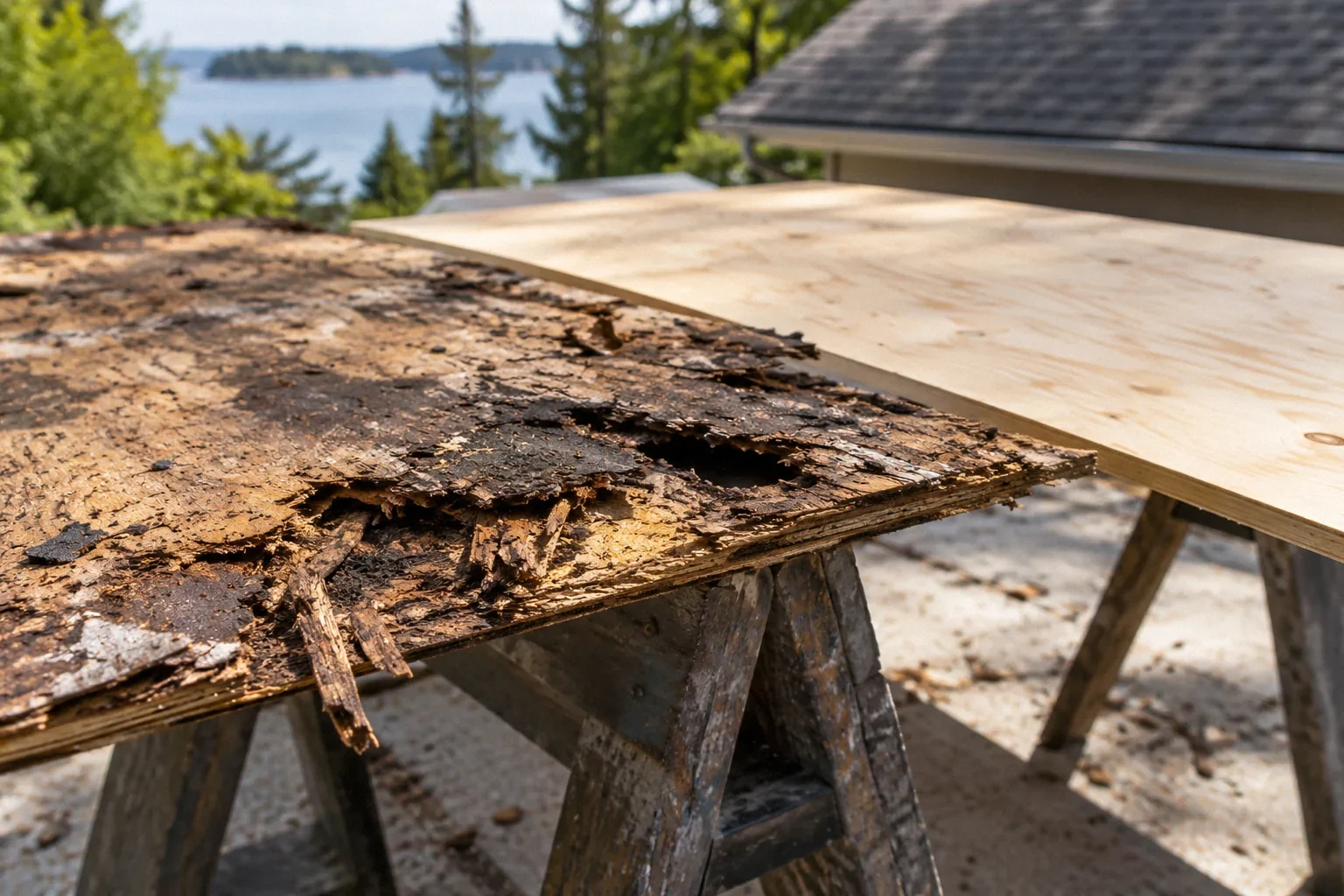
Hidden decking cannot always be counted accurately before removal. A useful bid explains the included allowance, the measurement unit, the unit price or pricing method for additional work, and the approval process. Sheets, square feet, and linear feet are not interchangeable. Ask whether cutting, attachment, demolition, disposal, and related finish restoration are included in each repair rate.
Check exclusions against the actual house
Look for intersections with chimneys, siding, gutters, skylights, solar equipment, and interior damage. 'Roof replacement' does not tell you whether any of these are included. Mark every excluded item that could prevent the finished system from working. An exclusion may be reasonable, but someone still needs to own the interface and the sequence.
Evaluate the company delivering the scope
Verify the contracting entity and license, speak with relevant recent customers, and identify the supervisor. CSLB recommends comparing written bids on equivalent scope rather than automatically choosing the lowest number.[1] A polished proposal is helpful evidence of organization, but it does not replace checking who will install the roof or handle a callback.
Compare schedule and closeout obligations
Ask how much roof may be opened at once, who responds if weather changes, how inspections are scheduled, and what final records you receive. A completion date without a weather or access plan is incomplete information. The contract should connect final payment to its agreed completion requirements, including any required corrections and documentation.[2]
Make the unresolved differences visible
Send a short comparison sheet back to each bidder. Use 'included,' 'excluded,' 'allowance,' and 'not answered' instead of guessing. Save both the original and revised proposals. The Reddit discussion behind this topic contrasts strong communication with apparent technical experience; it is a useful question, not proof that either style reliably predicts installation quality.[3]
Turn the comparison into a purchasing decision
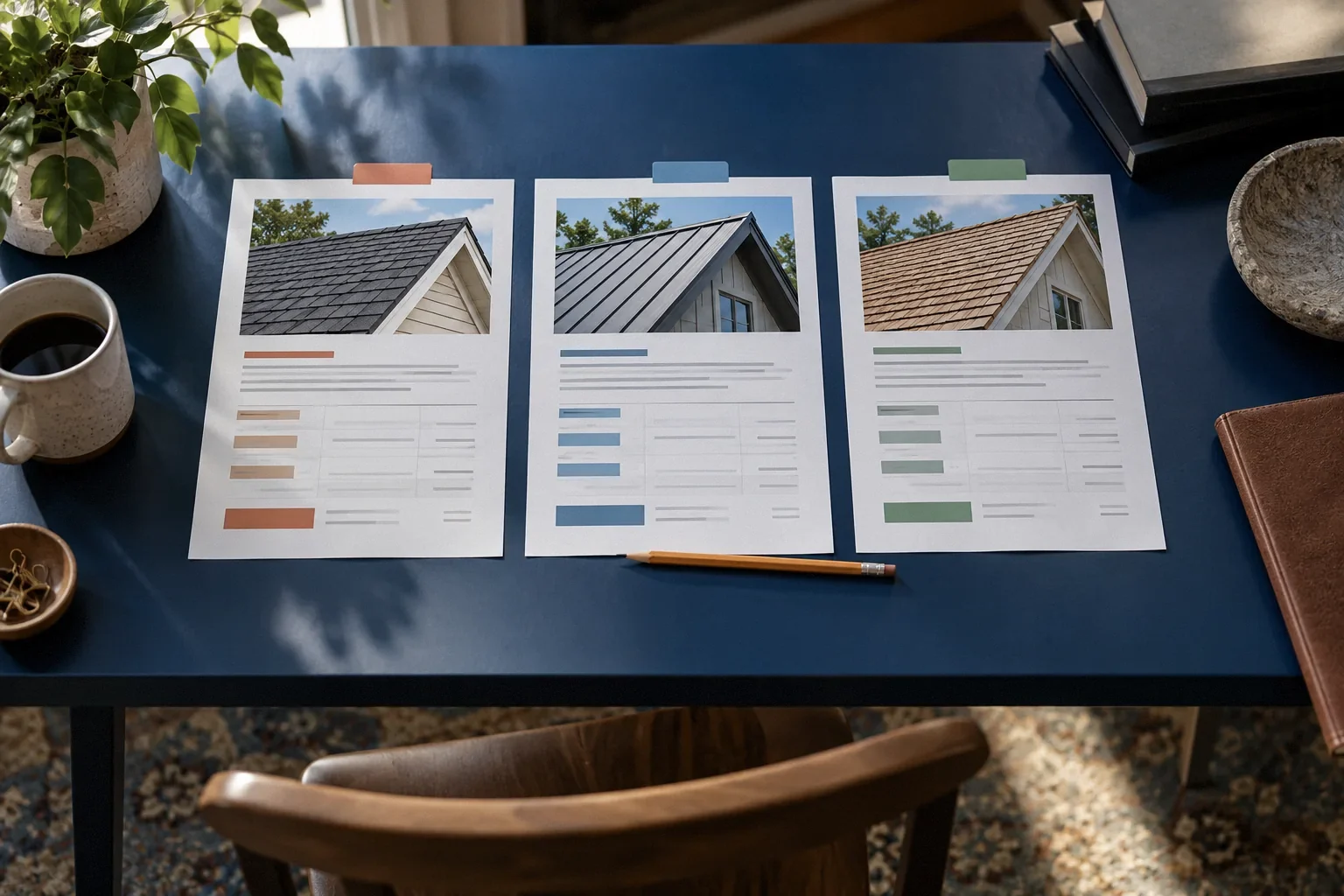
Create a matrix with one row per obligation and one column per contractor. Use the exact proposal wording in the first pass. Then add a separate column for the homeowner's required outcome: for example, replacement of the leaking wall transition with a documented detail, rather than merely 'flashing included.' This prevents a long proposal from appearing complete simply because it contains many words. The matrix is a question list until the contractors confirm the interpretation. Do not silently rewrite their offers or assume that an unanswered item is included.
Ask for alternates when a genuine design choice drives the difference. One contractor may propose retaining serviceable components, while another replaces them to reduce future access risk. Have each explain the expected benefit, limits, access required, and incremental scope. A higher price can be reasonable without being mandatory; a lower price can be reasonable without being a shortcut. The comparison should show what risk or work changes with the price. If the proposals reflect incompatible diagnoses, obtain clarification of the condition before deciding between assemblies.
Check the bid's assumptions against conditions you can verify before signing. Measure access restrictions, identify rooftop equipment, confirm whether the attic can be entered, and disclose known prior repairs. Ask the bidder which assumptions would change the price if wrong. This is not an invitation to accept unlimited extras: it is a way to separate foreseeable scope from genuinely concealed conditions. Keep your own notes about site constraints and make sure every bidder received the same information. Otherwise the comparison may reward the company that simply knew less about the house.
Finally, assess whether the chosen contractor answers difficult questions clearly. A useful response describes the work, gives evidence, and revises the proposal where necessary. A vague reassurance leaves the uncertainty with you. References can help test whether the company followed through on similar promises, especially supervision, change approval, cleanup, and callbacks. Ask former customers about those specific experiences instead of only whether they liked the contractor. Save the final accepted proposal and superseded versions so later scope questions have an identifiable starting point.
- Ask each bidder to confirm the same roof areas and included layers; do not compare totals while one roof section is missing.
- Record whether each uncertain item is priced, allowed for, excluded, or awaiting investigation, and resolve critical gaps before selection.
- Compare realistic repair and replacement alternatives separately, with their own limitations, instead of disguising them as equivalent offers.
A practical example
One bid includes replacing roof-to-wall flashing; another says existing flashing will be reused where serviceable. Do not simply add an invented allowance to the second bid. Ask what access is needed to inspect that flashing, what defects would require replacement, whether siding removal is included, and how additional work would be approved. The second contractor may produce a sound, less invasive scope, or may reveal a significant omission. Your comparison becomes defensible only after that difference is explicit.
When the comparison is ready for a decision
You are ready to choose when the meaningful differences are explicit, the responsible company is verified, the uncertain work has a defined approval method, and the final agreement reflects the selected scope. You do not need identical proposals in every respect. A contractor may offer a different assembly or service level for a defensible reason. What you need is enough information to understand that choice and its consequences. Keep optional upgrades separate so they do not disguise omissions in the essential work.
If a bidder will not clarify a critical interface, pricing unit, or exclusion, treat that uncertainty as part of the offer rather than filling the gap yourself. A low price with an unresolved necessary task is not yet a complete project price. Conversely, do not reject a careful contractor merely for acknowledging a concealed condition that cannot be known in advance. Clear uncertainty with a sound investigation and approval process is more useful than false certainty. The final purchasing decision should identify what is being bought, what remains conditional, and how the parties will resolve discoveries.
What to take away
- Require a written answer for every material scope difference.
- Compare decking allowances using the same measurement units.
- Choose with scope, verification, supervision, and closeout obligations visible.
Sources & further reading
Reddit links show the questions people ask; they do not establish a diagnosis or a legal requirement. Technical requirements depend on the product, building and jurisdiction. See our research approach.
- CSLB: Finding the Right ContractorTechnical / official reference
State consumer guidance: compare same scope; verify license and insurance; active C-39 WC requirement.
- CSLB: Homeowner ChecklistsTechnical / official reference
Permits, written change orders, deposit cap and work-based payments.
- Which contractor would you choose?Community question · anecdotal
Anecdotal discussion used to identify reader questions. Not verified incident evidence or legal, insurance, or technical authority.
Planning a Bay Area project?
Explore YKCA’s website and discuss the scope and services you need directly with them.