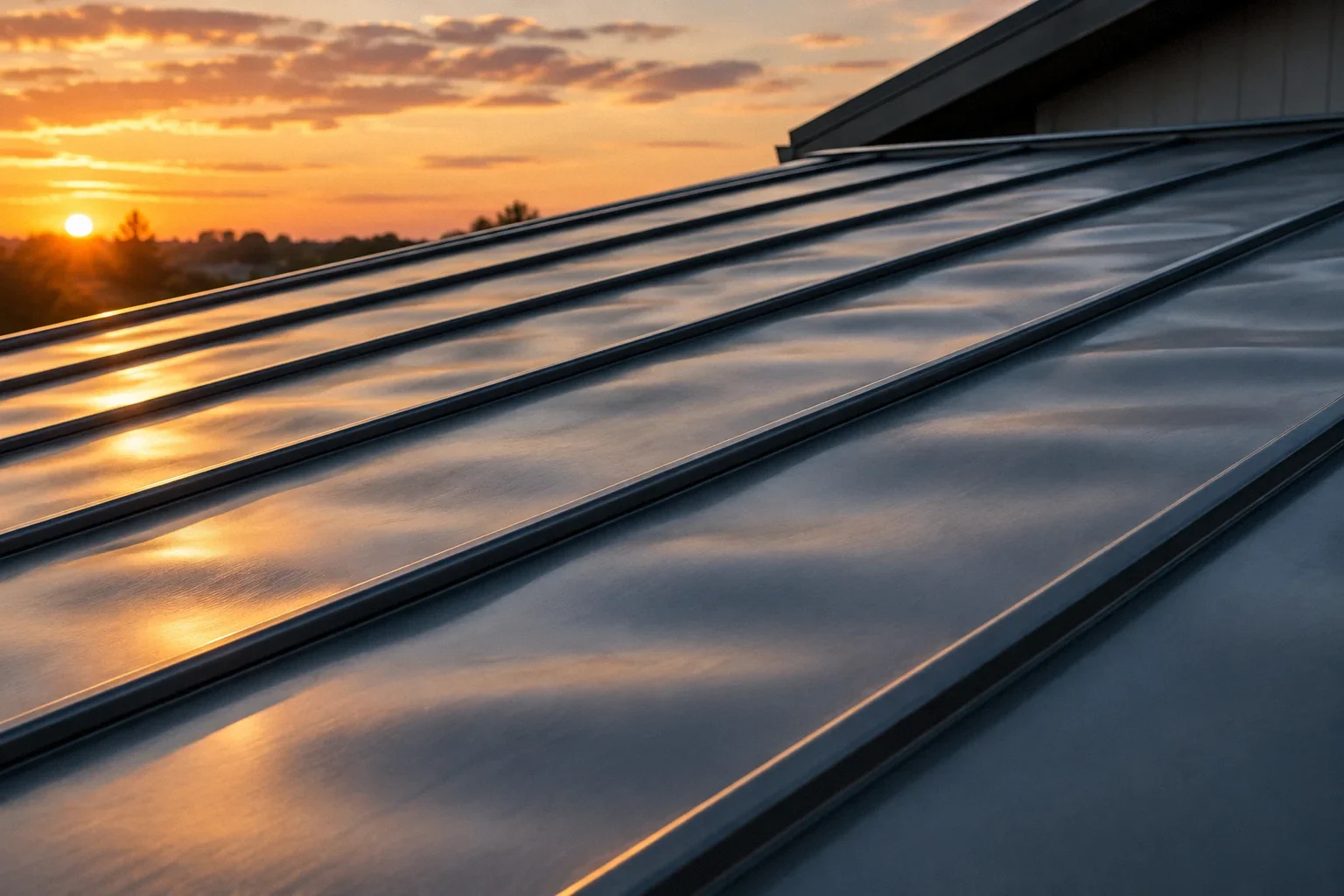
Oil canning is visible waviness in metal panels. It can be an appearance characteristic without proving that the roof leaks, but that does not mean every distorted panel should be dismissed. Evaluate the waviness separately from seams, attachment, substrate and flashing conditions that determine performance.
Distinguish waviness from functional defects
The Metal Construction Association describes oil canning as stress wrinkling and identifies material, panel design, production and installation as relevant factors. [1] The practical point is that more than one influence can create visible waves. A photograph of the finished surface cannot reliably allocate responsibility among them, and a broad assurance that metal always does that is not a complete condition report.
Other explanations to distinguish
Viewing angle and lighting can change how prominent a panel looks. Local substrate irregularity, installation stress and panel configuration may also influence appearance. These possibilities are not the same as open seams, damaged coatings or distorted flashings. A technical review should identify whether the concern is only visual or accompanied by an observable functional defect.
Evidence to request before choosing the work
Retain the panel specification, approved appearance samples, installation photographs and any written discussion of expected waviness. Take comparison photographs from ordinary viewing locations under stated conditions, rather than using one extreme reflection as the whole record. Ask the installer or manufacturer to inspect the actual configuration and distinguish product characteristics from conditions that depart from the intended assembly.
Where appearance is disputed, compare ordinary agreed viewing positions rather than moving indefinitely between more flattering and less flattering angles. Record lighting and the extent of the affected area. That does not create a technical tolerance, but it makes the discussion reproducible. Any proposed remedy should then be evaluated separately for its appearance benefit and its effect on the supported panel assembly.
How the findings change the repair decision
If the issue is appearance alone, the decision concerns expectations, the approved product and feasible remedies. If functional defects are present, those require their own correction regardless of the appearance discussion. Do not accept a repair that promises perfectly flat panels without explaining its basis. Equally, a disclaimer about waviness should not be used to avoid investigating an unrelated open seam or deficient flashing.
A practical example and what it does not prove
A sampled standing-seam discussion involves flat dark panels, visible waves and disagreement about substrate and installation. [2] The competing explanations illustrate why internet votes cannot settle workmanship. A useful response asks for an on-site review against the selected panel system and the preconstruction appearance agreement, while documenting any independent water-control concerns.
Limits and when professional review matters
Do not press, pry or alter panels to test whether waves can be removed. An attempted cosmetic adjustment can affect attachments or finishes. Manufacturer review may be valuable where a remedy changes panel support or movement behavior. The article does not provide an allowable waviness tolerance; acceptance must be tied to applicable project documents and product information.
Keep appearance acceptance and water control separate
An owner may dislike waviness even when the assembly performs its water-shedding role. That is a legitimate appearance discussion, but it should not be confused with a leak diagnosis. Compare the approved panel configuration and documented expectations. At the same time, investigate any open connection or distorted flashing on its own merits rather than allowing an appearance disclaimer to end the technical review.
The proposed remedy deserves the same separation. Ask what visual improvement is expected and whether the change is supported for the panel system. An intervention that affects support or attachment should be reviewed beyond its immediate cosmetic effect. Do not accept a promise of perfect flatness without a clear basis and an explanation of the limits.
- Waviness is visible only under particular lighting: record reproducible viewing conditions before comparing proposed remedies.
- A wavy area also has a separate open detail: investigate the detail independently from appearance acceptance.
- The remedy changes panel support or attachment: obtain system-specific review rather than judge it only from an after photograph.
Questions that resolve the remaining uncertainty
An appearance sample is useful only if the parties understand what it represents. A small sample may establish color or finish while saying little about the look of a long installed panel. Ask the supplier and installer to explain the relevant limitations before using a sample as proof of expected flatness. The goal is an informed appearance agreement, not a retrospective argument about an unrelated display piece.
If there is no preconstruction appearance record, document the current concern and request a system-specific review. Avoid substituting an informal internet tolerance for the missing agreement. A practical resolution should identify feasible options and their limits, while keeping any separate water-control defect on its own corrective list.
Appearance remedies need their own technical review
A proposed cosmetic intervention should identify both the expected visual change and the components it alters. Changing support or attachment is different from merely documenting an appearance characteristic. Ask whether the manufacturer supports the intervention for the selected panel. A photograph showing reduced waviness immediately afterward does not establish that every system relationship remains appropriate.
Before discussing remedies, make the concern reproducible. Use agreed ordinary viewing locations and record relevant lighting. This does not create a universal tolerance, but it allows the parties to discuss the same appearance. A small product sample may establish finish or color without representing the appearance of a long installed panel. Its limitations should be acknowledged rather than used as definitive proof on either side.
Keep unrelated defects outside the appearance argument. If a seam is open or flashing is distorted, document and evaluate that condition independently. An oil-canning disclaimer should not answer a different water-control question. Conversely, dislike of waviness does not prove that seams are defective. The resolution becomes clearer when the owner can compare an appearance issue, a verified functional issue and an unsupported suspicion as three distinct items instead of one generalized claim that the roof is wrong.
What to take away
- Evaluate appearance separately from seams, flashings and attachment performance.
- Use the selected panel specification and documented expectations.
- Request manufacturer-supported review before attempting cosmetic alterations.
Sources & further reading
Reddit links show the questions people ask; they do not establish a diagnosis or a legal requirement. Technical requirements depend on the product, building and jurisdiction. See our research approach.
- MCA oil canningTechnical / official reference
Stress wrinkling mechanisms and mitigation
- Homeowner discussion: Oil Canning Standing SeamCommunity question · anecdotal
Anecdotal issue research, not technical authority or proof about another property.
- Homeowner discussion: What's wrong with oil canning?Community question · anecdotal
Anecdotal issue research, not technical authority or proof about another property.
Planning a Bay Area project?
Explore YKCA’s website and discuss the scope and services you need directly with them.