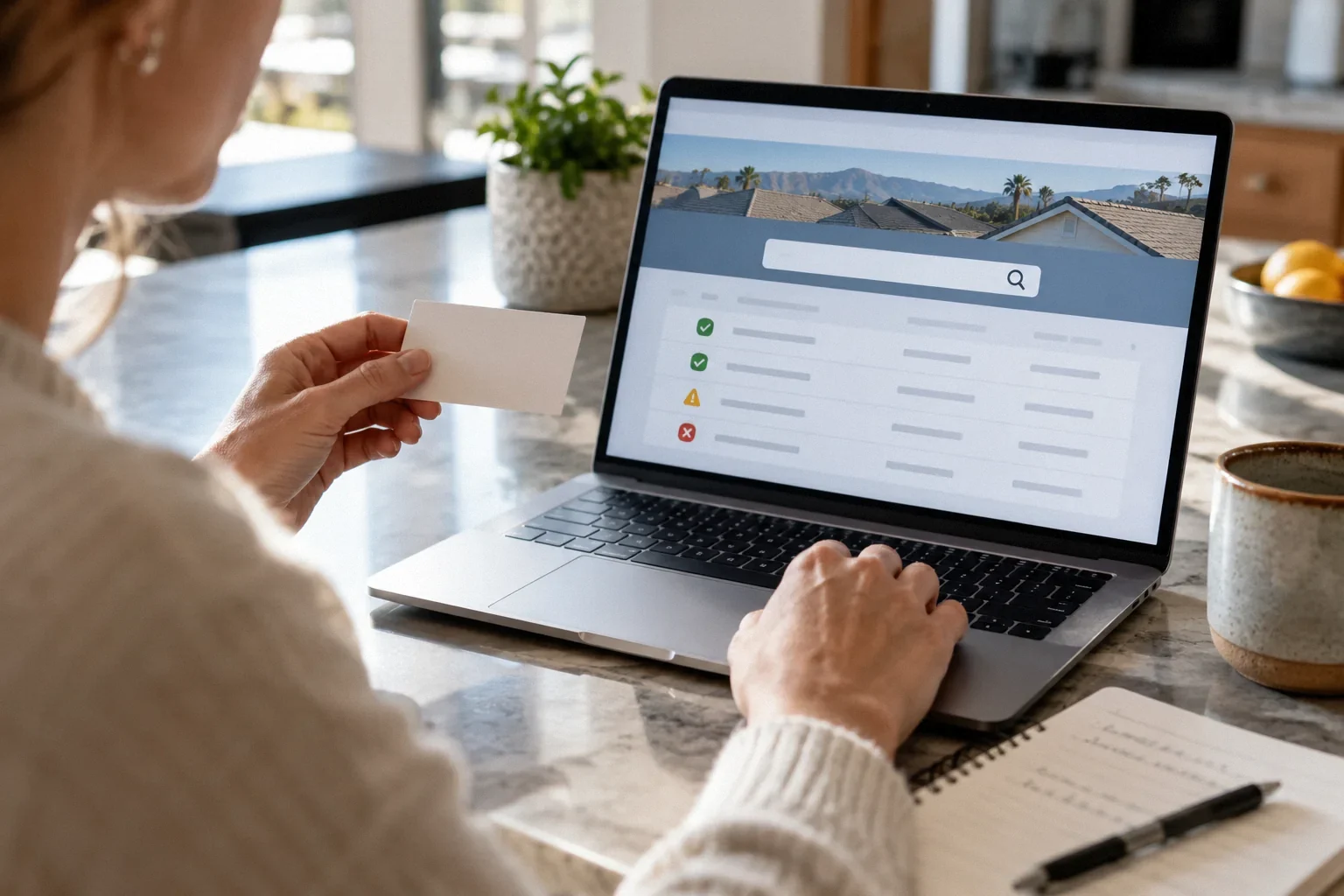
Look up the exact company and license number in CSLB's official database, then compare the result with the proposal and the work being offered. Check status, classification, disclosed history, and insurance information; save a dated copy before signing.
Match the identity on every document
A familiar brand name, a salesperson's name, and the legal contracting entity may differ. Ask which entity signs the agreement and receives payment. Compare that name and address with the CSLB record. A real license belonging to somebody else does not verify the company in front of you. Resolve unexplained mismatches before making a deposit.
Read the status rather than the logo
Advertising may display a license number long after circumstances change. Use the official lookup and review what it says now.[1] A screenshot sent by the contractor is useful only as a lead to your own check. Record the check date because license and insurance status can change between estimating and the start of construction.
Check whether the classification fits
California distinguishes general building and specialty contracting. Roofing commonly involves the C-39 classification, but the permitted contracting arrangement depends on the actual scope and who performs specialty work. CSLB explains how general contractors may contract for specialty work under applicable conditions.[2] Do not accept an invented extra trade as a substitute for a lawful scope.
Examine disclosed history carefully
Read public disciplinary or complaint information in context. Absence of a public complaint is not a certificate of flawless performance; a disclosed item is not automatically proof the current proposal is defective. Ask specific questions about relevant unresolved issues. Save the actual record rather than repeating a rumor or a reviewer's interpretation.
Verify the person selling the work
Ask how the salesperson is connected to the licensed entity and whether required home-improvement salesperson registration applies. CSLB provides a registration lookup as well as contractor searches.[1] Make sure any promises about materials, labor, pricing, or warranty become part of the agreement. A verbal assurance from a representative should not remain your only evidence.
Connect licensing to insurance and supervision
An active license does not establish every insurance coverage question or identify tomorrow's crew. Ask who supervises, whether subcontractors are involved, and who handles corrections. Check the insurance information relevant to the contractor and request carrier confirmation where appropriate. These are distinct checks, not benefits automatically conferred by a license number.
Recheck before mobilization if circumstances change
A long delay, different company name, replacement supervisor, or request to pay another entity warrants a fresh review. Keep a simple record of the change and the explanation. The subcontracting discussion that prompted this article illustrates uncertainty about responsibility, but Reddit users cannot verify your contractor's California licensing arrangement.[4]
A practical license-check record
Keep a one-page verification record containing the lookup date, business name, license number, address, status, classifications, and relevant insurance information displayed. Add the proposal's entity name and the person who explained any difference. This record is not a professional certification; it documents the due diligence you actually performed. If the project is delayed substantially, revisit the live record rather than assuming the saved page is still current. A dated record is especially useful when the agreement is signed long before mobilization.
If a contractor says a general building license covers the job, ask how the actual roofing scope will be lawfully contracted and performed. The answer may involve a valid specialty classification or an appropriately licensed specialty contractor, depending on the arrangement. Do not try to manufacture a qualifying scope by adding a nominal unrelated task. The question is whether the real work and contracting structure meet the applicable requirements. CSLB's guidance and a direct clarification can resolve uncertainty more reliably than an anecdote about what another contractor once did.
Check the relationship between the person at your door and the business you intend to hire. Ask who will sign, who can authorize a price change, and who will receive the payment. A salesperson may appropriately represent a company without being its owner, but promises still need to be incorporated into the agreement. If the contract suddenly names a different company, repeat the identity check. Do not regard a matching phone number or a shared brand as proof that two legal entities have the same responsibilities.
Public records are only one input into selection. They do not inspect your proposed details, verify the skill of a particular crew, or establish that the company has enough capacity for your schedule. Combine the licensing check with a clear scope, relevant references, insurance verification, and a supervision plan. This avoids two opposite mistakes: rejecting all nuance because a record contains a historical issue, or assuming an active status makes every other question unnecessary. Document the unresolved items and ask the relevant authority or professional for clarification before committing.
- Record the exact entity named in the agreement and compare it with the live license record before making the first payment.
- Ask for an explanation of any classification or entity mismatch; do not invent a favorable interpretation on the contractor's behalf.
- Recheck meaningful changes in name, payment recipient, scope, or start date rather than relying forever on an old screenshot.
A practical example
Suppose a proposal uses a trade name, while the deposit request names an unfamiliar corporation. That difference may have an ordinary explanation, but your next step is not to infer either fraud or legitimacy. Request the legal entity name, license number, and explanation of the relationship. Confirm them in the official record and have the contract identify the responsible entity. If the parties cannot make those documents consistent, postpone payment and obtain professional guidance.
What to do when the lookup raises a question
If the record cannot be found, first check spelling and the license number with the contractor. Search by the legal business name as well as the advertised name. A typographical error can be resolved; a refusal to identify the entity cannot be solved by guessing. Save the proposal and the search result, then ask CSLB for guidance if the explanation remains inconsistent. Do not use a third-party lead directory as the final authority on California license status.
If the record exists but does not clearly support the proposed arrangement, pause the commitment long enough to obtain clarification. Explain the actual scope and who will perform it. Avoid broad accusations based on a classification you have not understood, but do not accept an unsupported claim that the rules do not matter for your small project. CSLB's current guidance addresses permits, use of workers, and contract value in determining licensure requirements.[2] The responsible decision is based on the applicable conditions together, not a single price threshold remembered from an older article.
What to take away
- Check the official record yourself and save the date.
- Match entity, classification, and actual contracting arrangement.
- Treat licensing, insurance, and installation supervision as separate checks.
Sources & further reading
Reddit links show the questions people ask; they do not establish a diagnosis or a legal requirement. Technical requirements depend on the product, building and jurisdiction. See our research approach.
- CSLB: Check a LicenseTechnical / official reference
License identity, classification, status and disclosed complaint checks.
- CSLB: What Kind of Contractor Do You Need?Technical / official reference
Current license thresholds and specialist/general contractor distinctions.
- CSLB: Finding the Right ContractorTechnical / official reference
State consumer guidance: compare same scope; verify license and insurance; active C-39 WC requirement.
- How risky is a roofer who uses subcontractors?Community question · anecdotal
Anecdotal discussion used to identify reader questions. Not verified incident evidence or legal, insurance, or technical authority.
Planning a Bay Area project?
Explore YKCA’s website and discuss the scope and services you need directly with them.