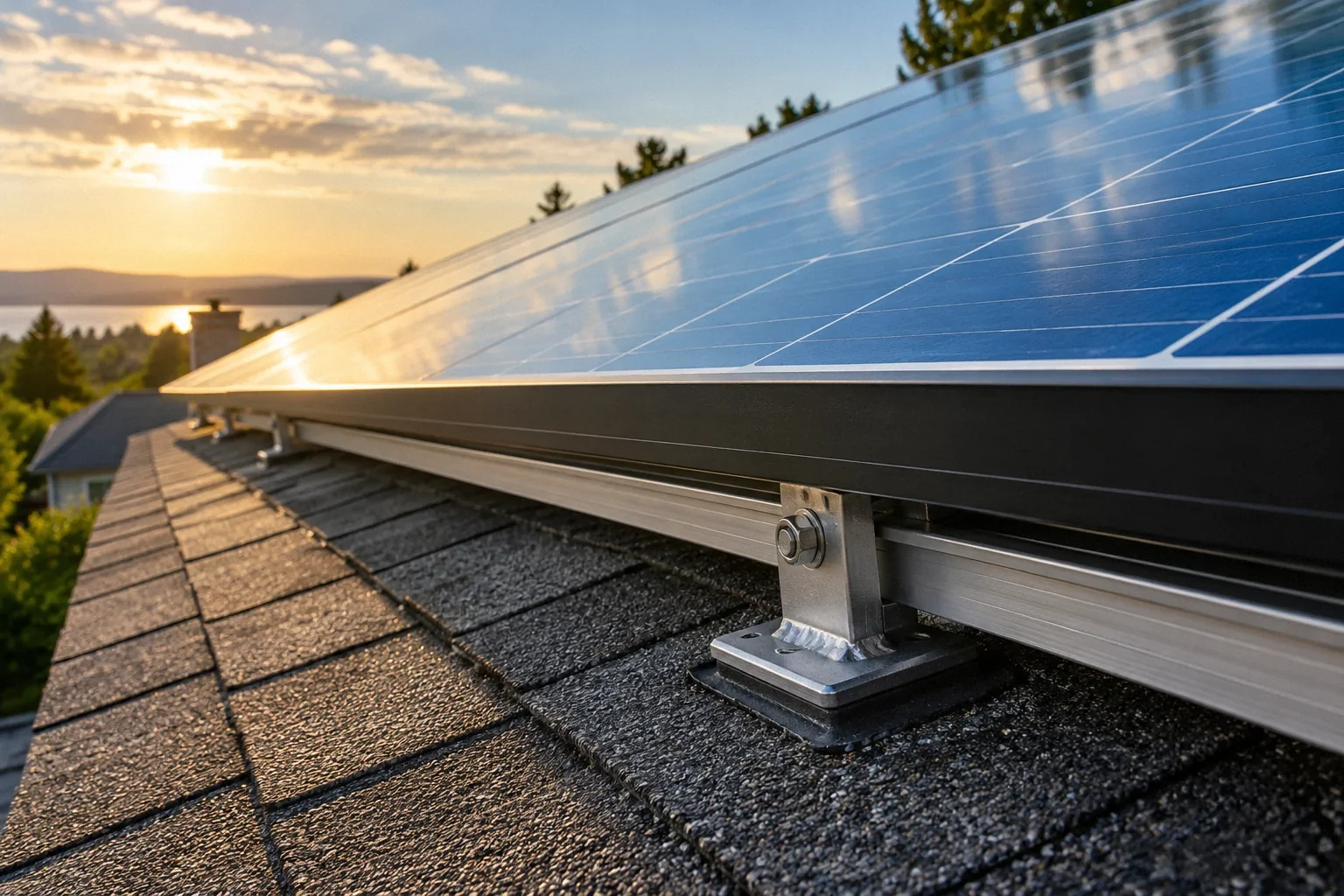
A leak appearing after solar installation deserves a coordinated roof and solar inspection, but timing alone does not prove who caused it. Document the moisture location, installation history and roof condition, then trace the water path. Mounts, conduit penetrations, disturbed roofing and unrelated preexisting defects all belong in the investigation.
Treat each solar penetration as an interface
Solar equipment introduces attachment and routing details into an existing roof assembly. Where a penetration crosses the roof, its flashing must integrate with the surrounding water-control layers. PNNL includes solar mounting brackets among roof interruptions that need this continuity. [1] The system is not protected merely because sealant is visible around a fastener or pipe. The selected mounting and roofing products must be evaluated together.
Other explanations to distinguish
The apparent connection to installation can reflect a new penetration defect, damage from access, previously concealed deterioration or a coincident problem at a nearby valley or wall. Water may travel before reaching the ceiling, so the panel directly over the stain may not mark the entry location. An electrical conduit route can be involved without the solar module itself being defective. Separate observations from conclusions about responsibility.
Evidence to request before choosing the work
Gather pre-installation roof photographs, the installation date, the roof's known age, mounting documentation and the first wet-weather observations. Ask for a location map connecting penetrations with the affected interior. The roofer should record roof-layer conditions, while the solar contractor identifies equipment and attachment details. If modules must be removed for access, the scope should address safe isolation, removal, storage, reinstallation and responsibility for final checks.
Keep the roof and solar location labels consistent. A photograph labeled only panel three can become confusing if the array layout changes during service. A shared drawing with fixed building references helps both trades identify the same penetration. Ask for the final equipment configuration to be recorded after reinstallation so later roof maintenance does not rely on an obsolete installation drawing.
How the findings change the repair decision
A local flashing repair may be appropriate when the surrounding roof remains serviceable and the correct connection can be restored. If access reveals broad underlayment deterioration or several compromised details, a larger coordinated project may be necessary. Do not approve separate contracts that each exclude the junction between roof repair and equipment reinstallation. Assign that interface explicitly and retain the product-specific detail used for the completed work.
A practical example and what it does not prove
A sampled Reddit thread describes a new roof with leakage near photovoltaic conduit as well as a separate valley-wall problem. [2] That combination demonstrates why all damp areas should not be assigned to one cause. Each location needs its own evidence. The eventual work may include both a penetration correction and unrelated drainage reconstruction, even though the homeowner first noticed them during the same storm.
Limits and when professional review matters
Solar equipment may remain electrically hazardous despite an apparently simple shutdown. Homeowners should not disconnect wiring, loosen mounts or climb between panels to investigate. Coordination is valuable precisely because roofing and electrical competence are different. Until the source is established, keep records factual: what changed, when moisture appeared, what was inspected and which conclusions remain provisional.
Allocate access responsibilities before the repair
The need to reach a roof defect can turn a local leak repair into a coordinated equipment project. Ask who determines safe equipment access, who documents the attachment condition and who reinstalls the components. The roofing proposal should not assume the owner will arrange an undefined removal at short notice. The equipment proposal should not assume the roof is ready without a handoff.
Preserve photographs of attachments before and after service. If the final layout differs from the original, update the location map. A future leak investigator needs to know what exists now, not only what was approved initially. Keep observations about water entry separate from electrical-system condition, because expertise in one field does not establish conclusions in the other.
- The suspect detail lies beneath equipment: coordinate access before committing to a repair date or fixed visible-only scope.
- A mount and a nearby valley both show concerns: investigate them separately before attributing all moisture to solar work.
- Equipment must be reinstalled on a repaired area: identify the accepted attachment and roofing interface in the final record.
Questions that resolve the remaining uncertainty
If a solar installer and roofer both attended the property, request a combined list of agreed observations and unresolved items. They do not have to agree immediately about responsibility to agree on locations, visible conditions and access needs. Those shared facts can support the next investigation. Keep any commercial disagreement separate from the immediate need to protect affected interior areas.
Compare penetration repair with equipment-access work
The physical leak correction and the work required to reach it are separate components of the project. A roofer may identify a bounded flashing defect while the solar contractor must arrange safe equipment access. The estimate should show both responsibilities. Otherwise the owner can accept a roof repair that cannot actually be performed under the installed array without another unplanned contract.
The handoff should identify when the roof is ready for equipment reinstallation and which attachment detail will be used. That is particularly important if the original attachment area was rebuilt. The final equipment configuration should match the documented roof interface; retaining an old drawing after the layout changes creates a misleading service record. Shared fixed-location references are more useful than informal panel numbers that may change.
When causation is disputed, separate agreed observations from responsibility. Both trades may agree that a penetration needs correction even while disagreeing about why it was deficient. They may also agree that a separate valley issue exists. Recording those facts allows protection and investigation to proceed without pretending the commercial dispute has been resolved. A technical report should not convert installation timing alone into proof that every current roof concern came from the solar project.
What to take away
- Post-installation timing is a lead, not proof of causation.
- Coordinate roof-layer inspection with equipment and attachment review.
- Assign responsibility for removal, roof repair and reinstallation interfaces.
Sources & further reading
Reddit links show the questions people ask; they do not establish a diagnosis or a legal requirement. Technical requirements depend on the product, building and jurisdiction. See our research approach.
- PNNL penetration flashingTechnical / official reference
Water-control continuity and penetration detailing; avoid treating illustrated assembly as universal code
- Homeowner discussion: Two leaks on 1y/o roofCommunity question · anecdotal
Anecdotal issue research, not technical authority or proof about another property.
Planning a Bay Area project?
Explore YKCA’s website and discuss the scope and services you need directly with them.