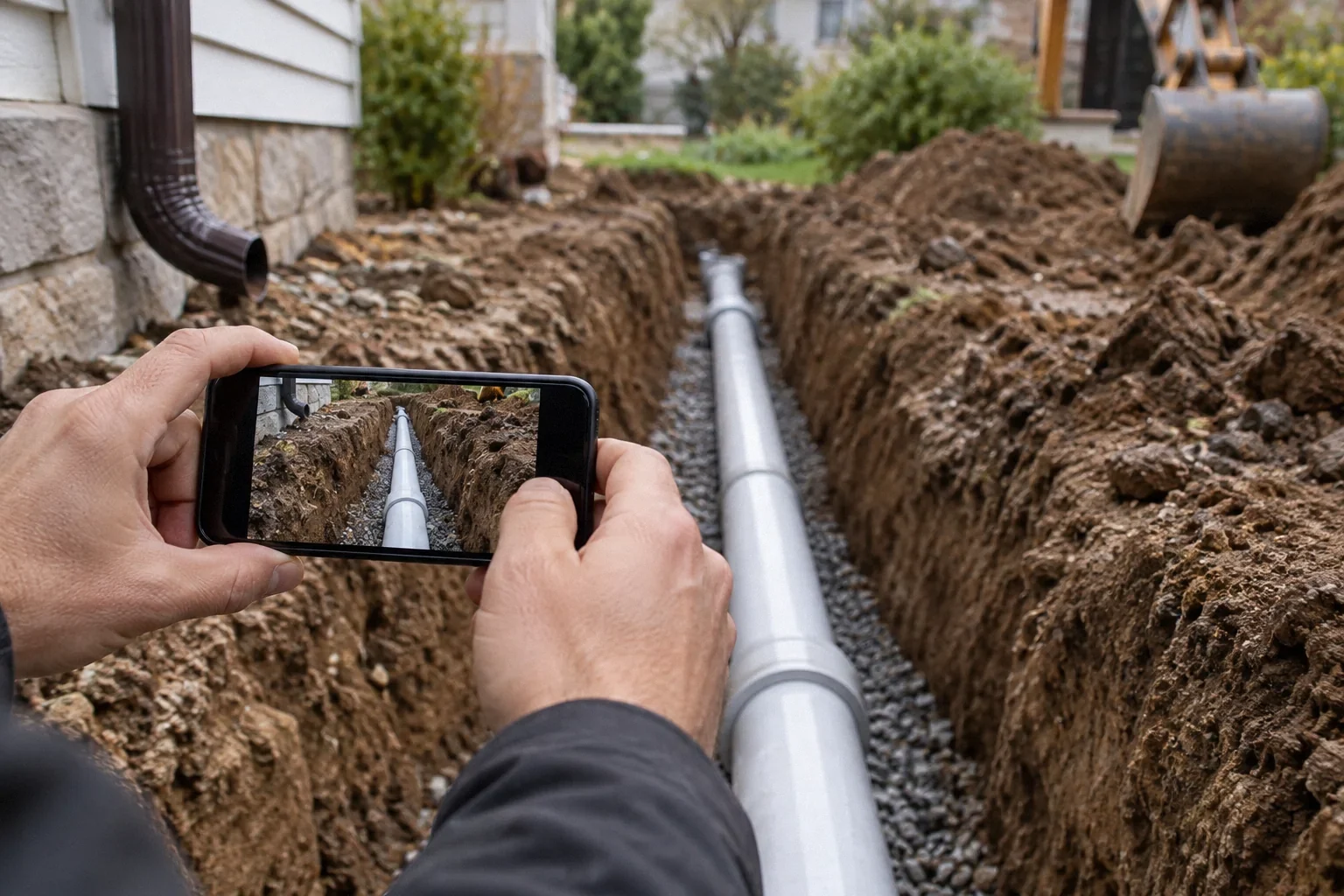
A useful drainage repair record shows the source, route, components, destination and observed completion checks. Photograph concealed work before cover and distinguish confirmed details from assumptions. These records support future maintenance without pretending a brief test proves every storm condition.
Create the record while the work is visible
Ask for documentation before construction begins so important stages are not missed. An overall plan and photographs tied to fixed landmarks can preserve the route. Do not rely on a collection of close-ups with no orientation. NDS’s drainage guide provides a framework for identifying components. [1] The project record should show the actual installation, including deviations from the original proposal. A standard product diagram can accompany it, but it should not replace photographs or an as-built sketch of what was installed.
The recurring corner-repair discussion shows why knowing exactly what changed can matter at the next service visit. This Reddit account is anecdotal, not technical authority. [3]
Label sources and destinations
Identify which downspout or surface inlet feeds each route and where the water leaves it. Use consistent names on the sketch, photographs and service notes. Mark retained existing piping and any unverified connections distinctly from new work. This prevents future crews from assuming every line on a drawing was installed and checked during the same project. If the outlet is a proprietary component, retain its model and instructions. Manufacturer guidance can support maintenance, but the site record still needs to show its receiving area. [2]
Photograph concealed connections with context
Request images before backfill or surface restoration, including connections and maintenance access points. Add an overall view that relates those details to the building or other fixed features. Where measurements are important, ask the contractor to record their reference points and method. Do not invent precise depths from photographs or assume a tape visible in one image characterizes the whole route. The record should be accurate enough to guide future investigation while remaining honest about measurement limits and later changes.
Preserve decisions and changes
If the route changed because of a utility, root or unforeseen condition, record the reason and revised arrangement. Keep the approved change scope with the final plan. An invoice that lists extra pipe without explaining its location is difficult to use later. Also preserve any specialist review relevant to the work, such as tree or structural constraints. The goal is not an unnecessarily large report; it is a coherent account of decisions that affect future maintenance, access or performance.
Describe the completion check precisely
State what was observed, where water was introduced if a controlled check was used, which outlet was watched and any limitations. Avoid a blanket passed drainage test statement without context. A brief flow observation may show continuity and visible leakage under that condition, while leaving storm capacity unproven. If camera footage was taken, label access point and direction. If a segment could not be inspected, keep that limitation visible. Good documentation distinguishes installed work from performance evidence instead of merging them into one reassuring phrase.
Plan the first-rain follow-up and maintenance
Keep safe observation points and the original complaint locations in the closeout notes. During an appropriate later rain event, record whether the symptom improved and whether a new issue appeared. Ask the installer how to report concerns and what maintenance is expected. Store product instructions and service access information where the owner can find them. Future landscaping should be reviewed against the drainage record so a new bed, border or paved area does not unknowingly obstruct an outlet or add an unplanned water source.
Make the record usable by someone who was not there
Review the closeout package as if you were a future service provider seeing the property for the first time. Can you identify each access point, connect photographs to the map and understand where the water ends? If not, add labels while the installation team still remembers the work. A small clarification now can prevent a much larger investigation later.
Avoid embedding important information only in text messages that may be lost. Save the final agreed scope, changes and images together in an ordinary folder with understandable filenames. Keep original videos as well as any short summary clips. If a map is revised, retain the final version clearly and distinguish it from the proposal so the intended route is not mistaken for the installed one.
The record should also state who provided each observation. A contractor’s test note, a designer’s plan and an owner’s later rain video are different evidence types. All can be useful when labeled. Do not merge them into a generic certification of performance. Their value comes from showing what was known at each stage and what remains available for future review.
Include any remaining uncertainties in the closeout summary rather than deleting them to make the project look finished. An existing downstream section may have been retained without full inspection, or natural-rain performance may still await observation. A clear record can state that the authorized construction is complete while preserving those limits. That distinction helps future service and avoids turning a completion invoice into an unsupported performance certificate. If later observations resolve an uncertainty, add the dated evidence without rewriting the earlier history. The result becomes a useful maintenance record rather than a static promotional report. Keep the package proportionate to the work, but do not omit the route, destination or verification limits merely because the project was small. Those details often determine what the next contractor needs most.
| Decision area | Question or evidence |
|---|---|
| Orientation | Fixed landmarks and consistent component names |
| Version control | Proposed route distinguished from installed route |
| Evidence type | Plan, contractor observation or owner rain record |
| Future access | Maintenance points and product instructions retained |
Example: a future blockage with and without a route record
Imagine a carrier blocks several years after installation. With a labeled as-built sketch, outlet photograph and accessible cleanout location, the service provider can begin a targeted assessment. Without them, the owner may first pay to rediscover the route and determine which grate connects to which pipe. The original documentation does not prevent every blockage, but it reduces avoidable uncertainty. Its value comes from linking images to real locations and preserving changes, not from the number of pages in the report.
A compact closeout package
Request a route sketch, labeled concealed-work photographs, component information, change notes, completion observations and maintenance instructions. Keep original files and a readable summary together. A future owner should be able to identify the system’s purpose and limits without contacting every contractor who worked on it.
- Does the final plan match the installed route?
- Are concealed connections and access points documented?
- What was observed during verification, and what remains untested?
What to take away
- Photograph concealed work before restoration.
- Label new, retained and unverified portions separately.
- Document completion checks with their actual limits.
Sources & further reading
Reddit links show the questions people ask; they do not establish a diagnosis or a legal requirement. Technical requirements depend on the product, building and jurisdiction. See our research approach.
- NDS manufacturer: Principles of Exterior DrainageTechnical / official reference
Surface/subsurface collection, discharge planning, sizing and maintenance.
- NDS manufacturer: What Is a Pop-Up Emitter?Technical / official reference
Outlet operation and sediment/leaf maintenance.
- Reddit discussion: How to repair leaky gutter corner seamsCommunity question · anecdotal
Anecdotal homeowner discussion used to identify the question; not technical authority or evidence of this property’s condition.
Planning a Bay Area project?
Explore YKCA’s website and discuss the scope and services you need directly with them.