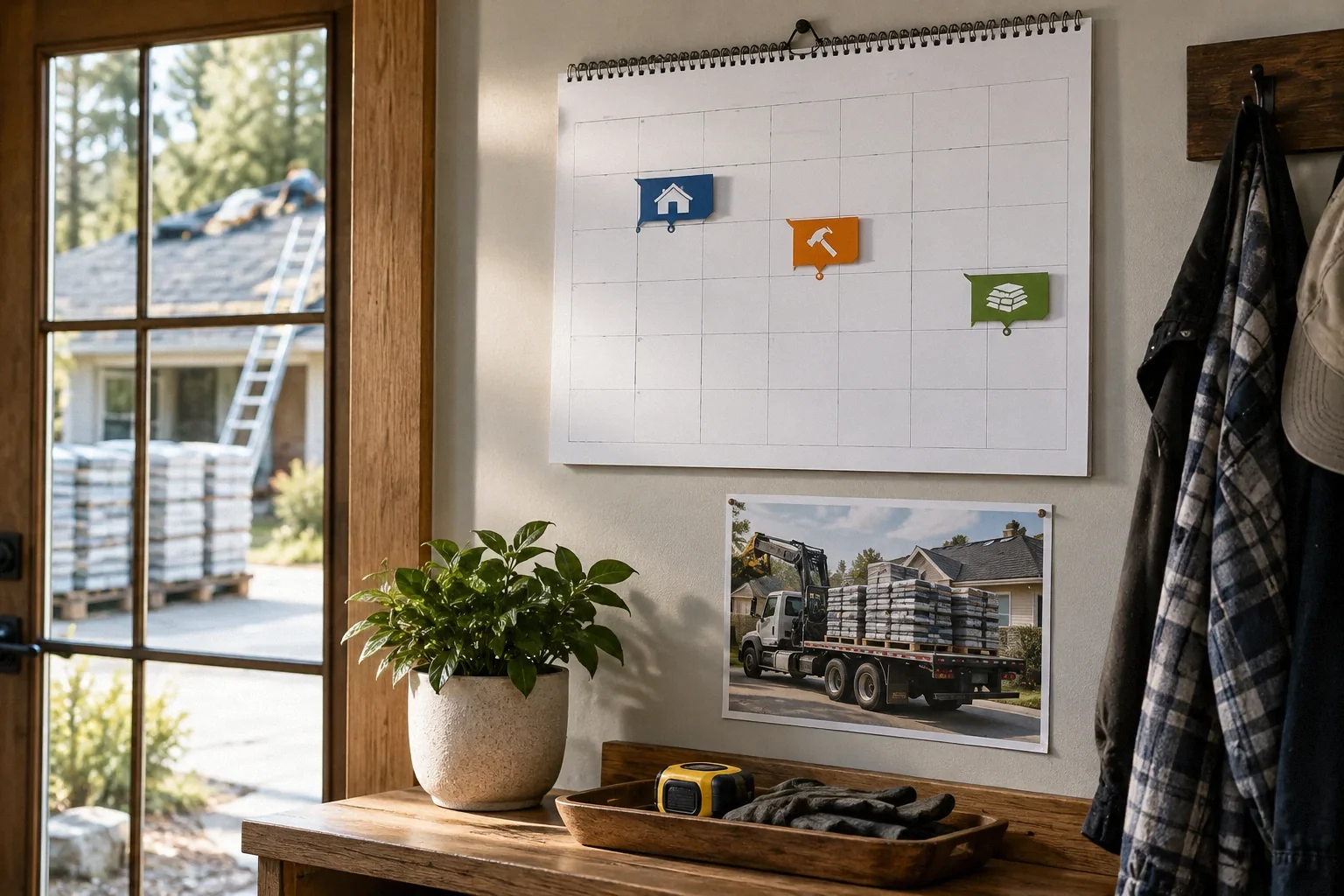
A useful roofing payment schedule names completed work or delivered materials, gives a dollar amount for each stage, and shows how completion will be verified. Percentage milestones without defined deliverables make disputes more likely.
Build the schedule from the work sequence
List the actual sequence: permitted start where required, delivery, tear-off and repair decisions, assembly installation, corrections, and closeout. A small roofing project may need fewer stages than a complex one. The schedule should fit the project rather than imitate a bathroom remodel, a commercial draw schedule, or another state's customary thirds.
Describe the value behind each draw
CSLB guidance connects payments after the down payment to completed work or material delivered.[1] 'Half at start' does not explain value. A better description identifies the material quantity and location or the completed roof area and work items. The contractor should be able to show what supports the invoice without inventing a milestone after payment is requested.
Keep the deposit calculation separate
For ordinary California home-improvement contracts, the initial deposit is subject to the smaller-of-$1,000-or-10% rule.[2] Progress payments do not become deposits merely because they arrive early. Equally, a permitted deposit does not require the contractor to use your money in a particular internal accounting system; focus on the contractual obligation and applicable collection rules.
Define who verifies completion
A homeowner can confirm delivered packages and visible completion, but may not be qualified to judge fastening or concealed flashing. Identify the contractor's quality-control checks, required municipal inspections, and any independent review agreed in advance. No single photograph, city signoff, or invoice should be treated as proof of every aspect of performance.
Coordinate changes without losing the baseline
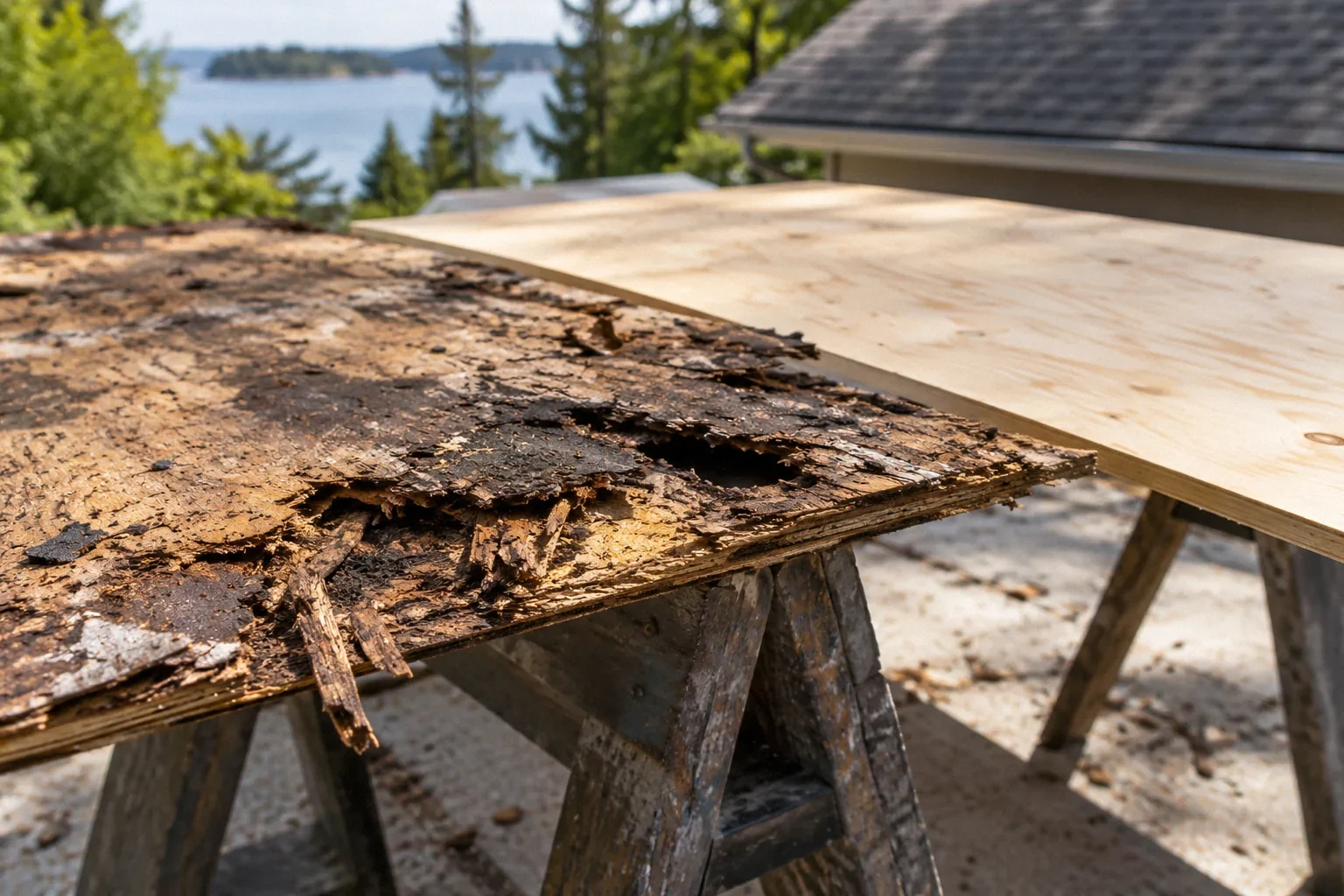
Maintain the original contract sum, each signed addition or credit, amounts paid, and remaining balance. If decking repairs change the price, the ledger should show the approved scope and where that amount enters the schedule. Replacing the original estimate with an unexplained new total makes it difficult to tell whether work was authorized or double-counted.
Plan the final invoice before the final day
Agree on required closeout records and outstanding corrections before installation starts. Do not invent a new retention percentage at completion or assume a Reddit suggestion governs your contract. If there is a dispute about withholding payment, seek project-specific advice. Separate undisputed completed work from the issue under review with a clear written record.
Use an invoice review routine
For every draw, compare the request with the schedule, inspect the supporting evidence, record the payment, and update the remaining balance. The Reddit example behind this topic describes nearly all money due before meaningful progress.[3] Its value is identifying front-loading as a question to investigate, not supplying a universal replacement schedule.
Build a payment ledger that both parties can follow
Use four running totals: original contract price, approved additions and credits, payments made, and remaining balance. Attach each change order and payment confirmation to its line. This makes arithmetic transparent without confusing a cost estimate with authorization. A contractor may discover a legitimate additional repair, but the ledger should show when the price changed and why. Keep proposed but unapproved changes outside the approved total so a draft request does not quietly become an accepted obligation.
For each invoice, record the contract milestone, the work area, the claimed completion date, and the evidence reviewed. Evidence can include delivery records, photographs, inspection results, or a walkthrough, depending on the milestone. No one piece proves everything. A municipal inspection may address a compliance stage without validating the contractor's quantity invoice, while a supplier receipt may establish delivered materials without confirming that the correct assembly was installed. Match the evidence to the question you are trying to answer.
Discuss partial completion before it becomes a billing dispute. If weather interrupts installation after one roof section is complete, the parties should be able to refer to a schedule that identifies the work and value rather than arguing over whether the whole job is 'half done.' Do not invent a new percentage calculation unilaterally. Request an itemized explanation and, where a revised schedule is appropriate, document it through the contract's change process. The same discipline applies to credits for work removed from scope.
At closeout, reconcile the final amount against the approved ledger and the agreed deliverables. Identify any disputed item separately, along with the requested correction and supporting evidence. Avoid withholding an arbitrary sum based only on a forum suggestion, and avoid signing a statement that every obligation is complete when known items remain. Payment rights can require legal advice when the parties disagree. A well-maintained ledger does not eliminate every dispute, but it makes the disagreement specific enough to evaluate rather than a contest between two unexplained totals.
- Keep proposed changes separate from signed additions and credits until the approval process is complete.
- Match each draw to its own evidence; a delivery receipt and an inspection result answer different questions.
- Reconcile the final invoice from the original agreement forward instead of accepting a new total without its history.
A practical example
Imagine a contract that calls for a payment after the roofing materials arrive, another after the contracted assembly is installed, and a final amount after agreed corrections and closeout. A delivery receipt helps establish the first event, but it does not prove installation. Likewise, completed shingles do not establish whether a pending flashing correction has been resolved. Each invoice should point to its own deliverable, keeping distinct obligations from being blurred together.
Handle a disputed invoice as a defined question
Tell the contractor which milestone, quantity, or approved change you believe does not match the invoice. Attach the relevant contract language and the evidence you have reviewed. Ask for an explanation or corrected invoice. This is more useful than declaring that the bill is simply too high, especially when part of the requested amount may be supported and another part remains unclear. Keep the response with the payment ledger.
If the disagreement cannot be resolved promptly, obtain advice about the payment obligations and available remedies under the actual agreement. Do not assume an online rule authorizes withholding any amount you choose, and do not sign a completion statement merely to avoid confrontation. A clear ledger and issue record help an adviser understand the dispute quickly. They also help the parties distinguish arithmetic error, an unapproved addition, an incomplete milestone, and a genuine technical disagreement. Those problems require different responses, even when they appear together on one invoice.
What to take away
- Tie each payment to named work or delivered material.
- Keep an updated original-price, changes, paid, and balance ledger.
- Agree on final deliverables before work starts.
Sources & further reading
Reddit links show the questions people ask; they do not establish a diagnosis or a legal requirement. Technical requirements depend on the product, building and jurisdiction. See our research approach.
- CSLB: Contracting for SuccessTechnical / official reference
Home improvement contract/payment guidance; dated guide cross-checked with current CSLB checklist.
- CSLB: Homeowner ChecklistsTechnical / official reference
Permits, written change orders, deposit cap and work-based payments.
- Contractor payment schedule .. red flag ??Community question · anecdotal
Anecdotal discussion used to identify reader questions. Not verified incident evidence or legal, insurance, or technical authority.
Planning a Bay Area project?
Explore YKCA’s website and discuss the scope and services you need directly with them.